Teenage Mutant Ninja Turtles: Splintered Fate is a run-based action-RPG that follows the four mutant turtle ninja brothers Leonardo, Donatello, Michelangelo, and Raphael as they fight through a randomly generated labyrinth to rescue their father Master Splinter from the clutches of a mysterious adversary. The story begins when a portal erupts in the turtles’ sewer lair, carrying Splinter away into a void. While investigating Splinter’s disappearance, the turtles encounter a shadowy stranger who challenges them to a game: Navigate a New York City teeming with Foot Clan ninjas, Baxter Stockman’s Mouser army, and a hostile gang of Punk Frogs, to where the Shredder, the turtle family’s nemesis, waits on a rooftop. Defeat Shredder, and Splinter will be returned. The night is long, the fight is difficult, and the stakes are high, especially when their host keeps moving the goalposts and it becomes clear that Shredder has been promised his own reward if he can repel the brothers. Only through perseverance against the shifting whims of Splinter’s captor can the Ninja Turtles triumph.
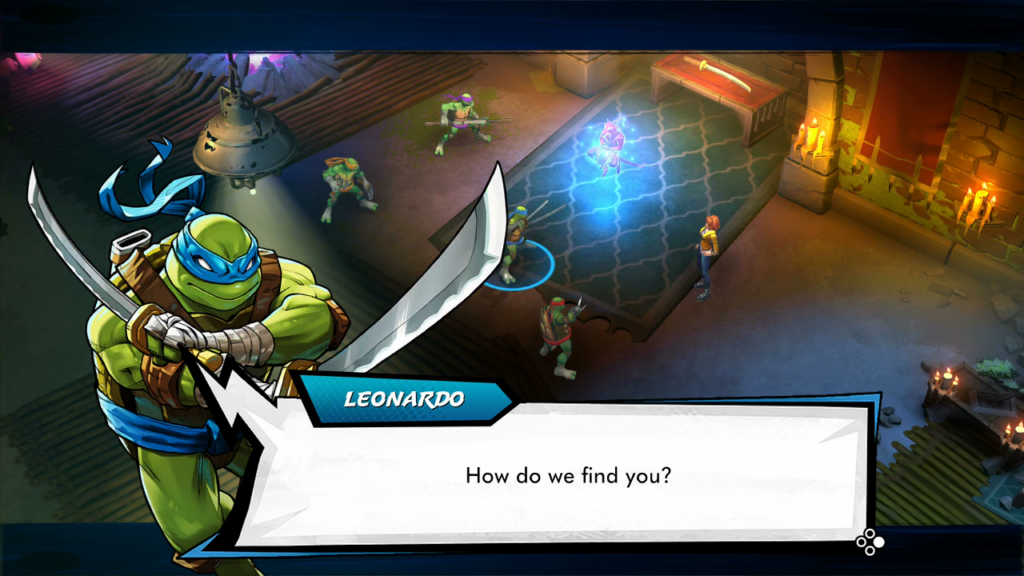
A particular strength that Splintered Fate shares with many other Teenage Mutant Ninja Turtles videogames is it allows up to four players to choose one of the brothers and play together in local or online coop. This is a particular factor in its favor when compared to similar run-based action-RPGs as they are uniformly single-player experiences. Whatever else I may say in the remainder of this review, if you are looking to spend a rowdy evening of couch co-op with three of your closest friends, then Splintered Fate will deliver.
Aside from their iconic colors, each of the four player characters are differentiated by the weapons they wield. Leonardo’s twin katanas are the middle-ground weapons, with good reach, damage, and speed. On either side of him are Raphael, whose fast and powerful sai have a short range that forces him to fight most enemies one-on-one, and Donatello, whose long Bo staff allows him to attack individuals or groups from a safe distance offset by a slow attack speed. Michelangelo is the quartet’s wild card. His twirling nunchakus create a broad circle of damage around him with the peculiar effect that a single hit may affect enemies multiple times. Thought and care is put into their design. Every player character operates with the same fundamentals but none feels too much like any of his brothers.
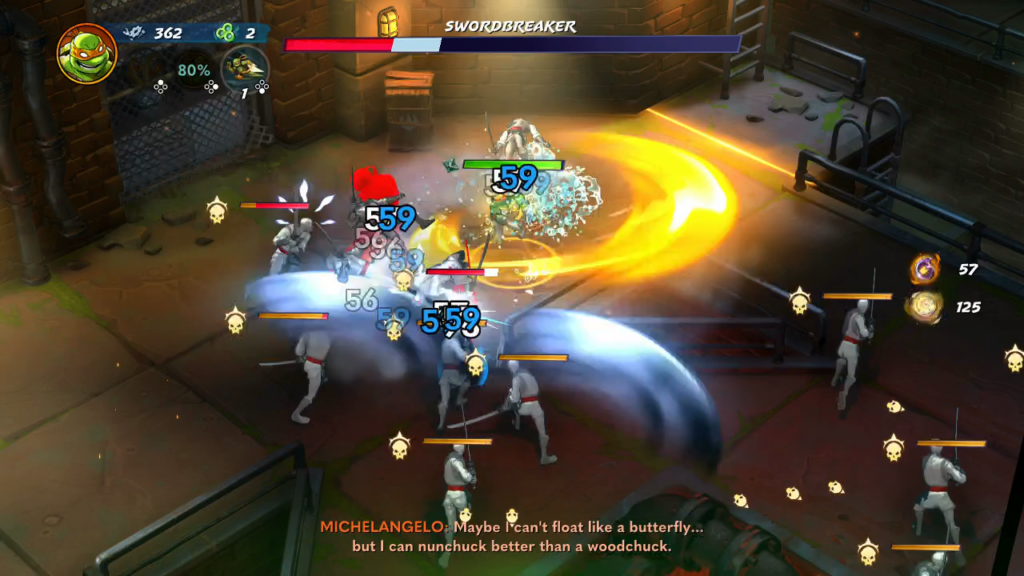
Aside from their iconic primary weapons, each brother begins their mission pre-equipped with an ability and a tool. Abilities further emphasize each brother’s unique fighting style. Leonardo performs a dashing attack that is useful for dealing damage and also giving him greater mobility in the battlefield, displaying his precision and his grace. Raphael is his counterpoint in combat as well as personality; his ability unleashes a fury of stabs against a single enemy, locking him in place but potentially dealing great damage if he is able to complete the entire combo.
Tools are like a backup weapon, but more unusual than the brothers’ primary weapons. Donatello’s technological genius is reflected by his Hardened Shell, an energy shield that protects him from harm for several seconds and damages all enemies in a circle around him when it activates. Michelangelo’s “tool” exploits his exuberant personality as a Taunt that forces all nearby enemies to focus on him, then stuns them when they are struck by his weapon, a tactic that works especially well with his nunchakus’ broad area of effect.
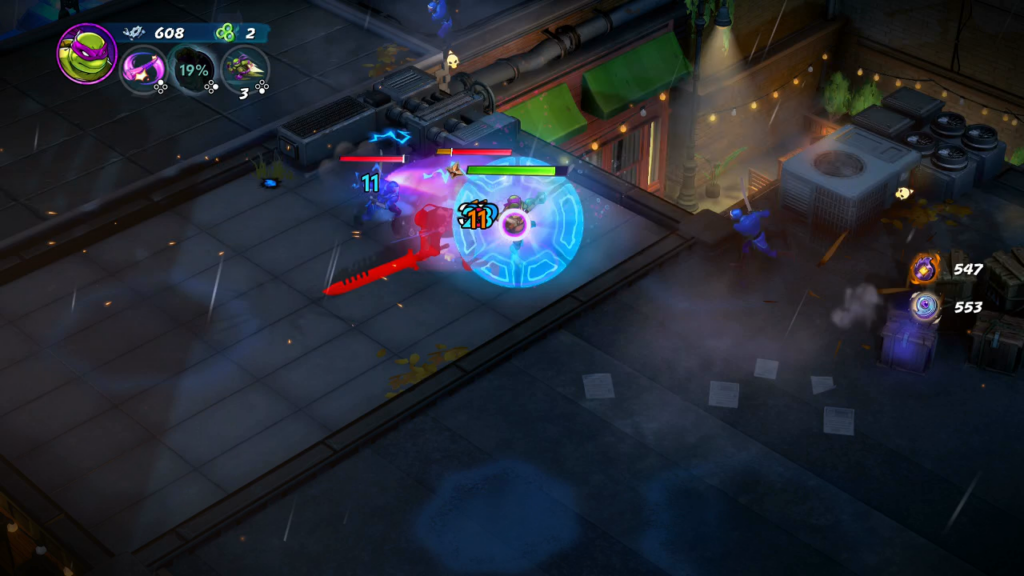
A player character’s ability to use their ability and tool is limited only by how often they can hit enemies with their basic attacks. Pressing the primary attack button prompts the player character to begin their basic attack string, an acrobatic series of stabs and jabs that displays their ninja mastery with their specific weapon. They loop repeatedly through their attack string for as long as they remain motionless while the attack button is held down. Every blow that lands on an enemy charges the player character’s ability and tool meters. When either is filled, they may be unleashed at any time, then its meter begins charging again.
This system of charging abilities and tools from basic attacks feels especially clever on a gamepad. I am able to direct the player character to unleash a continuous string of basic attacks by holding a face button, then when an ability or tool is charged it may be activated using the left or right triggers. This allows for a flow of aggression that looks impressive while feeling effortless, utilizing just three buttons to perform masterful ninja feats. My fingers barely seem to move on the controller while my player character fills the screen with PG-rated carnage.
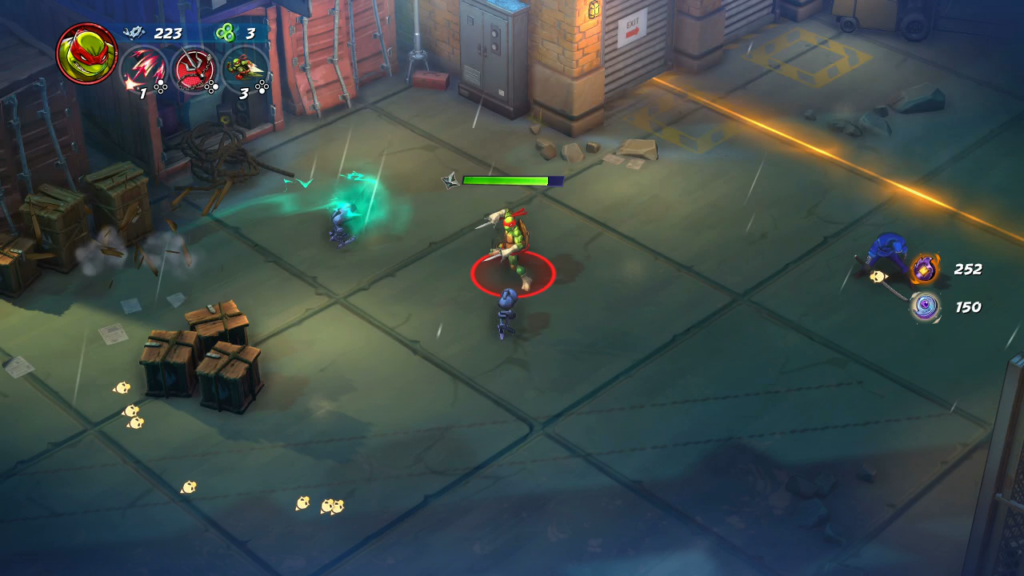
A broad criticism I point at Splintered Fate is a lack of visual feedback about the player character’s current state, and its first occurrence focuses on abilities and tools. The only way to know if my player character’s secondary powers are charged is to look at small icons that appear below the status meter at one of the screen’s four corners. Looking away from where my player character is standing for even a moment can be deadly, especially as the difficulty mounts, so I either have to risk a split-second glance at the meter or play by feeling to know when my player character’s most powerful abilities are ready to be used. Callouts from the brothers or a unique visual effect applied directly on my player character’s avatar would make it much easier to identify when abilities and tools are available. They do not exist.
The labyrinth the brothers navigate is divided into dozens of rooms representing small portions of New York City. Rooms lock as soon as they are entered and new ones will not appear until every enemy inside is defeated. Before they leave the room, the brothers are allowed to choose a randomized reward. Rewards always provide some kind of benefit that ensures the brothers will be stronger in the next room, but these powerups are temporary. Whether the brothers win or lose their current attempt to reach and defeat the Shredder, they are always returned to their sewer lair stripped of every reward they earned that run. When they re-enter the labyrinth, they navigate a new city and must choose from a new set of randomized powerups.
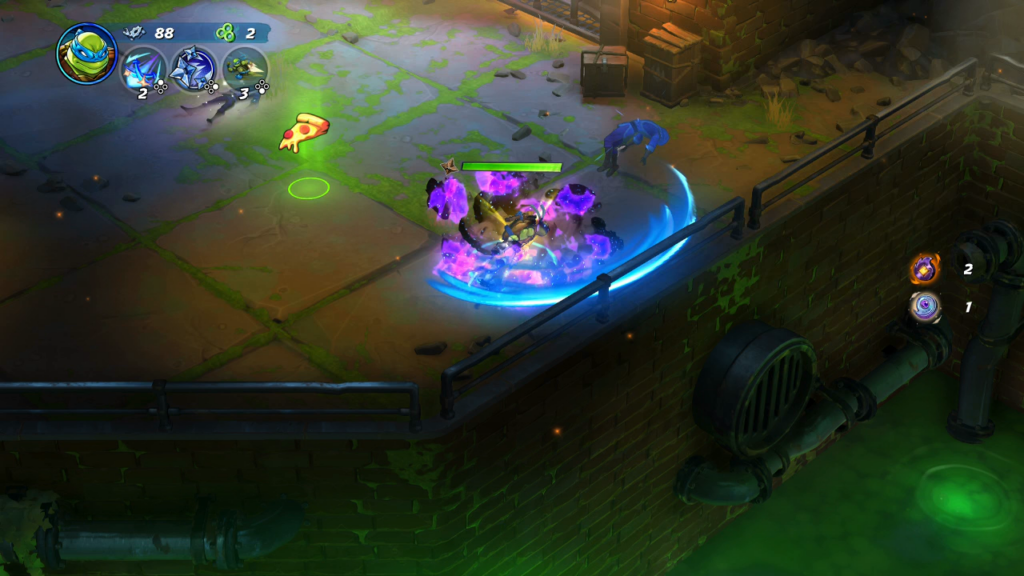
Rewards affect nearly all important aspects of the player character. Pizza increases their hit point total, allowing them to absorb the higher amounts of damage they encounter the closer they come to Shredder at the labyrinth’s end. Some rewards allow them to replace their default abilities and tools with new ones—potentially even the ones wielded by their brothers. The most useful are the Turtle Powers that add new damaging effects to a player character’s weapon. The expected collection of elemental effects like fire, water, and lightning don’t step a toe outside the action-RPG box. Some effects are given intriguing names like Ooze and Utrom. I am not fooled. These are just poison and electric effects given a Ninja Turtles-themed rename.
Chosen Turtle Powers stack. If one room offers a Water damage reward and the next Utrom, the player character may wield both powerups. Disappointingly, while effects stack, they do not interact. A player character enhanced with both Water and Utrom damage effects will deal both damage types separately with every swing of their weapon, but an additional stun effect from mixing water with lightning does not occur. On the bright side, gathering many effects at once quickly builds the damage dealt by every weapon swing, up to many times higher than unboosted damage.
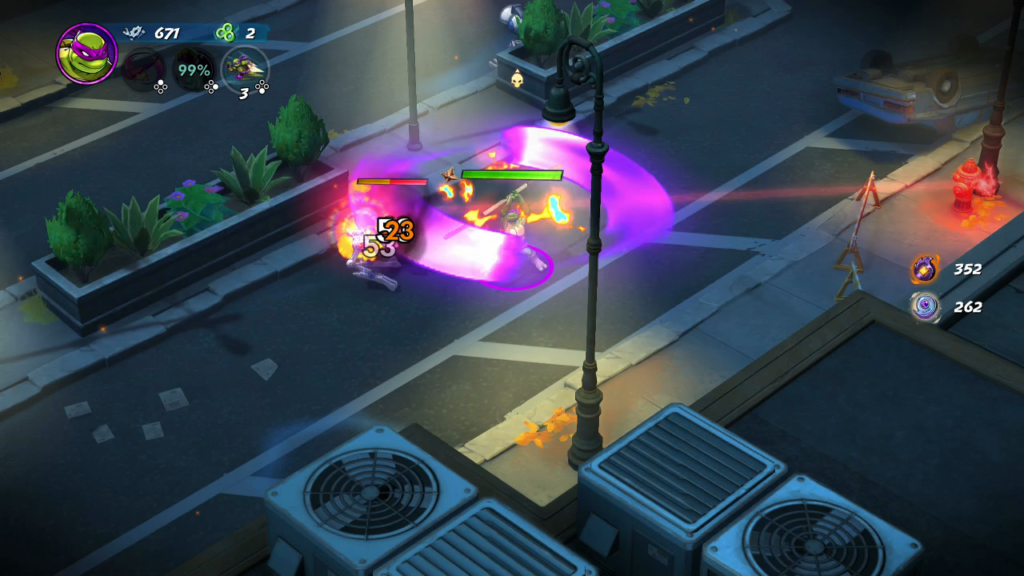
Instead of choosing a Turtle Power’s damaging upgrades, I may add a secondary effect to the player character’s attacks instead. Each elemental type has a unique effect. Water adds a Torrent effect to enemies that increases the chance they will take multiple hits from a single attack. Utrom spreads electrical discharges to nearby enemies. Both Flame and Ooze add damage-over-time effects to enemies; while Ooze is far more potent, there’s nothing stopping me from double-dipping both effects to a player character’s attacks. Stacking many damage modifiers and elemental effects and watching the Foot soldiers encountered in the labyrinth’s deepest sections crumble is incredibly satisfying.
As enjoyable as it is to build Turtle Powers, it should also feel as effortless as combat. I should be able to browse every option presented at the end of a room with a single glance and make my choice on pure instinct. Instead, the menu that pops up to display potential rewards has overlarge icons and texts placed in a small box, forcing me to scroll up and down to see every choice. If I choose a Turtle Power, those choices are then presented in a nested menu which I also must scroll up and down. This menu feels rushed and crude, introducing an onerous amount of friction to a system that is already a necessary speedbump between the fast-paced action. It’s a failure in UX design.
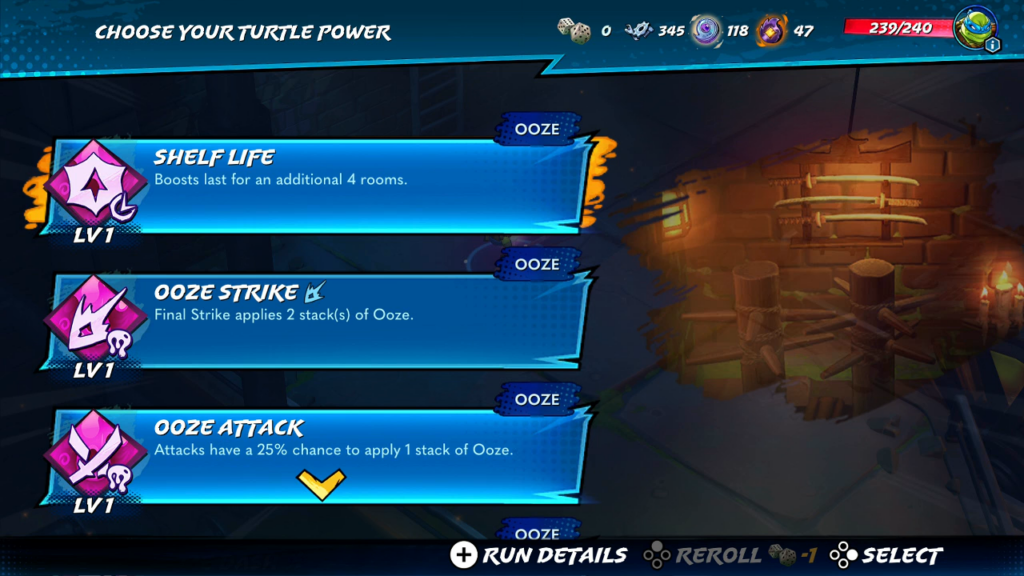
Once I’ve chosen new Turtle Powers, they are visually boring. A faint cloud of red, blue, or purple indicates an attack empowered by Fire, Water, or Ooze, but these effects are overwhelmed by the frenetic swirl of onscreen action generated by enemy attacks. This leaves the player character’s elemental damage to be represented mostly by the differently colored numbers that appear when they strike enemies. More spectacular visual effects would add a new layer of gratification to the enjoyably blunt Turtle Powers system.
Enemies do not stand helpless while they are attacked. In the labyrinth’s earliest rooms, enemies are simplest. Their attacks have long and visible windups that are easily dodged by maneuvering the player character out of the way. If an attack does connect, the damage dealt is minimal.
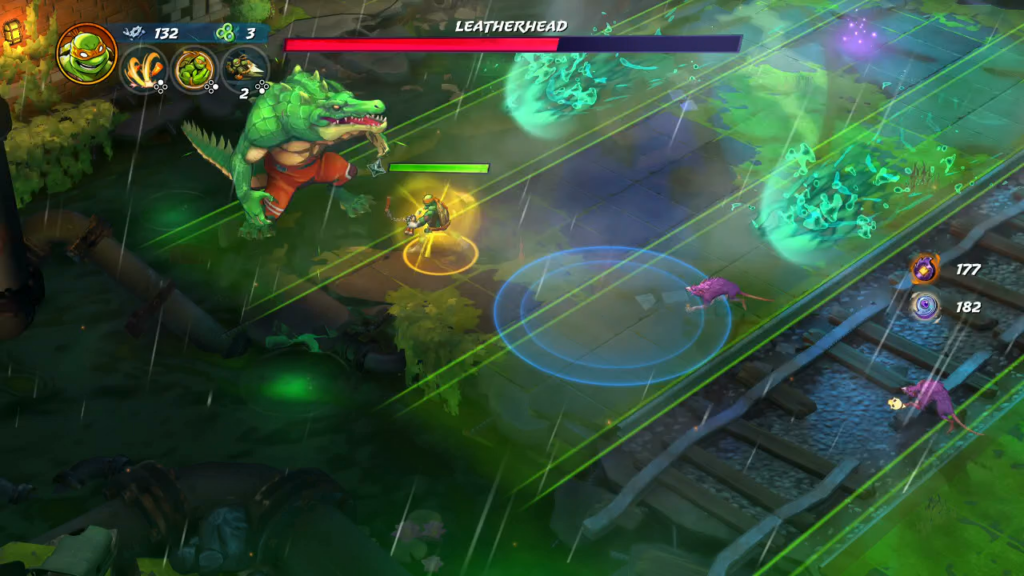
Before the brothers even leave the Sewers, the labyrinth’s first environment, these simple enemies are joined by stronger ones. They have thicker hit point bars and more dangerous attacks. The power of these attacks is represented by outlines on the ground showing where they will soon take effect; the more powerful the enemy, the bigger outlines become and the shorter the charge time of the attack.
While less numerous than the weakest enemies, it’s still common to face up to a half-dozen of the stronger enemies at once. They will happily intermingle their attacks, turning the floor of the battlefield into a minefield of symbols marking where powerful attacks will soon land. Each player character is equipped with a dash ability to evade these attacks. The dash is essential for survival and recharges in a fraction of a second upon use, so there is little reason not to mash the dash button at the slightest glimpse of oncoming damage.
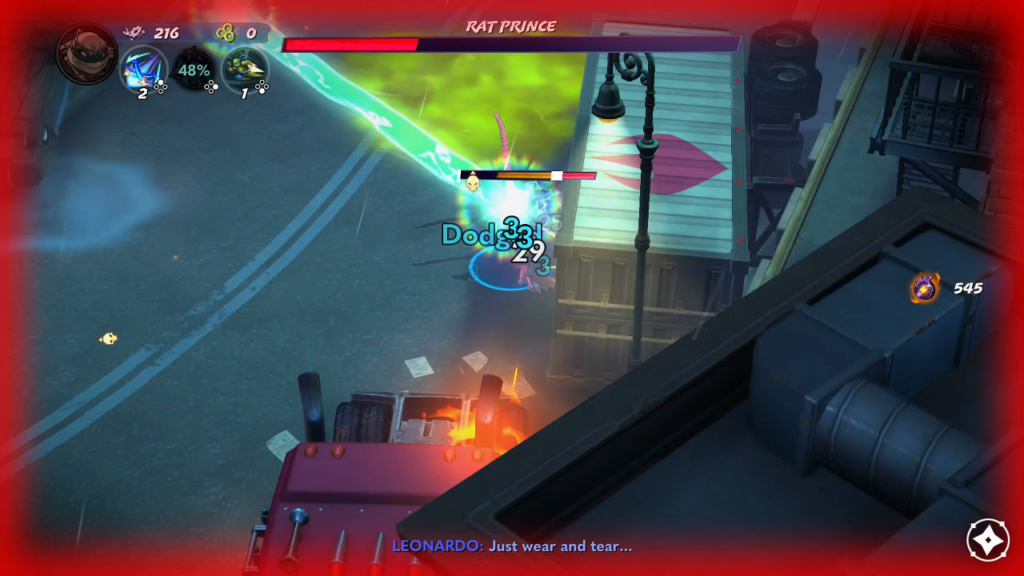
The player character taking damage is another area where I feel Splintered Fate is lacking in visual feedback. The battlefield often becomes so overwhelmed in enemy attacks and floating numbers that what’s meaningfully happening to my player character in the moment becomes invisible. Splintered Fate does not believe in mercy invincibility, that split-second of invulnerability enjoyed by a player character after they take damage, so losing track of where my player character stands for even a split-second can see their hit point meter melt to a swarm of enemy attacks or a puddle of toxic ooze in an instant. Defeats like this, while not feeling totally unearned, also feel demoralizing.
Where Splintered Fate feels especially lacking is the overall variety of the challenges the labyrinth presents to the brothers. There are only four enemy types—sewer rats, Foot Clan ninjas, Stockman’s robots, and Punk Frog thugs—and two or three different versions of each type. By just the second visit to any of the labyrinth’s four distinct regions, I already feel like I’ve seen everything it has to offer. There is an effort to create variety by granting individual enemies randomized elemental effects. Since these effects are coming from the same few attack patterns, the effort feels half-hearted.
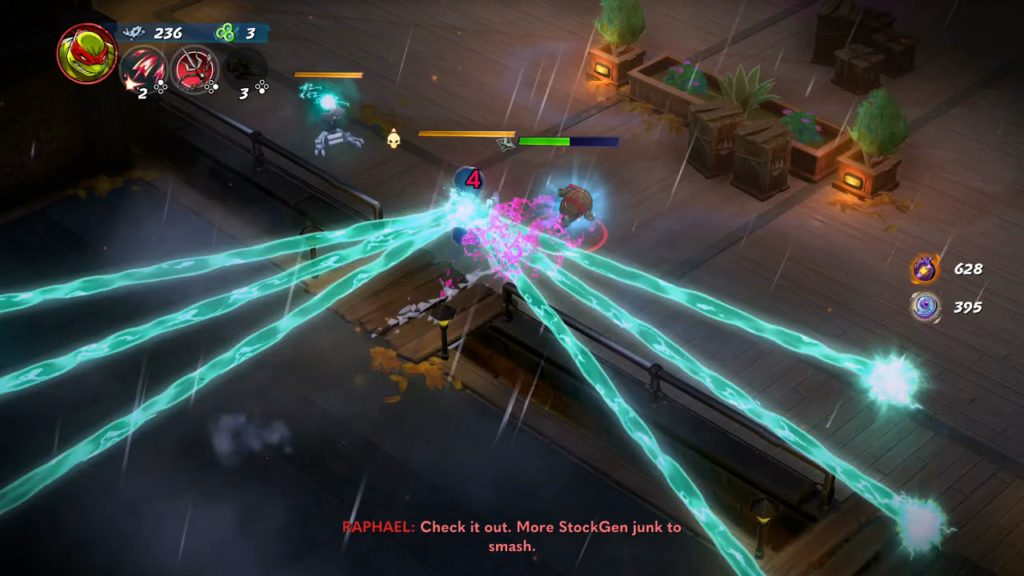
The limited number of enemy configurations is emphasized by the plain environments they are fought in. Splintered Fate hosts an unexciting vision of New York City. Their journey always begins in the sewers, then a dockside shipping yard, then the streets, and finishes on the rooftops. These environments have few distinguishing characteristics to place them in the Ninja Turtles world; this could be any New York City in any other videogame, comic book, or film. The only variety injected into this lifeless space is a periodic rainstorm that sometimes pelts the battlefield with lightning bolts. This is the only weather effect offered. Splintered Fate’s environment feels like it has just one single idea, repeated endlessly. It quickly becomes tedious.
The main method Splintered Fate uses to break up its monotony are Portals of Power. After the brothers defeat Shredder for the first time, they begin encountering a new voice in the labyrinth. It is similar to the stranger’s as it may appear at any time and in any place, but this voice sounds older and friendlier. It offers the brothers alternate pathways through the labyrinth represented by multicolored portals. These Portals of Power make drastic changes to Splintered Fate’s previously mild difficulty.
Despite the new voice’s friendly tone, the Portals of Power actually make the brothers’ task more difficult. The first Portals of Power they encounter appear at the beginning of each labyrinth region. Entering one of these increases the power and toughness of every enemy they face from then on by a flat amount. Portals of Power also offer hard mode versions of every boss and miniboss encountered in the labyrinth, transforming them from committed affairs that require all my concentration to intense struggles where I spend more time guiding the player character away from danger than actually attacking the boss. These portals do a good job reinvigorating my interest in continued runs after I have beaten the Shredder with all four brothers, though even they become routine after a few runs.
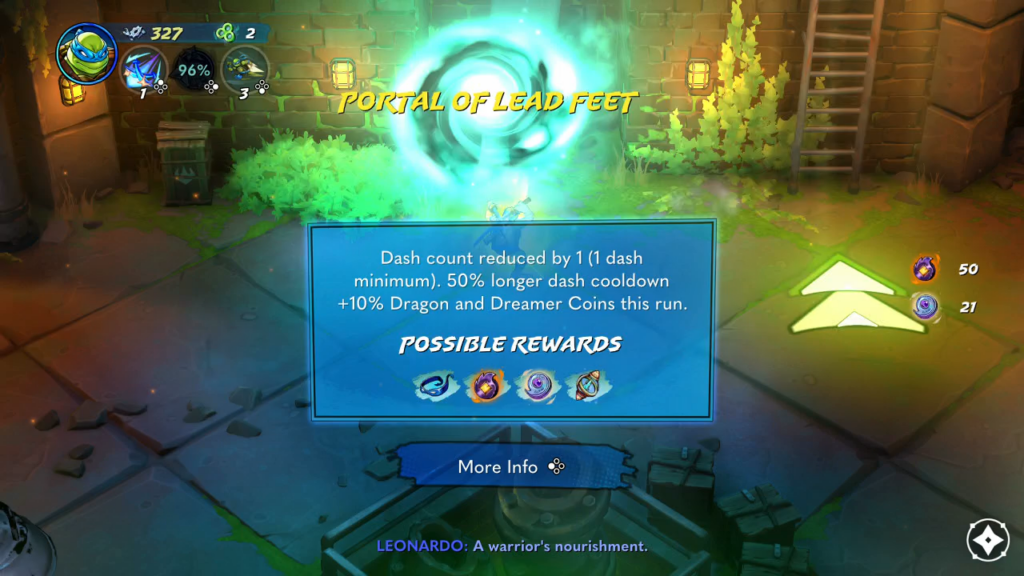
Less inviting are the smaller Shimmering Portals that appear midway through each labyrinth. Despite appearing less dangerous, the stacking effects they add to the turtles quickly become insurmountable. Some Shimmering Portal effects like Lead Feet, which reduces the turtles’ dash charges and the recharge time of their dashes, are death sentences all by themselves. Thankfully, the brothers are not required to enter Shimmering Portals, but they are cut off from greater long-term rewards if I choose to ignore them.
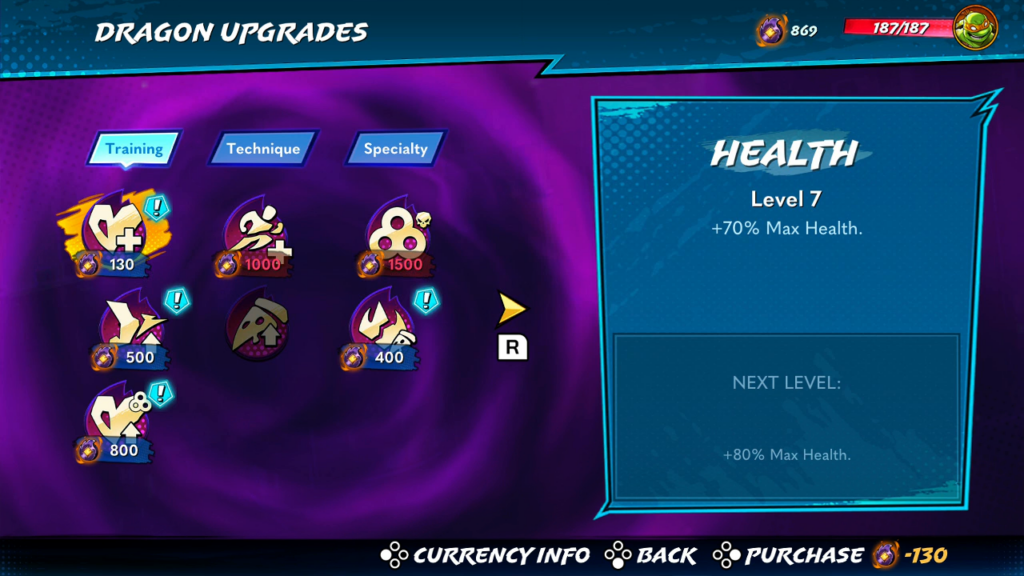
The main benefit of accepting the greater challenges created by the Portals of Power are the increased currency totals the turtles earn for entering them. Any tokens the brothers earn in the labyrinth are carried back to their sewer lair where they may be spent on permanent upgrades like more health, greater damage, and extra lives. At first tokens must be chosen in lieu of a Turtle Power after finishing a room, forcing me to weaken the player character for one run so that they may purchase greater power for all future runs. As more permanent upgrades are purchased, basic tokens are added as bonus rewards alongside Turtle Powers, allowing me to focus more on the current run without sacrificing progress on future ones.
This is a smart system that pushes me towards focusing on powering up the player characters in my early hours with Splintered Fate, then shift to individual wins once essential upgrades have been purchased. I see this most clearly with the brothers’ dash action. It’s literally impossible to avoid the damaging gauntlets created by enemies encountered later in the labyrinth with just the single dash available at the start of the brothers’ struggle; they are too numerous and arrive too quickly to be dashed from before the damaging effects take hold. The brothers don’t really start to succeed until they have earned enough tokens to purchase several more dash charges.
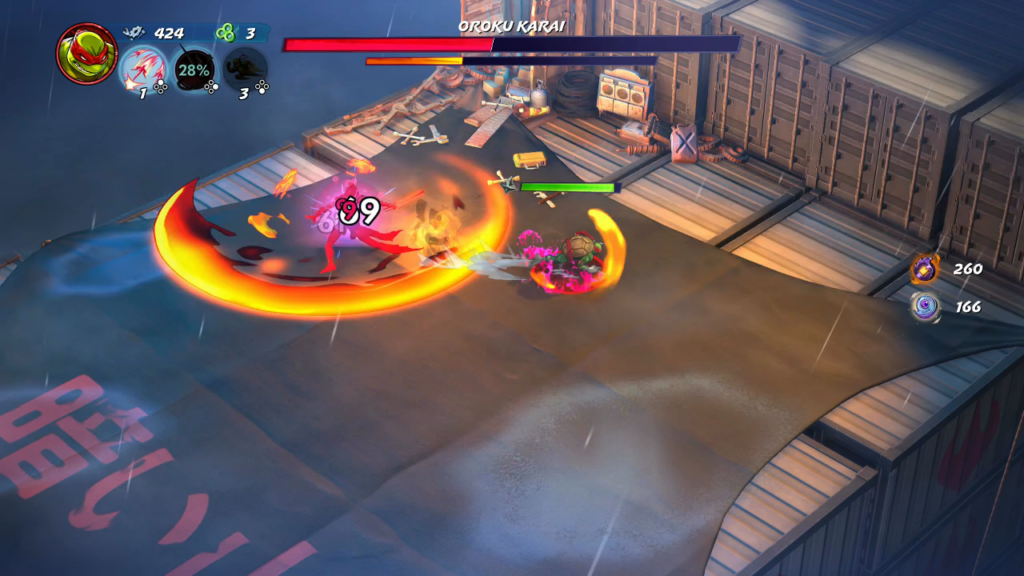
Thus far my evaluation of Splintered Fate is mixed. On the positive end, its combat systems and character development systems are excellent. The maelstrom of enemy effects the player characters must navigate are challenging and satisfying. More negatively, there is a lacking number of enemy types, the environments are bland and quickly feel repetitive, and there’s an overall lack of visual feedback that can make telling what is happening in the moment difficult. Another factor weighted either way could push my overall opinion of Splintered Fate towards approval or disapproval. There is one last aspect of Splintered Fate I must now address.
The story is unfinished. After completing enough of the shadowy stranger’s challenges, Splinter is returned to the turtle family’s sewer lair. Despite this victory, many issues remain unresolved. The stranger’s identity remains hidden. The identity of the benevolent voice who creates the Portals of Power also goes unaddressed. Shredder still waits on a random rooftop, plotting to overthrow the Turtles. The reason that Baxter Stockman’s robot army is also participating in the stranger’s game is questioned by the brothers, then ignored. Stockman never even appears in the narrative. The brothers may continue fighting through the labyrinth and defeating Shredder into infinity but no more resolutions will be made about any of these unresolved conflicts.
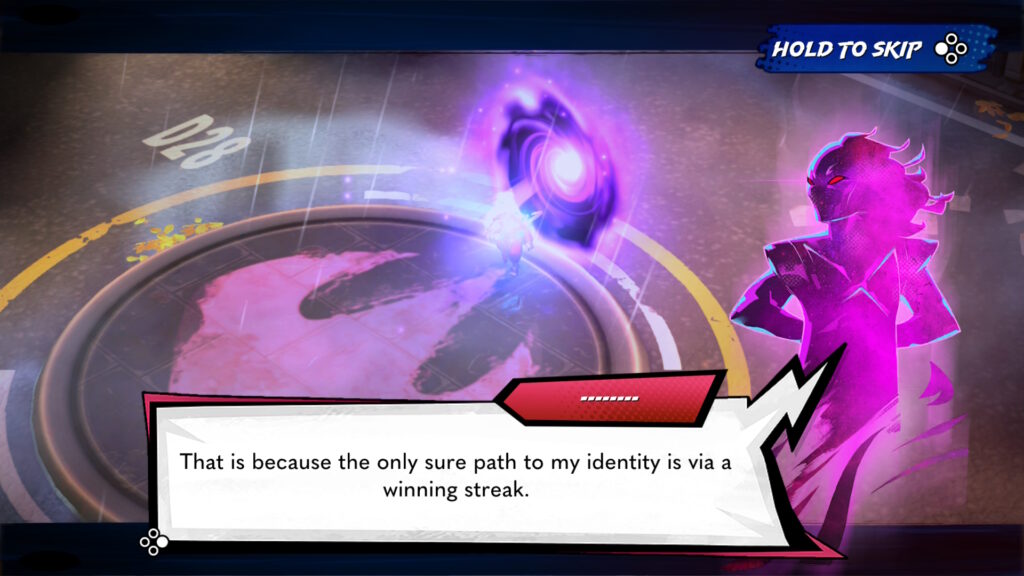
Any or all of these conflicts might have been resolved by new content patches. The recently-released “Gold Edition” of Splintered Fate seems to be an admission that development is done and the unresolved threads will never be concluded. I can be happy with a videogame that has a few excellent systems and a lot of acceptable ones. A videogame with just one excellent feature, a lot of shallow ones, and an unfinished story is much more difficult to grant a recommendation. (UPDATE 08/20/2026: Defying my pessimism, a new content update has finally been released that includes the story’s ending, more than two years after Splintered Fate’s original retail release).
Splintered Fate’s many unresolved story threads are doubly disappointing because of the amount of premium downloadable content it has received. Three new characters have been added, each adding their own subplot on top of the turtle’s quest to rescue Splinter. Street hockey-themed vigilante Casey Jones suggests taking a shortcut through a junkyard to reach the Shredder, though he has ulterior motives for bringing the Ninja Turtles there. Mutant turtle android Metalhead opens an arcade in the sewer lair where the brothers may attempt small, self-contained challenges set in the stranger’s labyrinth. Arctic fox mutant Alopex grapples with her past as a former agent of the Foot clan. All of them are fine additions by themselves, but none advance the core story in any way. It’s a missed opportunity.
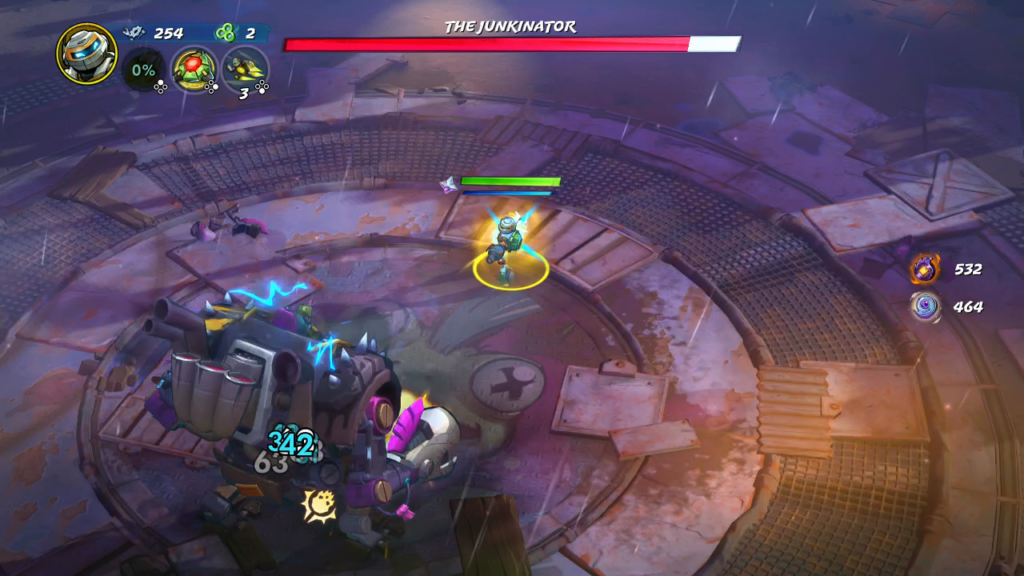
These DLCs are still notable for the substantive content they do add as new player characters. Casey Jones combines Raphael’s aggressiveness with Leonardo’s versatility. His DLC also adds a welcome new area to the labyrinth. Metalhead’s arcade challenges are forgettable, but his weapons focus primarily on ranged attacks, making him unique among all the player characters. His DLC also adds Robotics to the pool of available Turtle Powers, an interesting addition that unleashes powerful effects when the player character charges a new, third meter with their basic attacks. Alopex is the least interesting DLC. She plays like a retread of Leonardo and offers no actual new content beyond her philosophical debates with the second boss. As the most recent and likely last DLC, she feels like the last puff of effort before Splintered Fate stops trying and enters the pool of indie videogames that regularly prices themselves at 90% off.
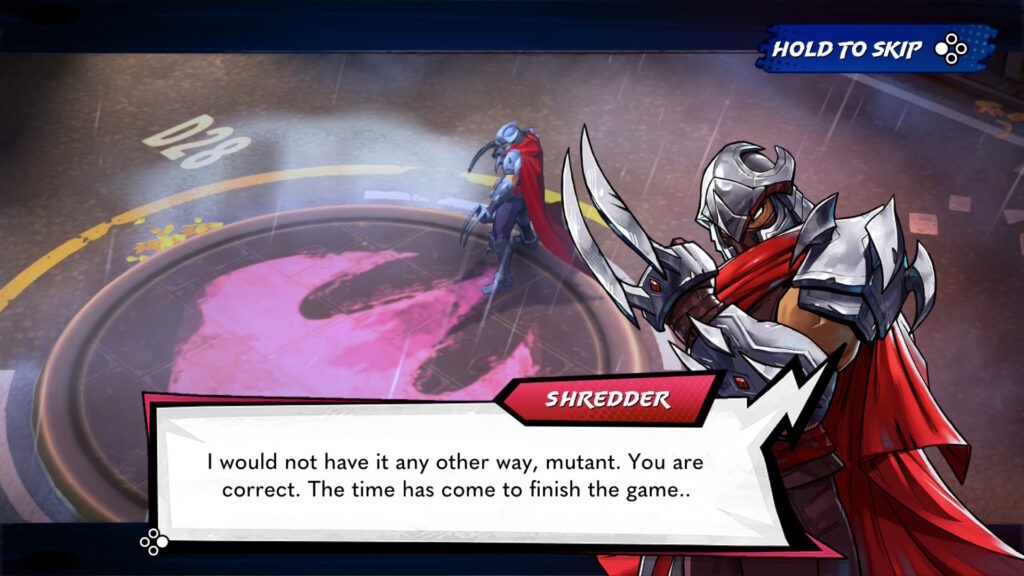
Splintered Fate has excellent combat systems. It feels like once a clear vision of these systems was executed then refined to near-perfection, a ramshackle of shallow development systems and limited environments was built around it to create the paucity of a videogame. The limited number of areas to fight through, the few enemy types encountered within them, and the feeble number of randomized variations do not feel like they received anywhere near the care and attention given to the sublime combat. The lacking state of the final product is most apparent through an unfinished narrative which, by my pessimistic reading, will never be built to a satisfying conclusion no matter how many content patches Splintered Fate receives. In barely more than twenty runs, including wins and losses, I feel like I’ve already seen everything Splintered Fate and all its downloadable content has to offer. All that’s left is to grind upgrades so I can pursue victories under more negative effects from the Portals of Power. For a randomized hack-and-slasher like this, languishing in the shadow of videogame pillars like Hades, such short-lived appeal is a death sentence for the normally reliable Ninja Turtle brothers.