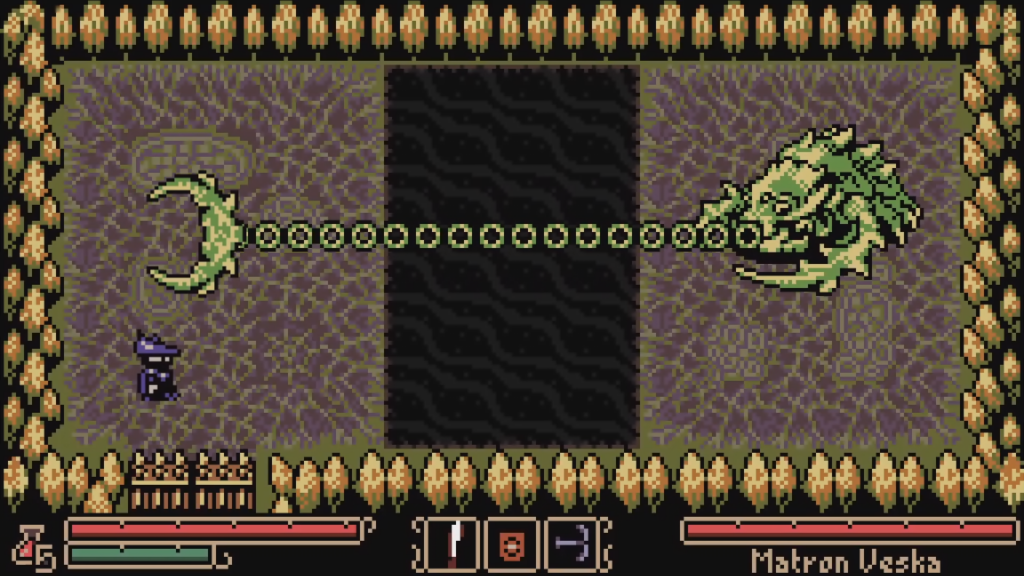
Tearscape is a retro top-down action-RPG that styles itself after 8-bit videogames of the early Game Boy era, particularly Final Fantasy Adventure and Link’s Awakening. I play as a Hunter of monsters, and that is the beginning and end of their motivation. A brief opening narration sets the scene: “You were forged to hunt; thus, the hunt begins.” This nameless badass wearing a tricorner hat fights their way out of a cave and into a kingdom overrun by the undead and other, more fearsome magical creatures. One by one, region by region, monster by monster, the Hunter pacifies the overrun kingdom, guided by an enigmatic man in a plague doctor’s mask. By putting an end to the bloodshed through vicious and judicious violence, Tearscape firmly argues in favor of taking an eye for an eye.
Tearscape’s greatest strength is its setting. Though it offers a comparatively short experience—it takes me just over eight hours to roll the credits and earn every achievement—its world still manages to feel satisfyingly large. It accomplishes this through density and interconnectivity. Every region is packed tightly onto the map, sharing a border with at least two others, and each region’s design ensures there are passages where these borders may be crossed. These border crossings are often sealed by gates and it may be some time before the Hunter finds the means to open them. Just as often, the passages between regions are unguarded and the Hunter is allowed to explore them freely. Aldric, the Hunter’s handler and guide, is available for advice on where they should travel next. But it’s only advice. The Hunter can explore the wretched kingdom in almost any order I wish, the only obstacle being enemy strength and certain tools needed to solve environmental puzzles.
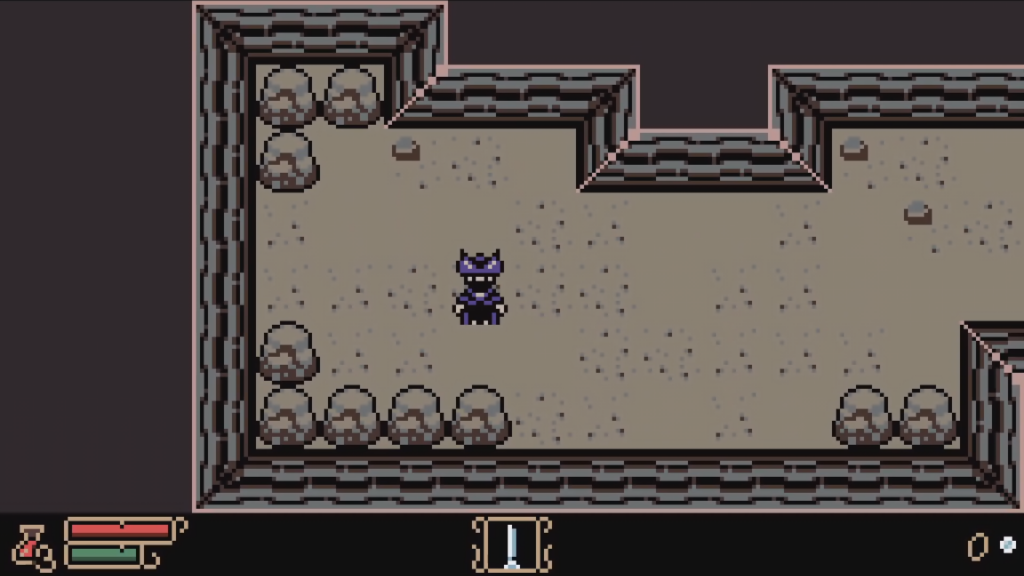
It is all the more remarkable that Tearscape’s world feels so large and open given that it’s constructed using design principles pulled from 8-bit Game Boy videogames. Objects are given exactly one model and reused ad nauseum to create the perimeters that keep the Hunter in each region’s bounds. I see this immediately in the tutorial cave and the graveyard that sits beside it. The Hunter passes the same boulders again and again in the cave, and then a line of identical trees guides them to a graveyard filled with crumbling gravestones and fallen masonry. These objects are fitted onto an invisible grid, giving each section of a region a uniform size that fits onto a single Game Boy-esque “screen.” When the Hunter approaches any one of a screen’s perimeters, they move to the next space seamlessly while my perspective shifts in an instant.
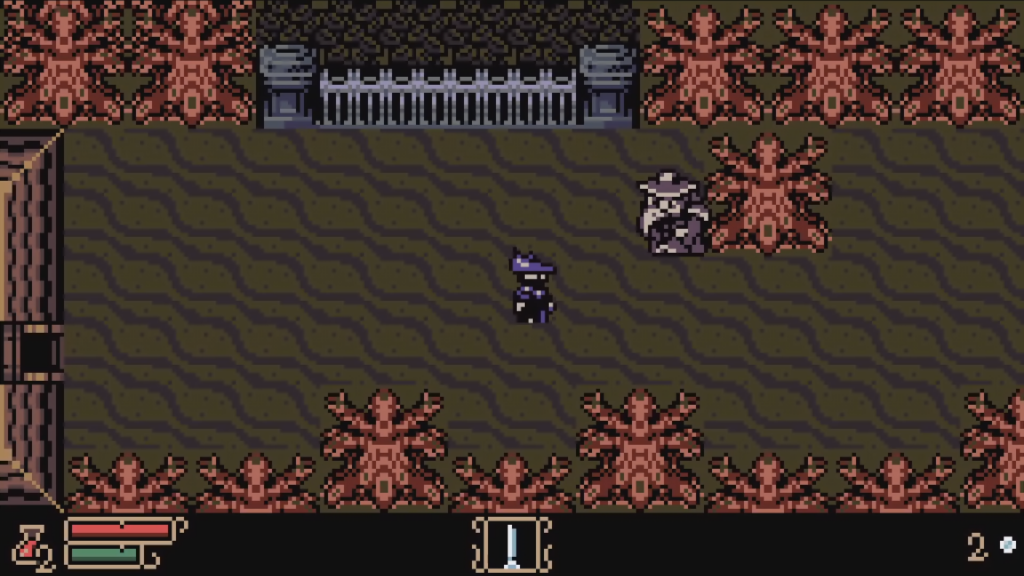
Tearscape’s level design has the expertise to prevent this uniformity from feeling monotonous or redundant. Each area draws from familiar fantasy RPG themes like graveyard, forest, desert, swamp, village, and castle, but no single screen is identical to another despite being built from shared pieces. Unique color palettes also help to differentiate each area from its neighbors. Their differences are further enhanced by unique environmental features, such as cave entrances hidden underneath bushes in the forest and obscured by waterfalls in the swamp. These careful differences help every area to feel distinct, ensuring I never feel lost or become bored so I can remain focused on the Hunter pursuing their prey.
The monsters encountered throughout the world are limited in variety and tactics. The zombies that infest the tutorial cave and graveyard make sense in those areas, as do their mindless attacking strategy. They recur in many other areas around the world. Though their approach never changes, they are kept relevant with increased resilience and damage. The same is true for most other enemy types. Evasive witches, agile skeleton swordmasters, and mighty troll executioners reappear throughout the Hunter’s quest, sometimes with enhanced statistics, but never with changed tactics. This is all in keeping with Tearscape’s 8-bit inspired design.
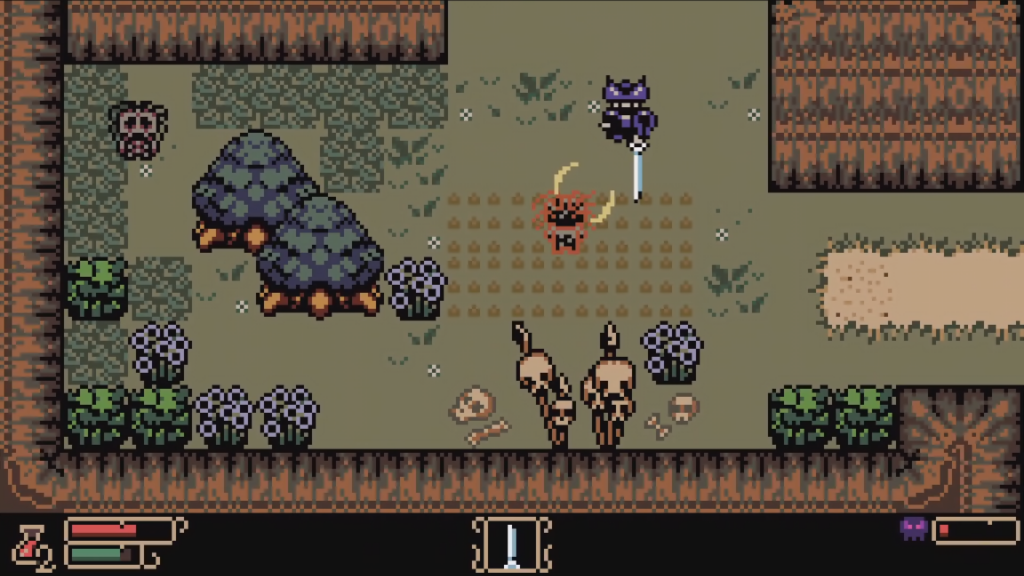
The Hunter’s options for dispatching these monsters are similarly simple. They begin their adventure equipped with an unremarkable sword. A single attack button prompts them to swing the sword once. There is no embellishment. Pressing the attack button once more causes the same attack animation to play again. Variety is found through the new weapons the Hunter discovers around the world. Daggers have short range, putting the Hunter in greater danger of taking damage, but the short animation time depicting a basic thrust may allow targets to be cut down with desperate button presses. Whips and greatswords have superior range and damaging ability but have a slow attack speed. The Hunter is forced to stand motionless until their weapon’s entire attack animation plays, so they are left more vulnerable by weapons with slower speed. With the change of an equipped weapon, this transforms the Hunter from an agile speedster to a mighty glacier.
The most important tool for defense and navigating the environment is the Hunter’s roll. The tutorial cave does a good job impressing its importance upon me by trapping the Hunter in a room until I am able to execute a roll across a pit, then setting them against a gauntlet of zombies with limited access to healing. The roll’s importance never diminishes even as the Hunter’s toolset grows. The first choice for avoiding damage or moving quickly across a space is always to roll.
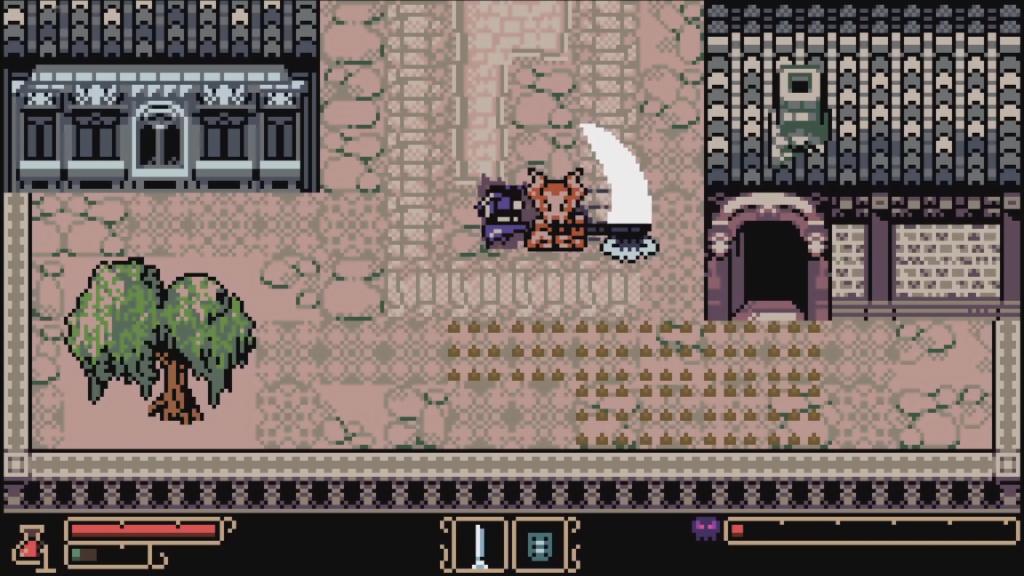
The Hunter’s ability to attack and roll is not unlimited. Every swing from their weapon or swift dodge away from an attack drains their stamina. Stamina regenerates quickly, but it takes a moment of inaction before that happens. This discourages aggressive play. Attacking too many times in a row may leave the Hunter unable to roll away from an oncoming attack. Even with a long hit point meter, a single hit from the most dangerous monsters can be devastating. Stamina encourages a conservative play of swift and decisive decisions instead of mindless button mashing. This, more than any other element of Tearscape’s design, sets it apart from the Game Boy videogames it imitates and puts it more in line with contemporary action-RPGs.
While attacking and rolling are the most prominent and important abilities in the Hunter’s toolkit, they do obtain a few others. They eventually find a shield to block oncoming attacks and projectiles. Because I have already been taught that these hazards can be avoided with rolls and counterattacks, the addition feels superfluous. I go through all of Tearscape mostly forgetting the shield exists. It is still a functional tool, with several options available conferring different advantages and disadvantages, plus a stun bonus if the shield is raised just before an enemy strikes the Hunter. Many players may find it useful. Tearscape still does a poor job justifying its existence.
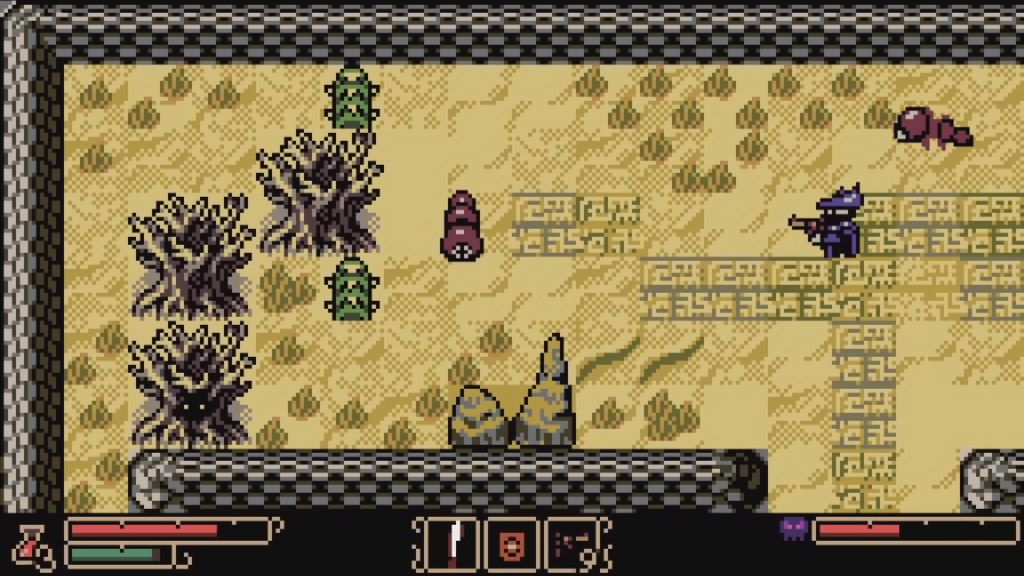
A far more useful category of secondary equipment is the Hunter’s tools. These gadgets serve as deliberate counterpoints to the standard weapons. Multiple gun types allow the Hunter to damage enemies from safe distances, from an ordinary pistol that fires single bullets to a massive cannon that sends a sphere of destruction ricocheting around the screen. Bombs and a hookshot also make appearances and their use are Tearscape’s most shamefaced pilfering from The Legend of Zelda; one boss must even be tricked into swallowing a bomb before it may be damaged. Tools are limited by a gunpowder resource that is easily refilled with pickups from slain enemies and smashed objects or replenished at checkpoints. The Hunter cannot totally rely on their tools for damage, but it’s a lot easier to remember they exist than the shield.
How effective the Hunter’s abilities are depend on their RPG statistics. This system will be familiar to fans of contemporary action-RPGs, though they are simplified to reflect Tearscape’s Game Boy inspirations. Vitality and Stamina increase the Hunter’s health and stamina pools. Strength increases damage dealt with weapons, while Skill increases damage dealt with tools. All four stats begin at level one and may be increased in one point increments every time the Hunter gains an experience level, allowing me to build a distinct player character from scratch. The simplicity makes these stats easy to understand but may be so simple that it stifles creativity. It’s difficult to justify investing a single point into Skill. Tools are only ever required to solve environmental puzzles and deal good damage even without investment, meaning every character build inevitably becomes high weapon damage protected by a beefy hit point meter.
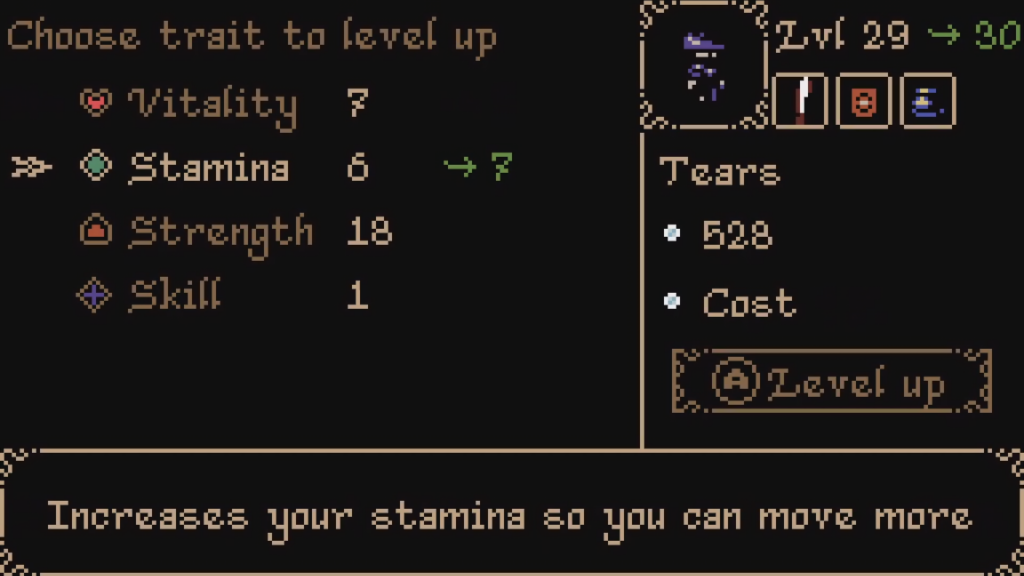
Leveling up in Tearscape will feel familiar to anyone who has played a recent action-RPG. Defeated monsters drop tiny white orbs called Tears. When picked up by the Hunter and returned to any of the world’s Angel statue checkpoints, they may be exchanged for an experience level. Each level up allows me to invest a single point into any of the Hunter’s four statistics. The higher the Hunter’s experience level, the more Tears the next level up will cost. Unused Tears are dropped whenever the Hunter dies, but may be reclaimed if they can fight their way back from a checkpoint to where they fell. If they die again in the attempt, dropped Tears are lost forever. This is basic stuff ingrained in most experienced players copied wholesale by Tearscape without embellishment or twist.
Another method to empower the Hunter is through optional powerups. The number of healing potions the Hunter carries and their efficacy may be improved by discovering hidden collectables. Again echoing the Legend of Zelda, it takes several of these items combined together to provide a single point of improvement, encouraging me to explore every corner of the ravaged kingdom thoroughly. A more flexible collectable are Tokens. These badges enhance the Hunter’s abilities with new effects like recovering life when killing a monster, increased gunpowder capacity, and greater stamina efficiency at low health. There are thirty Tokens in total and the Hunter may only equip up to three, encouraging individual players to search for the combination that best suits their playstyle.
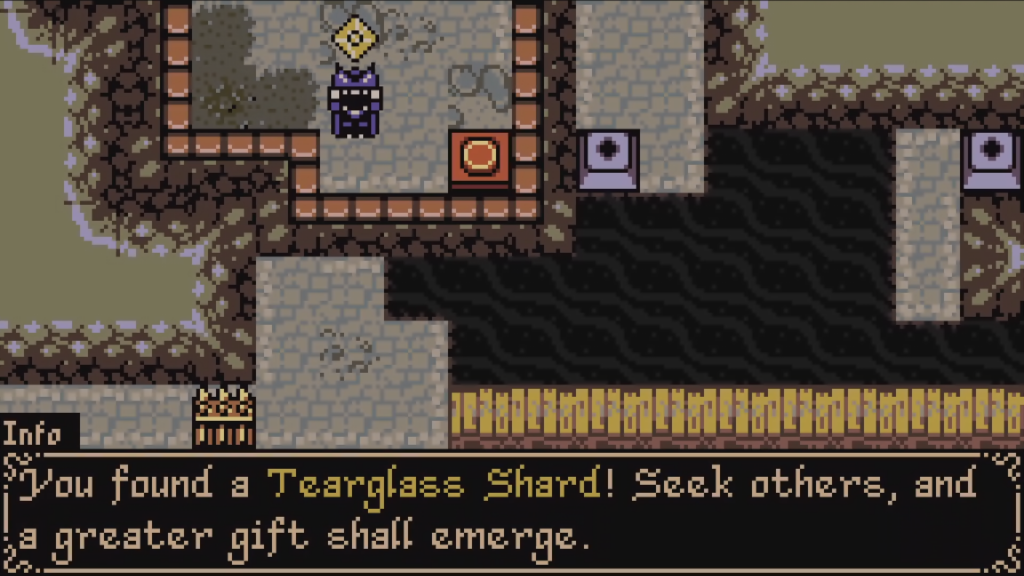
Collectables are rarely placed out in the open. Even the simplest ones are stashed off the beaten path or guarded by an especially vicious pack of monsters. The most useful are sealed behind doors that can only be opened by a combination of nearby switches. Many combinations must be brute forced which is easy to do when there are only three or four switches. Other combinations are entered on circles that cycle through multiple colors when struck. Finding the correct combination of colors to open a related door is much harder to brute force, though still possible if I’m patient and methodical. Hints for these passcodes are painted on the walls of the nearby environment, encouraging me to pay close attention when exploring and take notes of what I see to minimize the pain of random guessing.
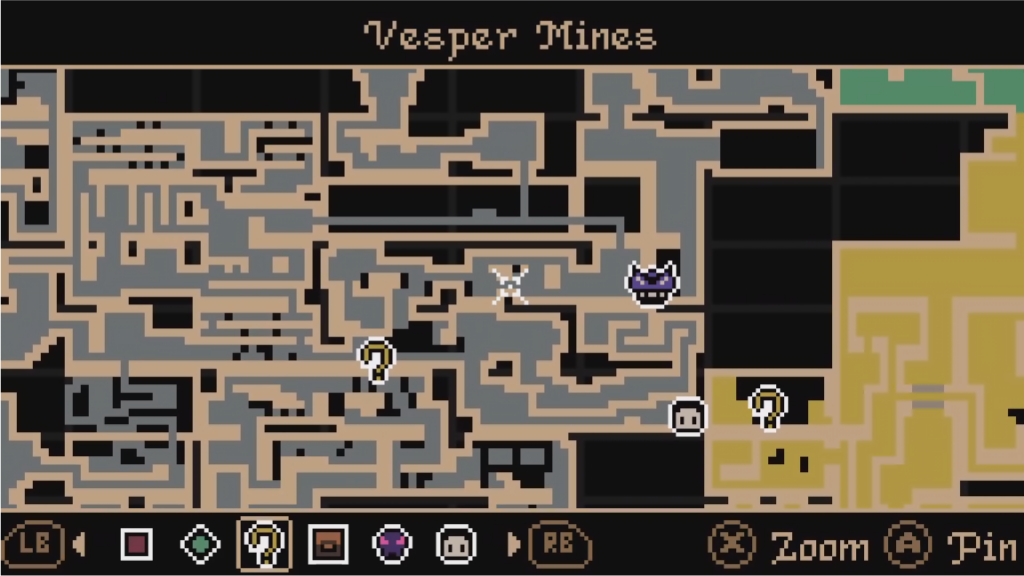
Still other collectables are protected by obstacles the Hunter needs a special tool to bypass. It’s common for the Hunter to pass a crumbling wall that is vulnerable to a bomb explosion, a bridge that will extend when a nearby target is shot, or a peculiar circular marking that will only respond to the Hookshot. The Hunter will pass many of these long before they discover the tools needed to bypass them. I am thankful to discover that Tearscape has a wonderfully detailed map that fills in automatically as the Hunter explores, as well as a suite of informative pins I may place on the map to remind myself to return to an area later. The reason I am able to earn all of Tearscape’s achievements is because it makes finding all its collectables a pleasant experience by minimizing the need for aimless wandering.
It’s satisfying to pursue all of Tearscape’s extra hidden rewards. Discovering them makes the Hunter extra prepared for the final boss with every possible option available to them and a few extra experience levels to give them the edge. When I tick the final target off the Hunter’s list, I do feel just a twinge of disappointment: I wish there was a little more.
There are no optional bosses or secret areas to uncover in Tearscape. In this way it is most like the Legend of Zelda and less like the contemporary action-RPGs it also borrows from. I think it would benefit from these additions. After putting in that extra little effort to find all of the Hunter’s optional collectables, it disappoints me that there is nowhere to use them except against the original final boss. There should be another challenge hidden somewhere in the kingdom for the Hunter to conquer. Judging by the achievement list, there is not. It feels like a missing part of a well-crafted whole.
Despite missing this one small feature, Tearscape is an excellent indie action scrapper. It masterfully synthesizes two videogame design philosophies separated by decades of development experience. Fans of the videogames it most closely imitates, 1993’s The Legend of Zelda: Link’s Awakening and 2015’s Bloodborne, will both be satisfied. Link’s Awakening fans will be drawn to a world that feels larger than it is, helped by interconnected design and dense secrets. Bloodborne fans will enjoy the subtle storytelling, refined RPG mechanics, and challenging combat. The indie scene loves to infuse new ideas into old favorites. Tearscape is near the head of its class in this effort.