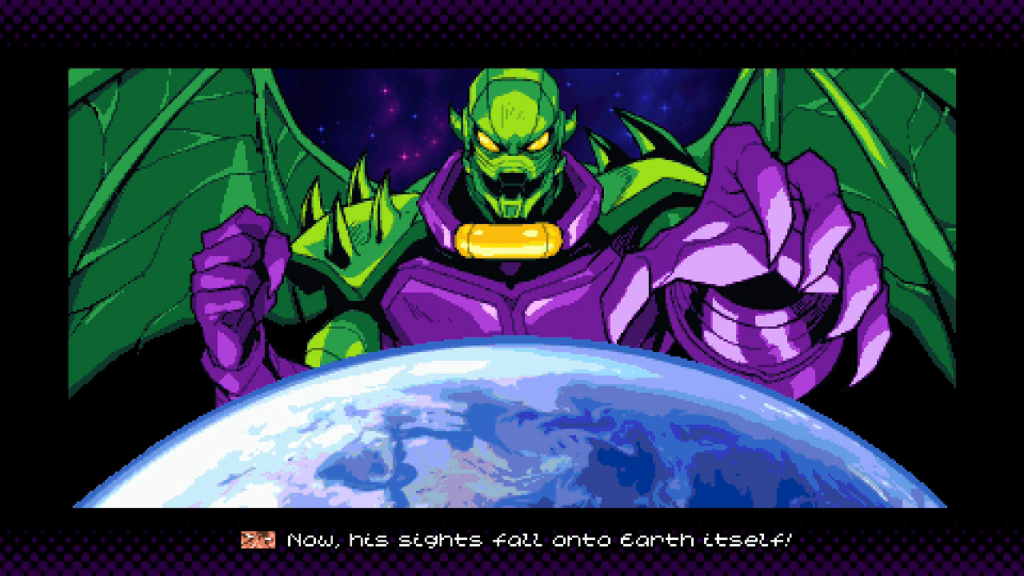
Marvel Cosmic Invasion is a retro beat ’em up featuring an array of requisite and unexpected Marvel superheroes. The galaxy is in danger yet again, this time from Annihilus, the monarch of an extra-dimensional alien insectoid race called the Arthrosians intent on destroying anything that is not him. Fifteen heroes from across the galaxy team up to repel Annihilus and his invading army of body-snatching superbugs. Their effort appears to be a traditional beat ‘em up on its surface, but hides surprising technical nuance. Only with skillful application of offensive, defensive, and movement mechanics both familiar and unfamiliar to the genre can the heroes hope to overcome this apocalyptic threat.
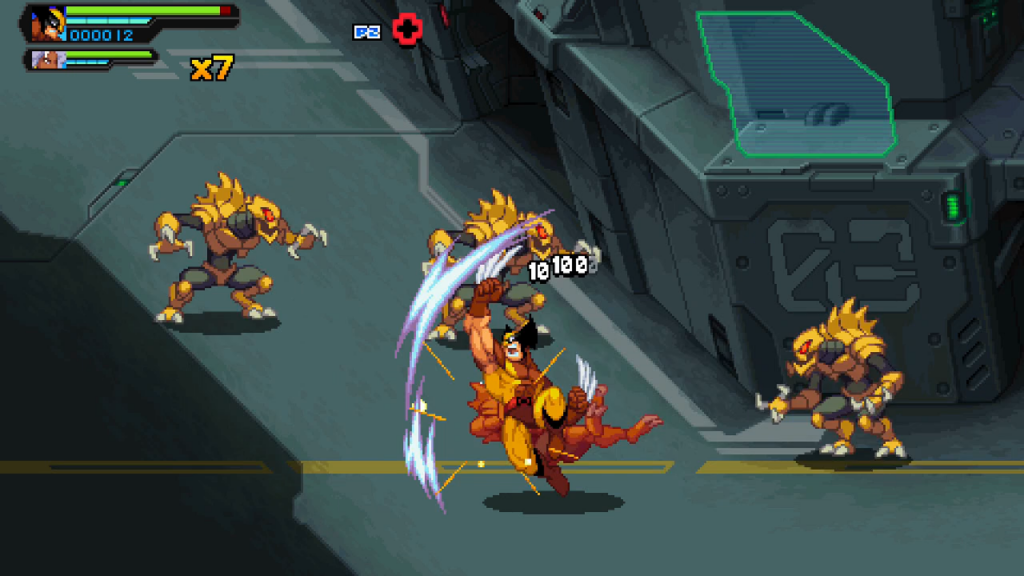
Marvel’s vast roster of superpowered heroes and villains are no strangers to beat ’em ups. Thirty-five years ago, not every comic book fan who passed by an X-Men arcade cabinet had the prior experience needed to engage with a complicated videogame. Their famous characters were placed into beat ‘em ups because they are easy to understand while delivering the action expected from superheroic burly brawls. The simple controls and level design ensured any player willing to plug enough quarters into the machine and keep pounding the attack button could expect to inevitably see the ending. This approach made beat ’em ups accessible and crowdpleasing, letting them dominate arcade floorspace in the early 1990s with original titles from seemingly any random property.
Marvel Cosmic Invasion is a retro beat ’em up, so at its surface it does appear to reproduce these same crowdpleasing features. It has a single attack button and much of my time playing is spent pressing it to disperse whichever of Annihilus’s minions is in the player character’s way. It only takes me a few enemy waves to recognize that the similarities to classic beat ’em ups stop there. Marvel Cosmic Invasion is an unexpectedly technical experience that demands much more skill and strategic choice than a typical beat ’em up.
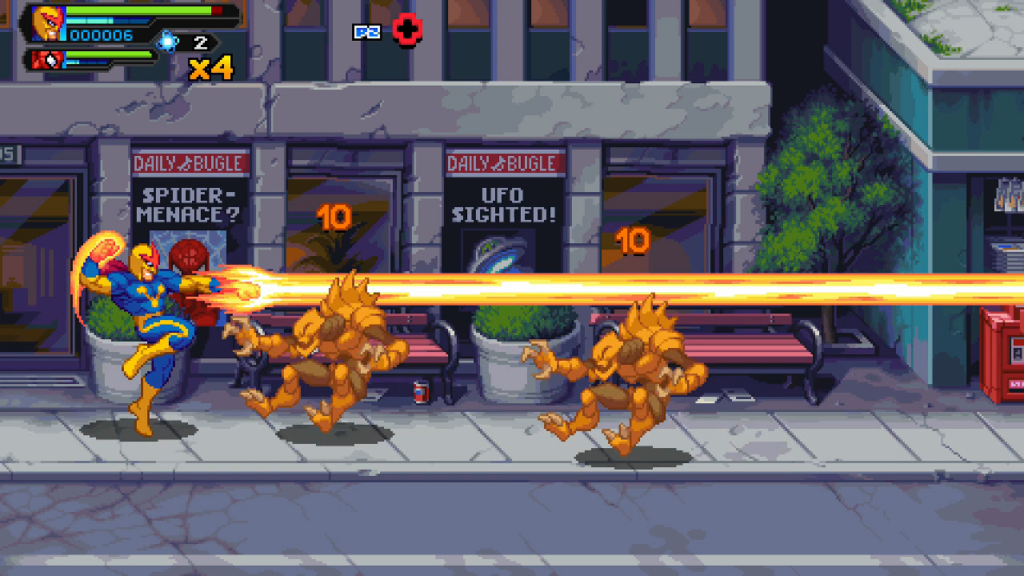
Much of Marvel Cosmic Invasion’s technical complication comes from its player character roster. There are fifteen Marvel heroes and antiheroes to choose from and each possesses distinct skillsets.
The most obvious difference between each potential player character is their unique superpower. Space cop Nova can launch beams of burning energy across the battlefield that penetrate enemies. Psychic pseudo-goddess Phoenix can pull her enemies from across the screen with telekinesis. Superstrong She-Hulk can grapple enemies then hurl them into their allies or suplex them into the ground with a number of devastating wrestling moves.
Characters’ superpowers are carefully balanced. Nova, Phoenix, and others with ranged powers must wait to recharge before they may be used again. Grapplers like She-Hulk, Wolverine, and Venom can use their powers as many times as they want, since they are already limited by melee range. Other heroes’ superpowers have deeper nuance to their limitations. Captain America’s superpower lets him hurl his shield to ricochet between multiple enemies before impossibly returning to his hand. There is technically no cooldown, but he will not be able to hurl his shield again until it returns, and his other abilities that require the shield will also be unusable. Any time I direct Cap to throw his shield requires careful consideration.
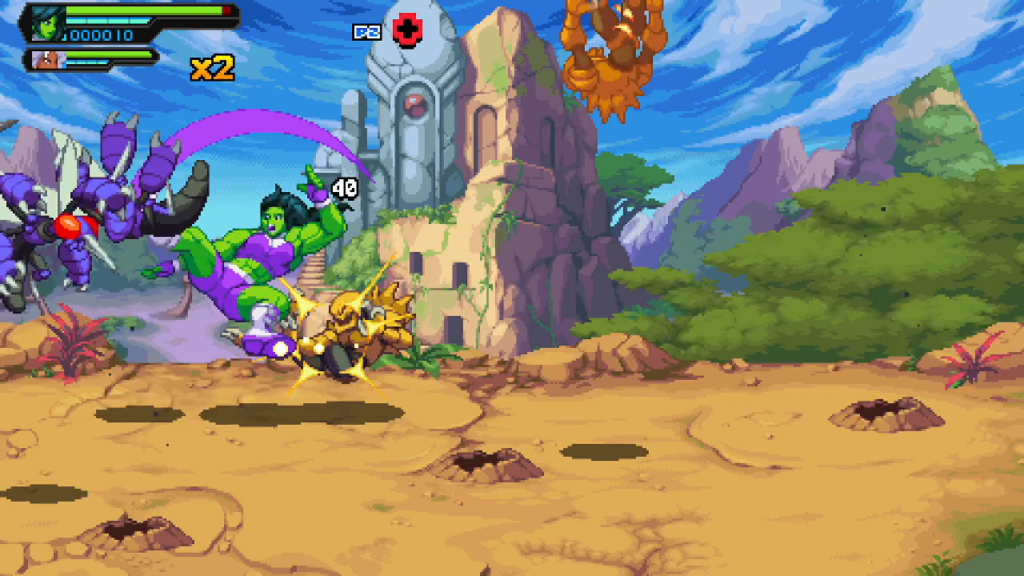
Every player character’s super power is distinct. Their other abilities are pulled from a pool they share with multiple player characters but are not universal. Storm and Phyla-Vell are among those with the power of flight, letting these superheroines approach airborne enemies with the same ease they do groundbound ones and effortlessly avoid hazards their flightless allies struggle with. Though Beta Ray Bill and Cosmic Ghost Rider cannot fly, they make up for it with a rising jump attack that most fliers lack. Knocking airborne enemies to the ground is often more prudent than matching them in the sky, where they remain a threat. A few characters have especially niche abilities they share with few others, like Spider-Man’s and Venom’s web swing. Webswinging across the screen is so situational that there’s never really a firm use case for it, as it would make playing as the other characters too difficult, but its existence does create the possibility of interesting tactics and exploits exclusive to the webheads.
The most significant way the fifteen player characters are differentiated is their primary defensive move. The agile characters are dodgers. Pressing the defensive button while controlling a dodger causes them to roll forwards or backwards. This is great for avoiding enemy attacks and moving the player character quickly across the battlefield. It will feel especially familiar to veterans of Shredder’s Revenge, an earlier retro beat ’em up from the same developer. It works almost identically.
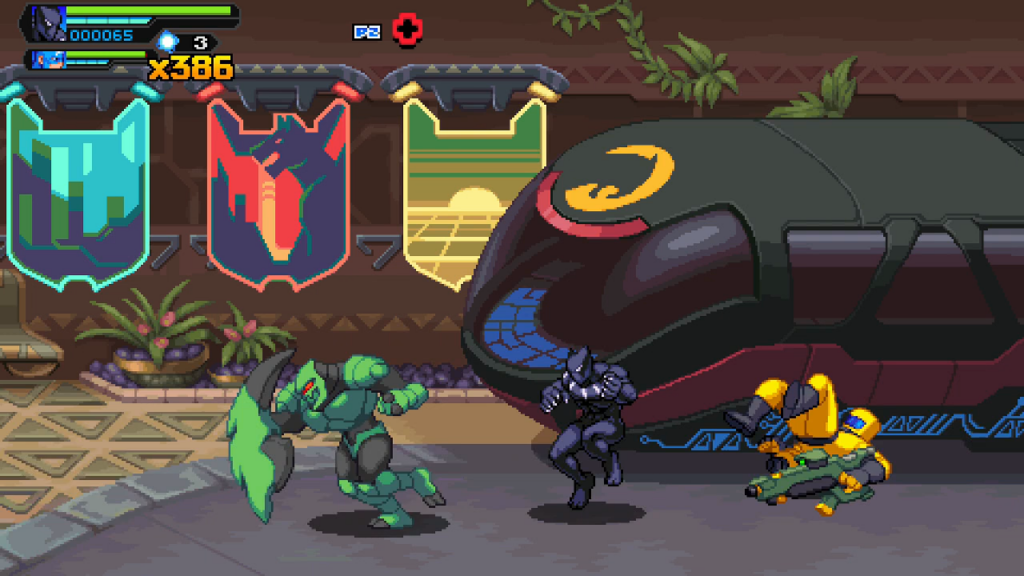
Dodgers are contrasted by the sturdier members of the cast. When I hold the defensive button while controlling one of these stalwarts, they plant their feet and brace for the oncoming attack. Any attacks that strike them in this pose deal much less damage. It takes a few hours for this simple fact to sink in. When first controlling a blocker, I keep pressing the defensive button expecting them to dodge out of the way of oncoming attacks, as the recent wave of indie beat ‘em ups has trained me to expect. Instead they stand still and eat the damage. Playing as a blocker requires a much more old school mentality, hearkening back to the likes of Golden Axe and Streets of Rage, where the player character must move up and down the screen to avoid attacks instead of dodging through them with a button press.
Like any other beat ’em up, success in Marvel Cosmic Invasion is contingent largely on my ability to control the enemy crowd. Getting every enemy on screen to cluster together in a single group makes it much easier to avoid their attacks and to damage all of them at once. Dodgers are much more effective at this vital tactic than blockers thanks to their ability to quickly change their position on the screen. Even once I have the crowd standing together, playing as a blocker feels like a bad deal. Blockers take fragmentary damage by absorbing an attack; dodgers take none at all by avoiding the attack entirely.
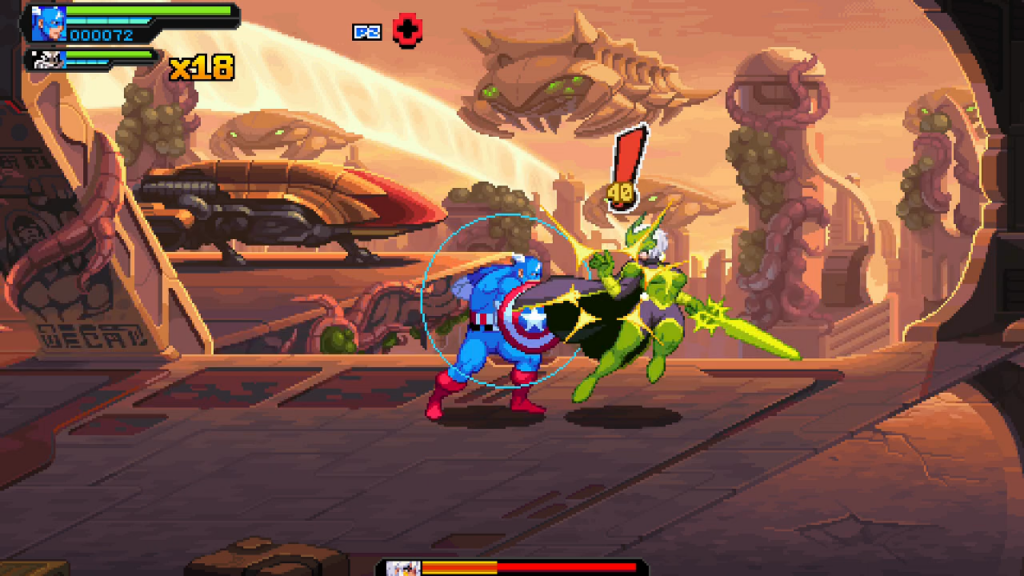
I don’t appreciate a blocker’s true power until I master their timing. If I press the defensive button just as an enemy attack connects with a blocker, they will take no damage and briefly stun their opponent. This parry is powerful, but limited. It’s ineffective against the barrage of attacks coming from large enemy groups, which the player character will inevitably face multiple of in every level. When wielded with skill against a single powerful enemy, parrying can completely shut down their attack pattern. It even works against bosses, including Annihilus. A skilled player in control of a blocker can trivialize what should be the most challenging encounters.
With all these deciding factors to consider, it can be difficult to choose which player character to adopt. This is where Marvel Cosmic Invasion’s final wrinkle comes into play. I do not choose a single player character to battle Annihilus’ invasion. I choose two.
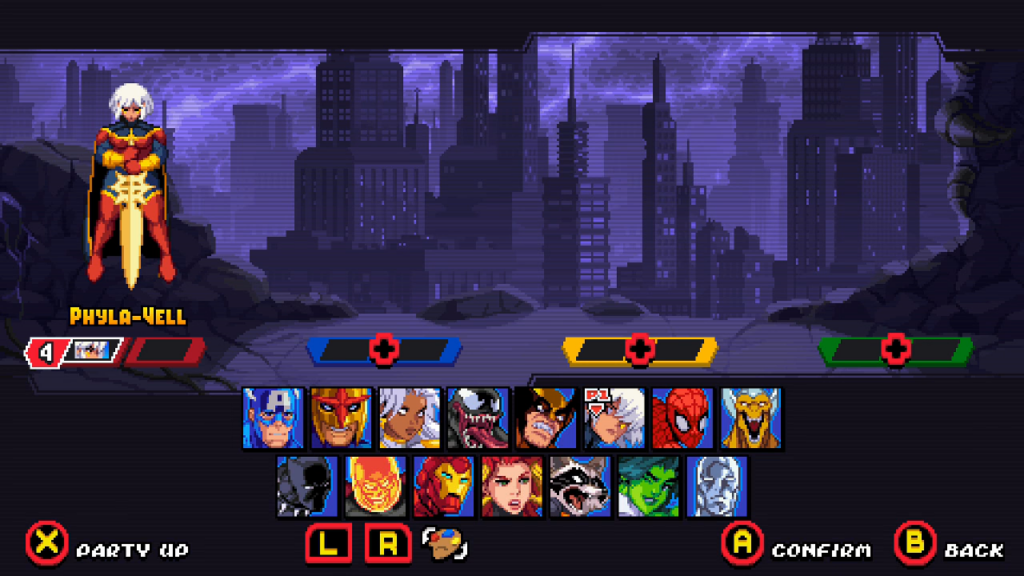
I am given total freedom of choice in which duo I control while playing. There’s nothing stopping me from pairing Iron Man with Silver Surfer. I may still find it difficult to complete a level with this pair because of their similar abilities; both have a ranged superpower, fly, and block to defend. It would be much more prudent to pair one of them with Rocket Raccoon, whose ground-based attacks and dodgeroll defense complement their toolsets much more effectively. It takes time and practice with every player character to learn their specific nuances so I can make informed choices about which to pair up.
Once deployed in a level, I control one from the pair at a time. I can switch between them in an instant with a button press. This makes it easy to strategically use a flier to float safely above a dinosaur stampede, then switch to their ground-based partner to fight the next wave of Arthrosian-infected enemies, or to whittle down a large group with a dodger then switch to a blocker to safely take out the single remaining enemy. Another button temporarily summons the benched partner to join in attacks. Learning to take advantage of these partner attacks can make the hardiest enemy groups much easier to overcome.
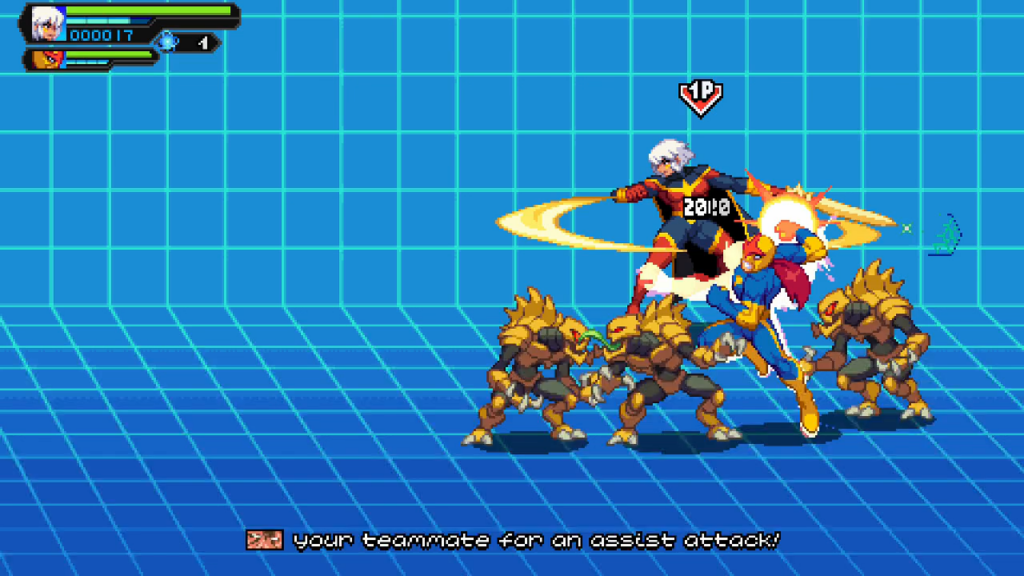
The large roster of player characters with distinct, contrasting skillsets and the strategic ways they may be paired together is what makes Marvel Cosmic Invasion a much more technical experience than the typical retro beat ‘em up. Its concept is a slight paradox: It’s an entry in a traditionally button-mashing and careless genre that penalizes button-mashing and rewards careful consideration of how individual characters work. This is underscored by its greatest departure from convention. Each hero has only one life. If one hero falls, the survivor will have to complete whatever remains of the level—including its protector boss—without the benefits provided by their partner. If the second partner dies, it’s a game over. Marvel Cosmic Invasion takes what is normally a self-imposed challenge for beat ‘em up masters, the single-quarter run, and makes it a baseline.
I may play through the heroes’ quest to stop Annihilus in Story or Arcade modes. Both follow the same path through the campaign. The difference is how much of the total campaign each mode expects me to play. In Story mode, levels are played individually with a fresh pair of heroes. They may be retried from their beginnings no matter how many attempts it takes. In Arcade Mode, the entire campaign must be played with the same pairing and in a single sitting—and again I emphasize, with a single life.
I am disappointed to feel that these two alternate modes are where Marvel Cosmic Invasion feels like it comes up short. The total number of characters to play as and the many combinations in which they may be paired feels vast. The number of available levels feels miniscule by comparison. Despite an adventure that takes its heroes to multiple planets across a galaxy, the fifteen levels that comprise this adventure feel small and short. I feel slightly ridiculous feeling this way. No beat ‘em up has benefited from being too long. And yet, when I see Annihilus defeated and the credits roll, I feel deflated. I’m disappointed that this is all there is.
The trouble is there isn’t much difference between the Story and Arcade modes. Both challenge me with completing each level in chronological order. Story mode allows me to play each level standalone and pick a new pair of heroes on each attempt; it offers the satisfaction of variety. Arcade tasks me with beating every level with a single pair of heroes; it offers the satisfaction of challenge. The actual content of the modes is identical.
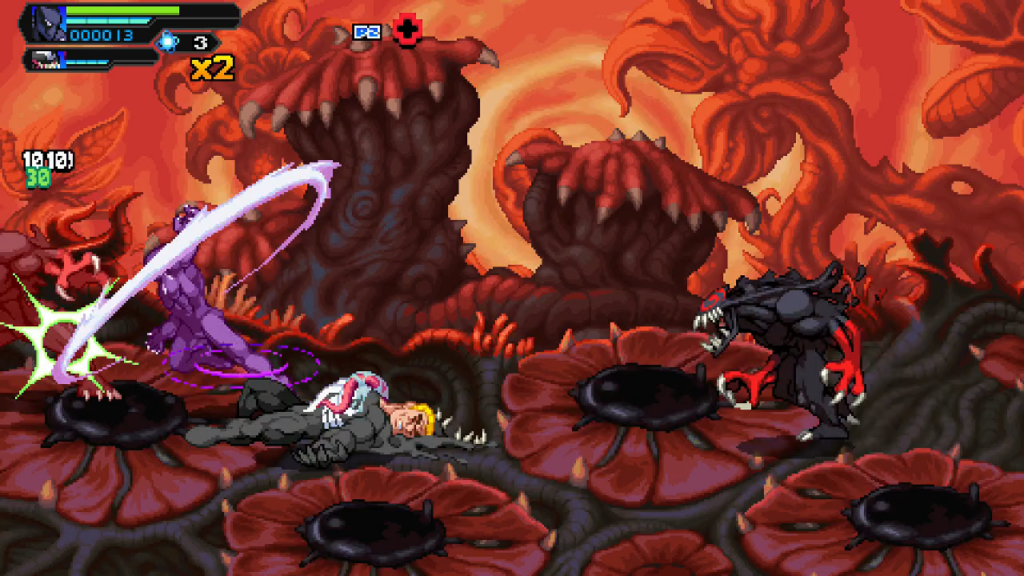
After finishing the Arcade mode with Wolverine and Phoenix, I’m eager to keep playing with a new pairing. I am not eager to do it through the same levels. I want to keep exploring different character combinations in new spaces. Marvel Cosmic Invasion provides the character combinations. It does not provide the spaces. As I write this review, X-Men’s Cyclops and Fantastic Four’s The Thing have just been added as downloadable characters. But they are just that: new characters, with no new levels or play modes. This pack is ominously listed as “DLC #1.” I wonder how many more player characters will be added—at additional cost—to a universe that already feels too small to contain the heroes that already exist there.
It would be incorrect to complain that Marvel Cosmic Invasion offers nothing besides its two modes. From the main menu, I may access the Cosmic Matrix. I may fill this large block of empty squares using Cosmic Cubes, tokens earned from just about every facet of play. One Cube is hidden in each level and is claimed when the player character attacks it. Other Cubes are earned by completing individual challenges in every Story mode level. The last batch are obtained by raising character experience levels, which also earns each player character more hit points and improves the efficiency of their most powerful abilities.
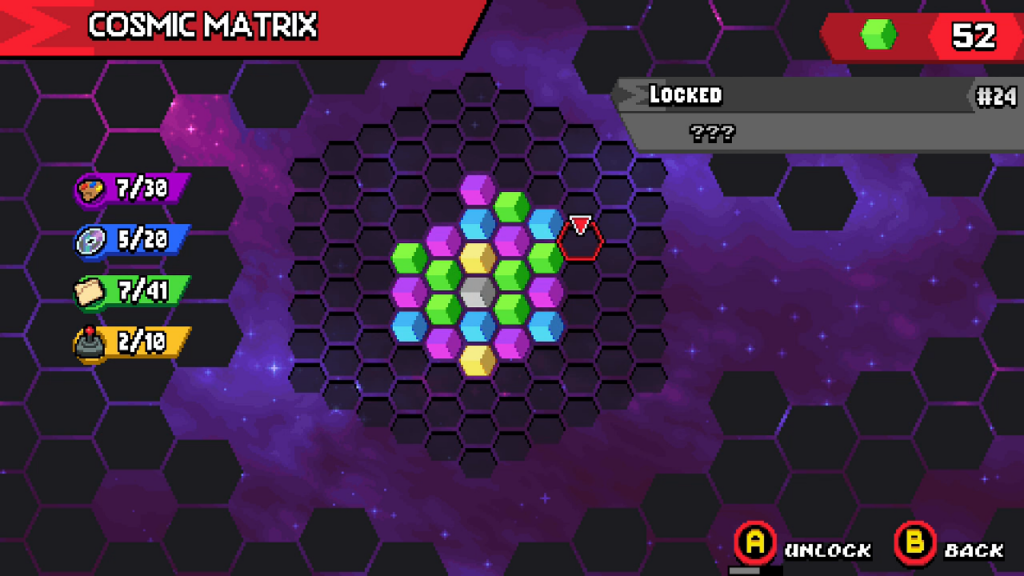
The Cosmic Matrix looks enticing and intimidating. It has over 100 squares to fill in and I imagine this taking enough time to keep me occupied for many hours, even if it does begin to feel like a grind. Once again, I am deflated to discover that a single 3.5 hour play of the Story mode earns enough tokens to unlock more than three-quarters of the entire grid. It takes only a few more hours of effort to earn the rest.
It’s further disappointing that much of what is unlocked in the Cosmic Matrix does not feel rewarding. The best rewards are modifiers for the Arcade mode, adding new layers like a classic Cast from Hit Points effect for super powers and an infinite lives Free Play mode that is perfect for families and younger players. Less exciting rewards are new color palettes for each player character. Some evoke the color schemes of their most famous costumes. None actually change the character’s clothing. The most numerous are encyclopedia entries. This information appears in a tiny box that can’t be manually scrolled through, making the tiny blurbs of information it offers about the characters difficult to read. I take some satisfaction in unlocking all of the Cosmic Matrix. I take little from indulging in its rewards.
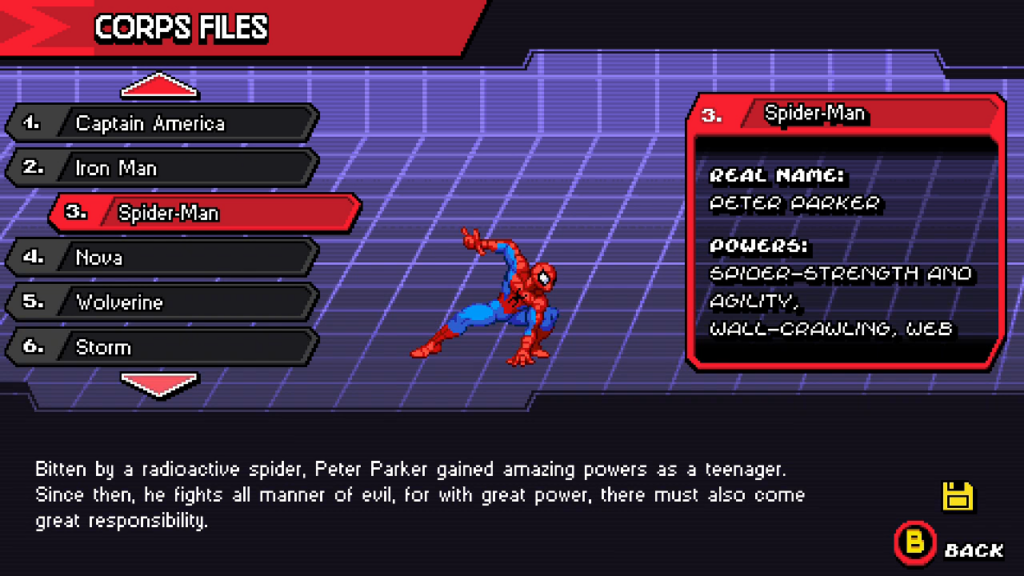
Marvel fans who are most familiar with its characters through the mainstream Marvel Studios films and streaming series may find their appearances in Marvel Cosmic Invasion odd. This setting draws much more from classic comic portrayals than from the Marvel Cinematic Universe. Iron Man is known as an anonymous “bodyguard” for Tony Stark instead of his identity being public. Silver Surfer is unambiguously male and is a coldly loyal agent of Galactus the Devourer. Frank Castle has moved on from his Punisher days, lives in outer space, and is possessed by the Spirit of Vengeance. A young man named Nicholas Fury, Jr. appears with his squad of SHIELD soldiers in a few levels; he is white and has a full head of hair. Much of this will seem strange, if not outright upsetting to film fans.
This choice to focus more on comic portrayals feels odd as film mainstays like Iron Man, Black Panther, and Wolverine are given early prominence. They fade into the background of the light plot once the story leaves Earth. I can still choose to play as them but they feel out of their element against the galactic threats that appear in the story’s latter half. It almost feels like a trick. Marvel Cosmic Invasion includes its film-famous characters early on to draw the movie fans into playing, then pulls the rug on them with strangers like Phyla-Vell, Beta Ray Bill, and Cosmic Ghost Rider once they’ve finished a few levels. None of this detracts from the visual quality, and it’s a treat for comic purists. Film fans should consider themselves warned. This is a step into a much bigger and much weirder Marvel universe.
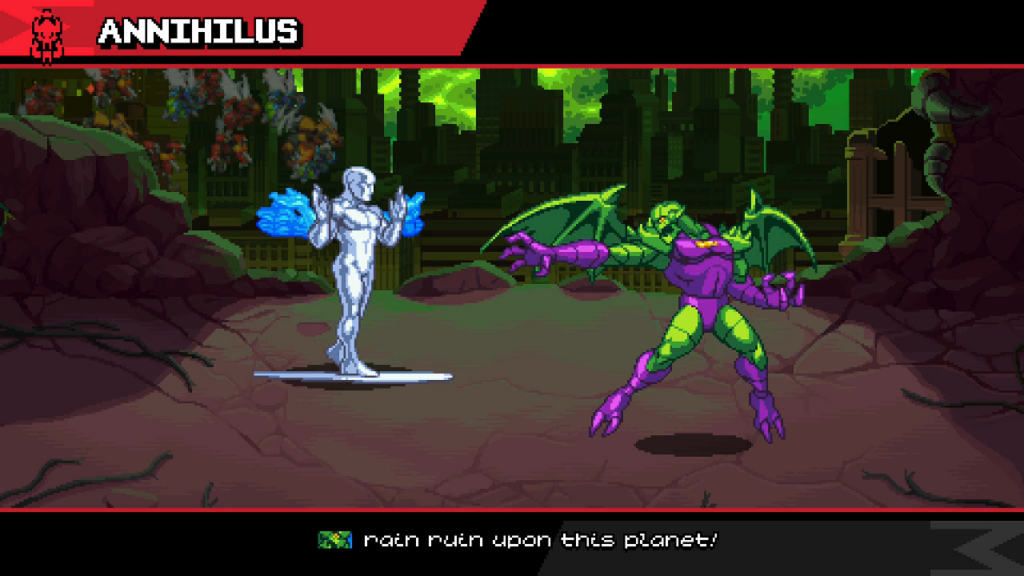
Marvel Cosmic Invasion will be most enjoyable for players who understand the intricacies of the beat ‘em up genre. Those who pound buttons to brawl their way through the likes of Double Dragon, Turtles in Time, or many of Marvel’s previous beat ‘em ups won’t do well in this offering outside of the unlockable Free Play mode. It’s in building these intricacies where it is most successful. The broad cast of player characters have enough unique abilities to feel distinct without sacrificing a basic, unifying skillset. Learning the specific powers of each character and matching them up in balanced and unbalanced ways is interesting and fun while it lasts. The problem is it doesn’t last very long. Despite telling an apocalyptic story transcending multiple worlds across a galaxy, the setting feels small. My interest in playing and replaying the same levels runs out long before I’ve explored every possible character combination. Marvel Cosmic Invasion doesn’t have the breadth of real estate to support the depth of its roster and their abilities.