Against the Storm is an unusual combination of ideas that seem at odds with each other. Primarily, it is a fantasy village building and management simulator. I am appointed the leader of a small settlement from its founding and must develop it over years to support the unique needs of its citizens. It is the secondary features of Against the Storm’s design which make these goals challenging. Settlements must be managed in a maelstrom of randomness. The makeup of a settlement’s citizens, the resources available nearby, the support provided by the monarch, and even the available buildings are all randomly drawn from multiple large pools when the settlement is generated and at regular milestones during its development. I only stay in a settlement for about ninety minutes, roughly ten in-game years, before I am asked to leave for a new settlement with all new, randomized factors. The result is a videogame that takes the methodical pace and vast scale of a typical city management sim, shrinks it down to the size of a small village, then brilliantly flips it upside-down by injecting constant turmoil and difficult decisions at a rapid pace.
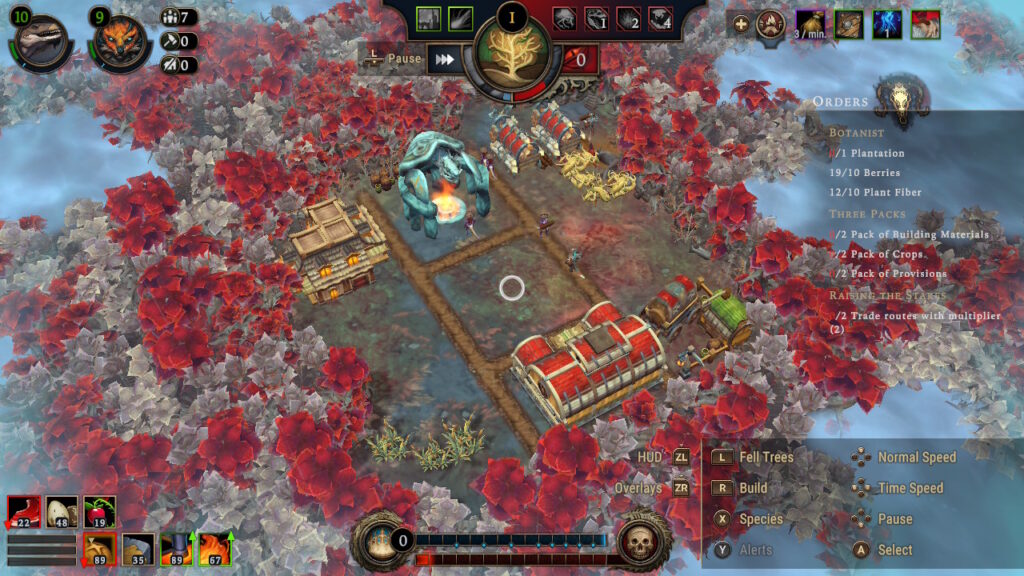
Against the Storm is set in a fantasy world trapped in a cycle of calamity. Every forty years, the world is consumed by the Blightstorm, a maelstrom that reshapes anything it touches into fresh, untouched forest. All the sentient races of the world—humans, beavers, lizards, harpies, and foxes—have had their once-great civilizations destroyed by this regular eruption.
The few survivors of the first Blightstorm found refuge in the Smoldering City, a haven built around a magnificent citadel and the one place in the world that goes untouched by the cycle of recreation. Old animosities and prejudices from before the Blighstorm are sometimes mentioned but are effectively forgotten as the races intermingle in their host’s land. It is the descendants of these first refugees who establish new, short-lived settlements in each reforged wilderness, carrying back what food and other resources they can to bolster their host’s home before the next Blightstorm. The long-term success of the new settlements is ultimately irrelevant. Only helping the Smoldering City to survive and expand amidst the cycles truly matters.
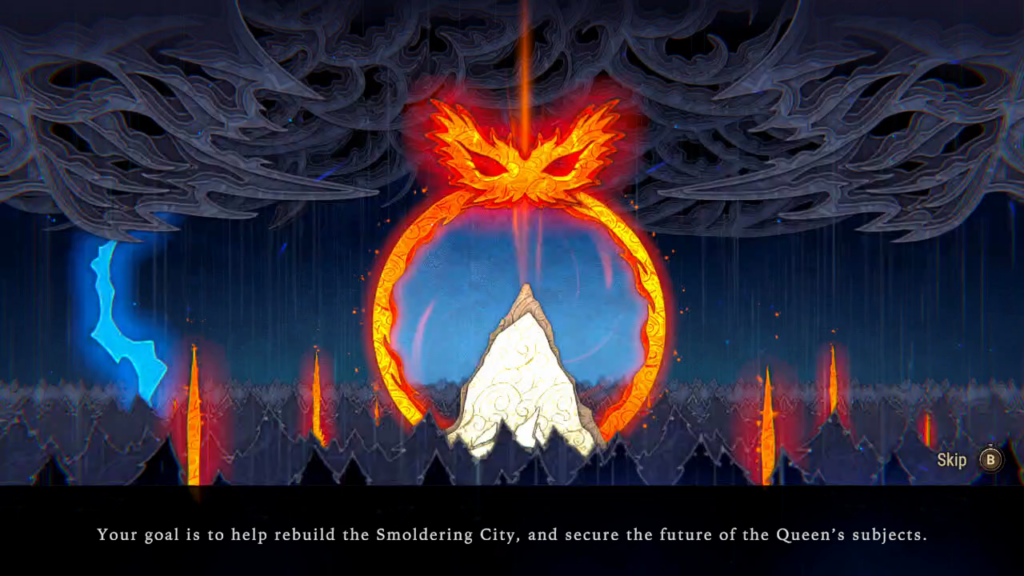
The ruler of this sanctuary is the Scorched Queen, who appears most often as a blank, staring mask of fire blazing above her citadel. The Scorched Queen is benevolent. It is Her magical power that wards the Blightstorm away from the Smoldering City and Her generosity which grants the refugees shelter within its boundaries. She is also cruel. The Scorched Queen does not execute those who violate the Smoldering City’s laws. Instead, they are exiled—which is a death sentence, as a new Blightstorm will inevitably arrive in their lifetime.
At first, I feel I am being set up to learn sinister truths about the Scorched Queen. Her immunity to the Blightstorm and the Smoldering City’s subsequent prominence feels a little too convenient, like an industrialist melting Earth’s icecaps then charging people to live on his city-ships. The more I play Against the Storm, the better I learn that its setting is excellently applied to create atmosphere and to contextualize its mechanics. It does not exist to indulge in slow-burn storytelling, shocking twists, and hidden villains. The Scorched Queen is an inscrutable goddess, not a cunning antagonist. Her behavior is irrational and Her decisions pitiless but She is not responsible for the present state of affairs. She is a literal deus ex machina and a net good for the refugees sheltered in Her territory.
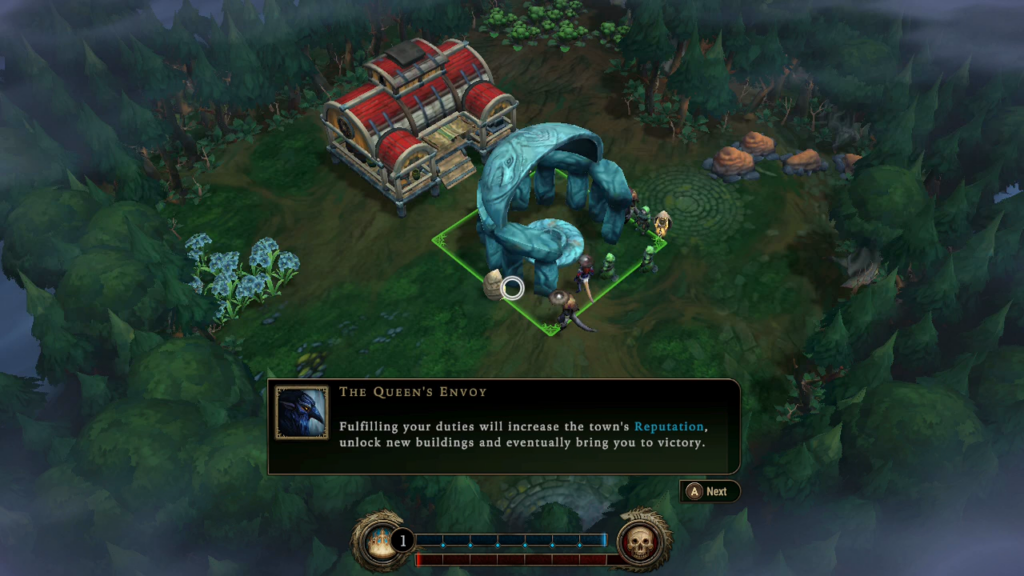
Whether I “win” or “lose” in my current settlement is dependent on my ability to appease the Scorched Queen. Two bars at the bottom of the interface mark my progress towards each end state. The blue bar represents my successes; when I keep the villagers well fed, protect them from the ceaseless rain, deal with random events discovered near the settlement, and complete tasks sent to me by the Queen’s Herald, then the blue bar fills. If the bar fills completely, then I win and I am summoned to another new settlement. The red bar represents the Scorched Queen’s impatience; when villagers abandon my settlement, I commit acts of blasphemy, I fail to complete certain tasks sent by the Herald, or I’m simply taking too long to develop the settlement, then the red bar fills. If the bar fills completely, then I lose and I am summoned to another new settlement. There is no real penalty for a loss. No matter how many of my settlements are abysmal failures, the Scorched Queen will endlessly send me on to the next one. Despite the limitations of Her patience, Her capacity for forgiveness seems boundless.
While it is the Scorched Queen’s impatience with which I am in competition, it is the world itself with which I feel in conflict. The dense growth of forest in which every settlement begins has a mind and a malevolence imbued in it by the neverending, cursed rain. The forest’s rage grows with my settlement; the more trees my villagers cut down to expand the settlement, the more precious resources are plundered to enrich the settlement, and most especially the longer a settlement merely exists beneath its boughs, the more ominous the forest’s presence becomes. It is this growing, eldritch terror from the land itself that can terrify my villagers into fleeing, increasing the Scorched Queen’s impatience. Her Majesty decides when a settlement is a lost cause; the forbidding forest around my settlement is the reason it is lost.
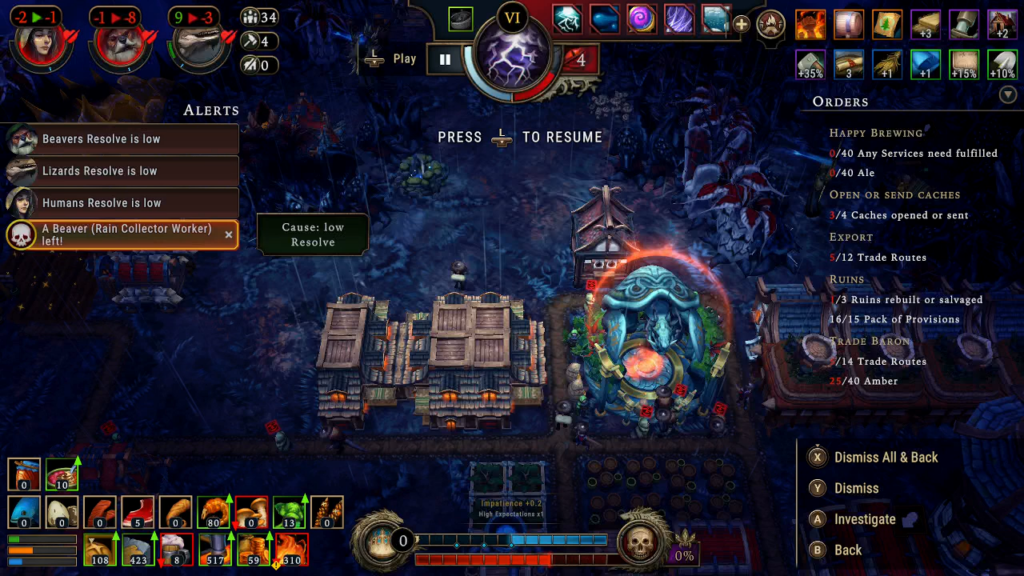
In general, I know the goals I need to reach for success in every settlement. It’s actually managing to achieve these goals that is challenging. Almost every factor of a settlement is randomized before it is established. In order to appease the Scorched Queen and win that settlement, I must find one of innumerable possible routes through all the randomness to reach the singular goal at their end. My confidence with Against the Storm grows with my ability to recognize which of these routes are most viable.
Each settlement is inhabited by three of the five races and each possesses both shared and distinct tastes. Beavers and humans both prefer eating bread, wear coats to protect themselves from the rain, and enjoy drinking ale for entertainment. They cohabitate in a settlement well because supporting a comfort for one group tends to benefit both. Lizards contrast beavers and humans in almost every way. They prefer eating skewers and jerky, wear boots, and enjoy brawling competitions. It’s not impossible for lizards to live together with humans and beavers, but they will require many comforts that cater to them alone. It is easier for them to live alongside harpies, who share their affinity for meat, and foxes, who also like to wear boots in the rain. Pleasing some villagers in a few ways is always possible. Pleasing every race in every way they prefer is nearly always impossible. The better a job I do at pleasing as many as possible in at least some way, the less likely they are to abandon the settlement and the faster the blue bar fills.
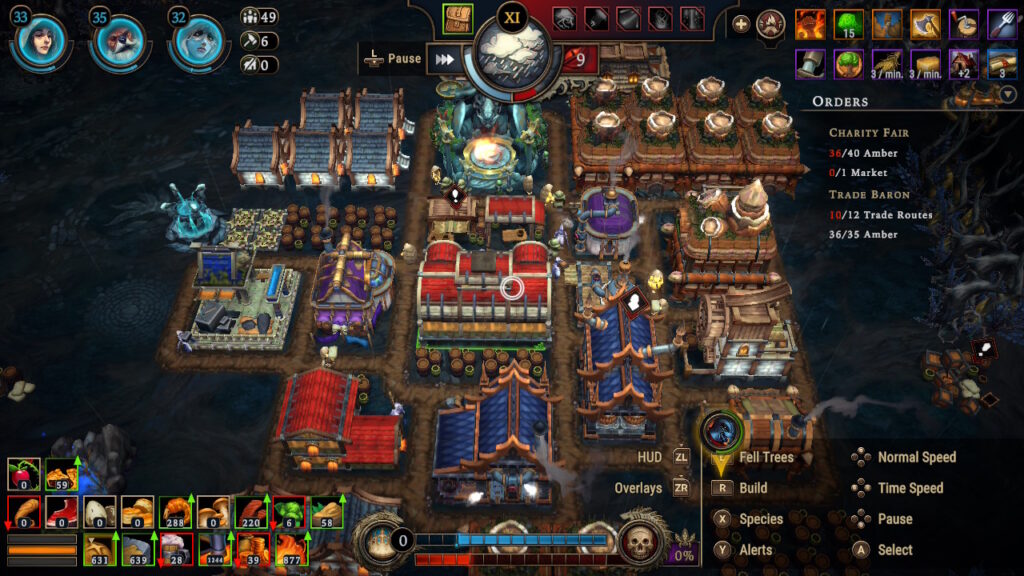
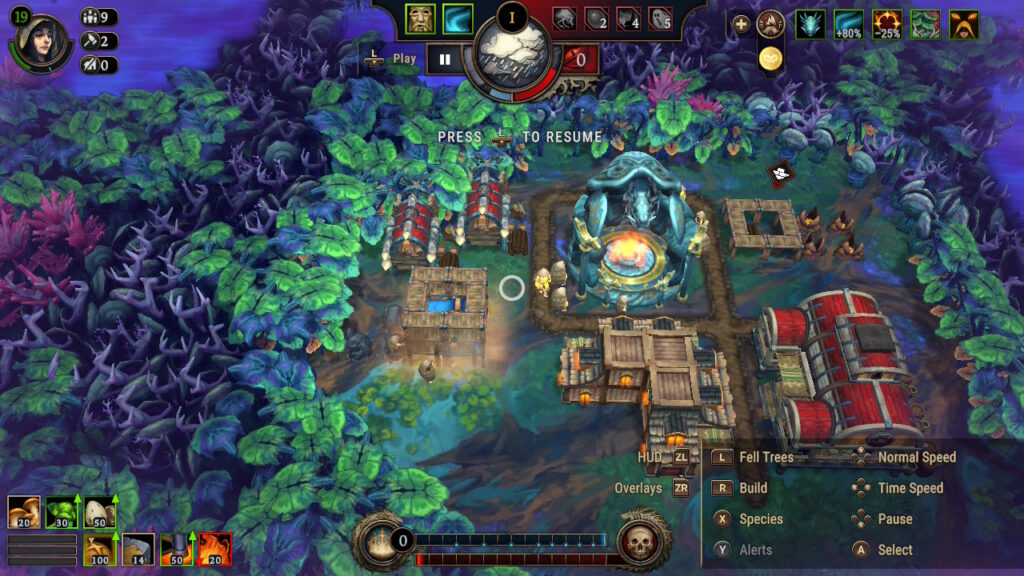
While the Smoldering City provides a small cache of food and supplies to get each settlement started, these are used up within a few years of the founding. I must immediately organize the villagers to gather the resources that grow around the new settlement if it is to survive.
The resources that villagers gather for the settlement are scattered in clusters across the map and are, of course, randomized. Each resource slots into a broad category. Some maps are abundant with raw meat, others abuzz with insect swarms, and the rest keep villagers busy looting raw eggs from nests. On the vegetarian sides of things, maps have varying sources of mushrooms, roots, vegetables, or berries. Other resources like grass, stone, clay, iron, and leather are used in construction and craft jobs. The only constant on every map is wood chopped from the trees that overwhelm the region. Lumber is key to expanding the settlement and keeping ablaze the Hearth, an altar central to every settlement whose massive bonfire strengthens the villagers’ resolve and keeps the forest’s evil influence at bay. The fastest way to lose a settlement is to allow its Hearth’s fire to go out.
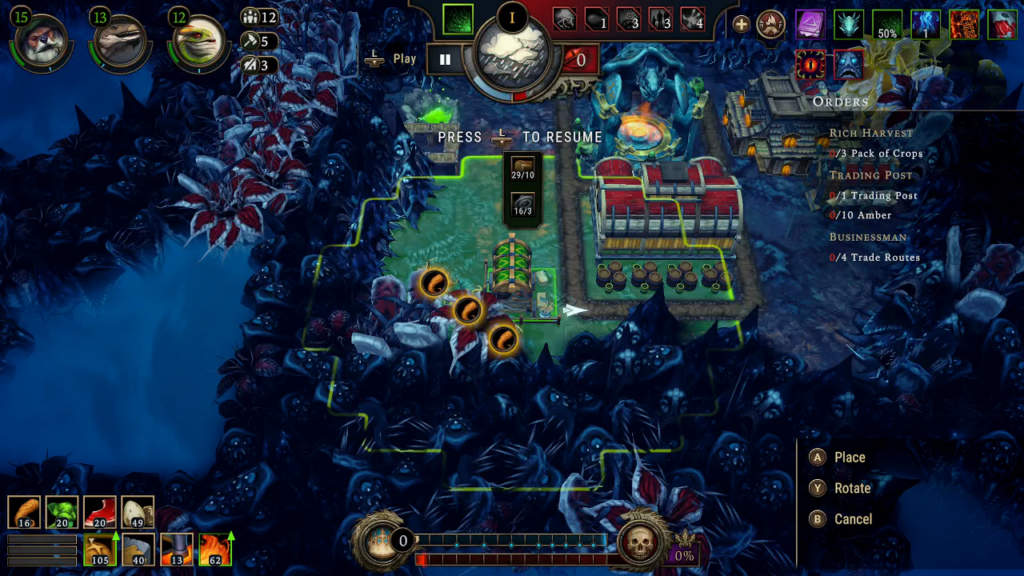
Every settlement begins next to two or three resource nodes. They don’t last long; villagers will pick them dry within a year or two. Additional nodes are found in glaves, clearings found adjacent to the settlement behind thick knots of trees. The only way to reach these glaves is to direct my woodcutters to cut down the forest to reach them. If the settlement is to grow, I must begin opening glaves as soon as possible by strategically directing my woodcutter’s deforestation efforts.
Every glave opened is a gamble. I don’t know what is inside one until the trees protecting it are removed. My villagers may be starving and need a new source of meat, insects, or berries, and the next glave opened may only have dry grass and clay. In desperate circumstances, I may have to open multiple glaves in short succession to find what my settlement needs. This is a dangerous choice, as the more trees my villagers cut down and the more glaves they pillage, the more the forest’s anger grows. Yet the larger the settlement becomes, the more resources my villagers require to keep their mood high. I must find a sustainable balance between supporting my villagers and risking the forest’s ire to succeed.
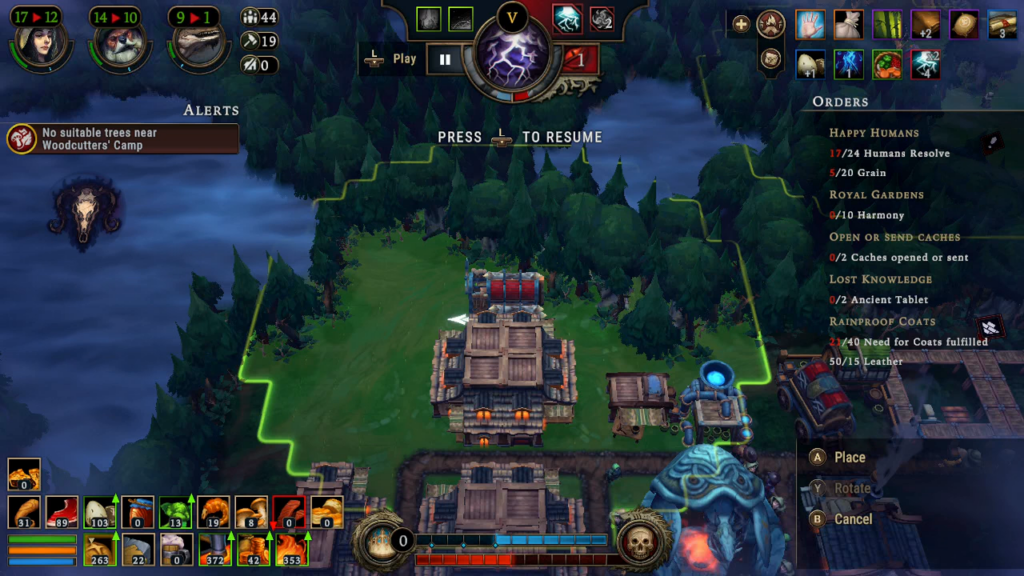
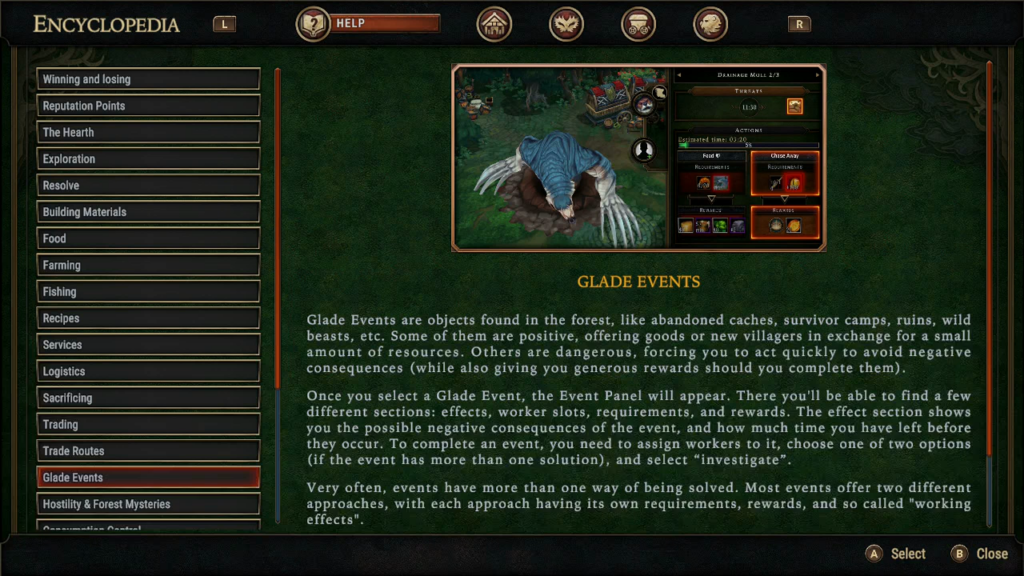
The glaves closest to the settlement are usually safe to open. Glaves further out are marked with baleful skulls—the dangerous and forbidden glaves. These glaves have more bountiful resources, sometimes even enough to last the settlement for the rest of the current game. The availability of these riches is offset by the threat of glave events. These are grisly, sometimes even deadly set pieces that maximize the tension of the normally sedate city management genre. To end a glave event, I must make vital choices where every option can have severe consequences.
A glave may contain the corpses of another expedition from the Smoldering City. My choices are to direct my villagers to loot the bodies or have them respectfully buried. Villagers will become upset if I order the bodies to be looted, but their discontent will pass and the resources gained may be vital to expanding the settlement. Giving them a proper burial will maintain the settlement’s mood—and maybe even earn me some approval from the Scorched Queen—but also requires expending a large number of resources I may need elsewhere.
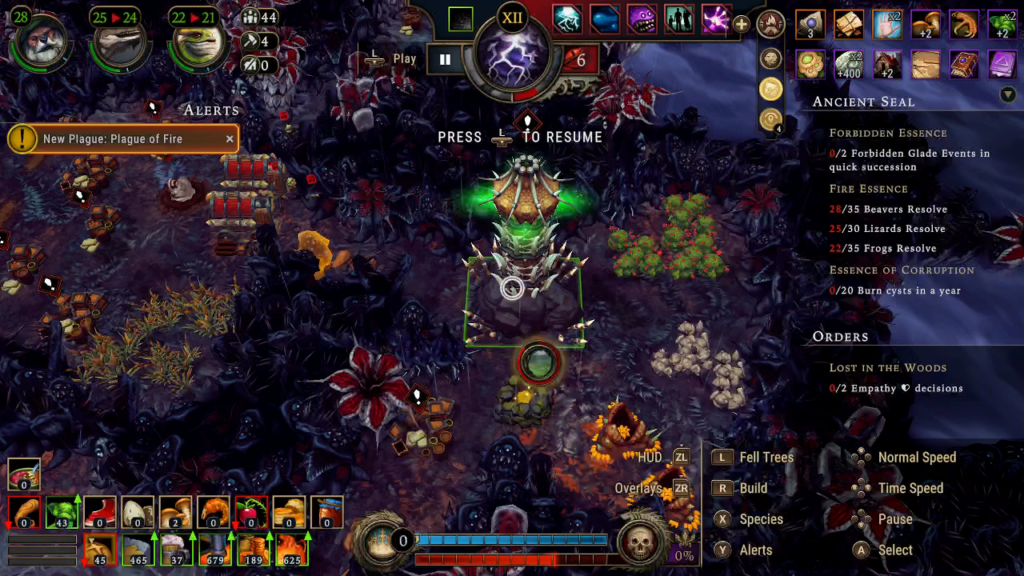
I must make a choice quickly and ignoring a glave event is never a viable option. If I allow the corpses to lie unattended for too long, they will begin to rot and spread disease into the settlement. Sometimes I have no choice but to take the less desirable or honorable path because I cannot afford the other outcome. Some unhappiness about my graverobbing is preferable to an outbreak of disease. For this same reason, I must be careful not to open more glaves than I can manage—and there’s never a guarantee I can manage whatever situation they hide in the first place. An unexpectedly tough glave event can send a stable settlement reeling.
It isn’t enough to gather resources from nearby glaves and store them in the settlement’s warehouse. Raw meat, vegetables, and roots will keep the villagers fed but they will not keep them satiated. Leather, dry grass, clay, and iron are components of useful tools but are useless by themselves. To truly maximize the benefits of the resources gathered from around the map, they must be refined into useful objects. Meat can be cooked into jerky and pies. Leather can be stitched and cobbled into raincoats and boots. Dry grass can be woven into cloth, clay baked into bricks, and iron forged into heavy tools. It is these objects, not their raw forms, which bring true satisfaction to my villagers. And each must be crafted in a building.
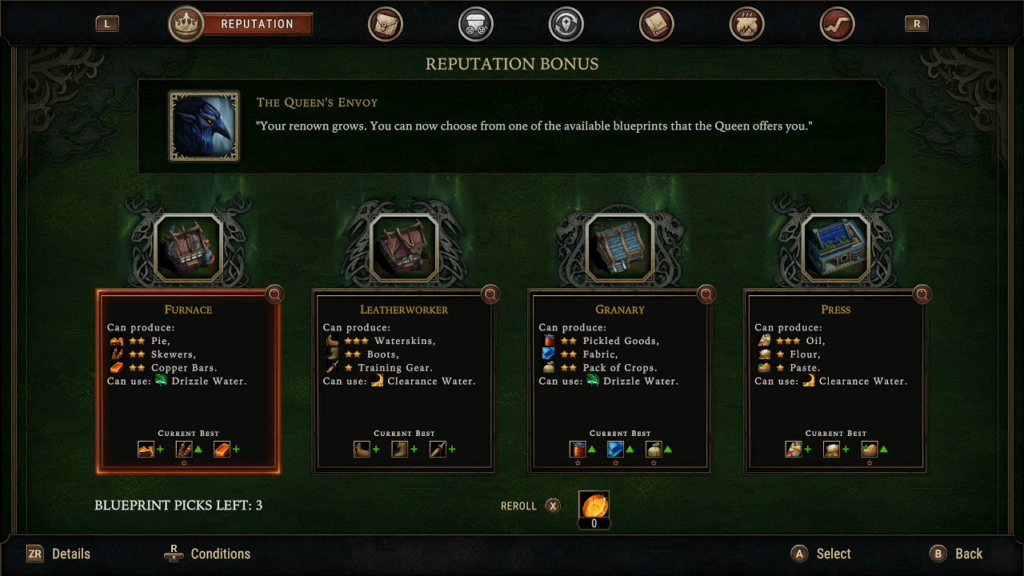
The buildings available in my current settlement are, as should be predictable by now, randomized. Through some bizarre bureaucratic quirk, instead of allowing me to pick and choose which buildings I need most to properly exploit the local resources, the Smoldering City sends regular packages containing multiple random blueprints. I am allowed to choose one of these blueprints and the rest are whisked away. I must carefully decide which of the offered blueprints offers the greatest benefit to my settlement. Any blueprints I pass over are unlikely to reappear until the next settlement.
It may seem that randomizing available buildings can lock me out of some products entirely. This is where Against the Storm displays some of its most brilliant design. Every item may be created in multiple buildings, so there is almost always some way to craft what my villagers need. If my villagers need coats, I may produce them from a Clothier, an Artisan, a Cooperage, or a Druid’s Hut. The difference between the four buildings is efficiency. The Clothier produces the most coats per used resource, while the Druid’s Hut produces the least. If both blueprints for both buildings appear in a draw, I’m more likely to take the Clothier. But if the only option is the Druid’s Hut, and I really need to produce coats for my villagers, then I can take that option, or I may gamble that a more efficient building will appear later. Beyond efficiency, every building also creates three different products. A Cooperage may make fewer coats than a Clothier, but the Barrels it can also produce may be useful to the settlement. A building that can make multiple items well can be more useful than one that makes a single item flawlessly.
This randomized availability of blueprints makes every game of Against the Storm heavily improvisational. I am always working towards the same goal of maximizing villager happiness by providing for their needs. The path I take towards fulfilling that goal changes greatly from settlement to settlement due to what randomized options are available. My confidence at playing grows as I recognize that there is almost always a path to success, I just need to look at my available choices and recognize the best ones possible. After completing more than sixty settlements in preparation for this review, only a handful were losses due to a lack of choices.
Keeping track of all this randomization is overwhelming and I might find Against the Storm impossible to manage if I also had to direct each villager individually, as in the real-time strategy videogames to which Against the Storm bears a strong visual resemblance. Thankfully, I am allowed to sidestep this issue through effective automation.
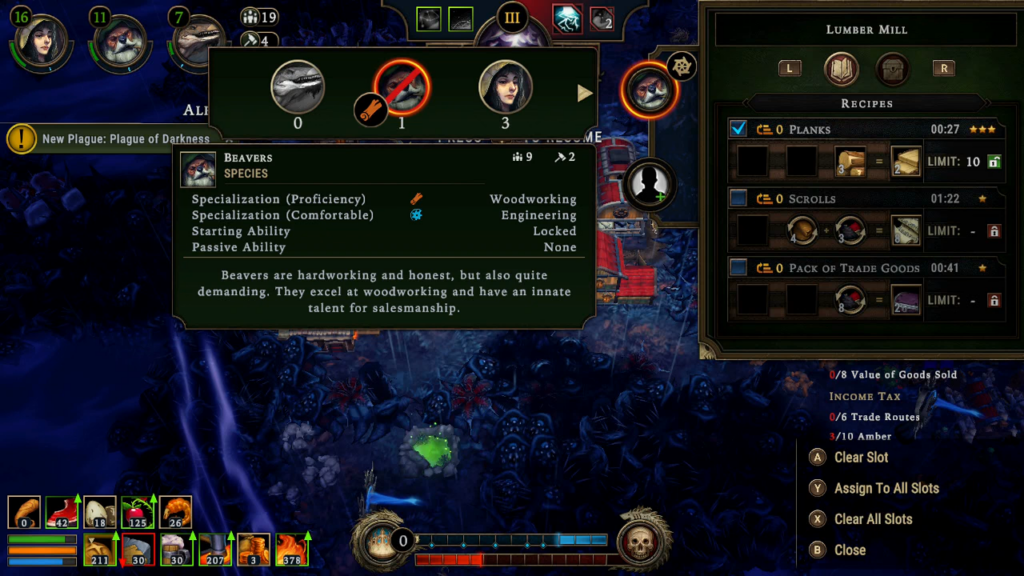
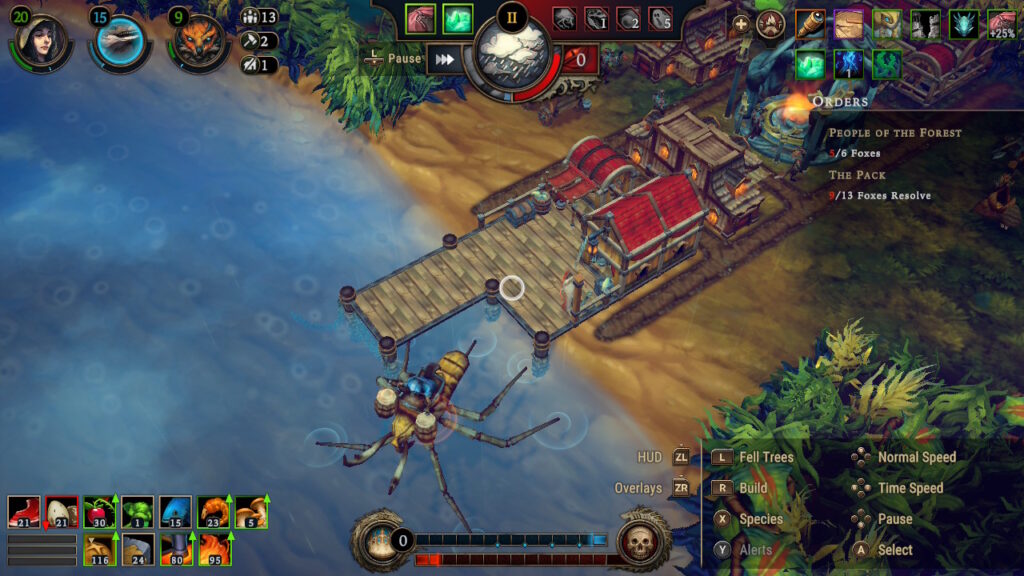
I never interact with villagers on a one-to-one level. While looking at a building, I can assign members of a specific race to work there. I simply select beaver or fox from the list, and one will promptly report for the job if any are available. Since settlements never grow much more than a dozen buildings wide, it only takes a few seconds for the villager to report for duty. Villagers not assigned to a building are automatically designated as builders and will immediately get to work constructing roads, buildings, and decorations as soon as I mark where they should be placed if the needed resources are available.
The automation is effective at keeping villagers on-task. It’s impossible for them to get stuck on obstacles; if a building, tree, or other obstruction is in their path, they will walk around it. If there is no path around, they can even walk through obstructions, though at a greatly reduced movement speed. These conveniences allow me to stay focused on the settlement’s big picture at all times, turning my attention between projects and crises without getting distracted by micromanagement. If I do need a moment to take in the entire situation or to make many decisions at once, I am free to freeze gameplay at any time to concoct a plan at my leisure.
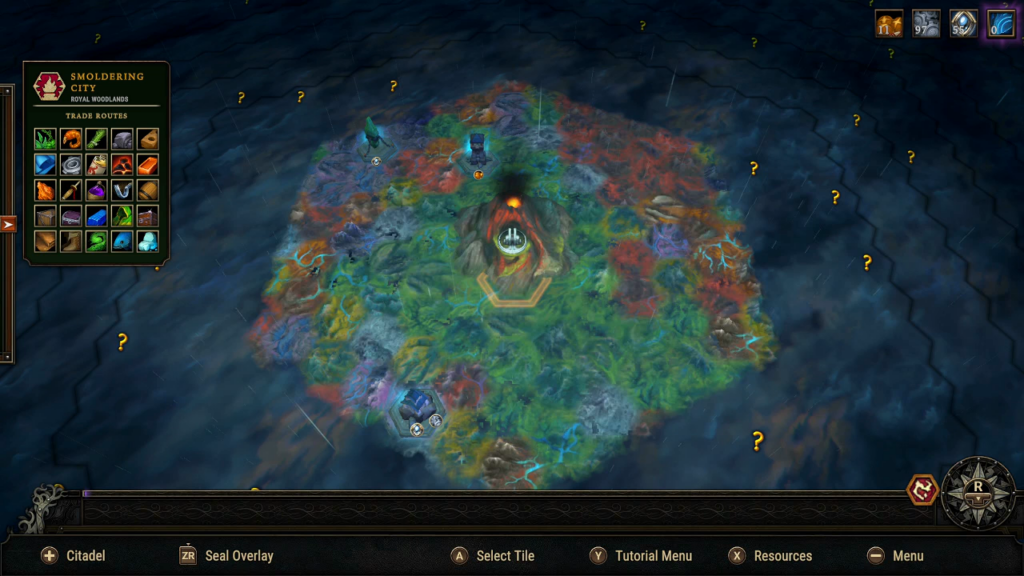
In the brief moments I spend moving between new settlements, I visit the world map. Here, I see the Smoldering City at the map’s center and a vast hexagonal grid spiralizing endlessly away from it. Each hexagon represents the potential site for a new settlement. The further the hexagon is from the Smoldering City, the higher difficulty I am required to play on, and the greater the rewards for my success or failure.
Against the Storm has masterful design in almost every sense but I have particular admiration for its difficulty curve. The chosen difficulty of a settlement has a broad impact on my priorities for winning. On the easiest Settler difficulty, the Queen’s Herald provides me with enough personalized tasks that I am able to win the settlement solely by focusing on them. In this scenario, I can completely ignore my villagers’ needs as I may win the settlement solely by fulfilling the whims of the Scorched Queen. Even though this is a poor representation of how to actually succeed in the long term, it establishes important fundamentals of how to interact with my settlements in scenarios that are difficult to lose.
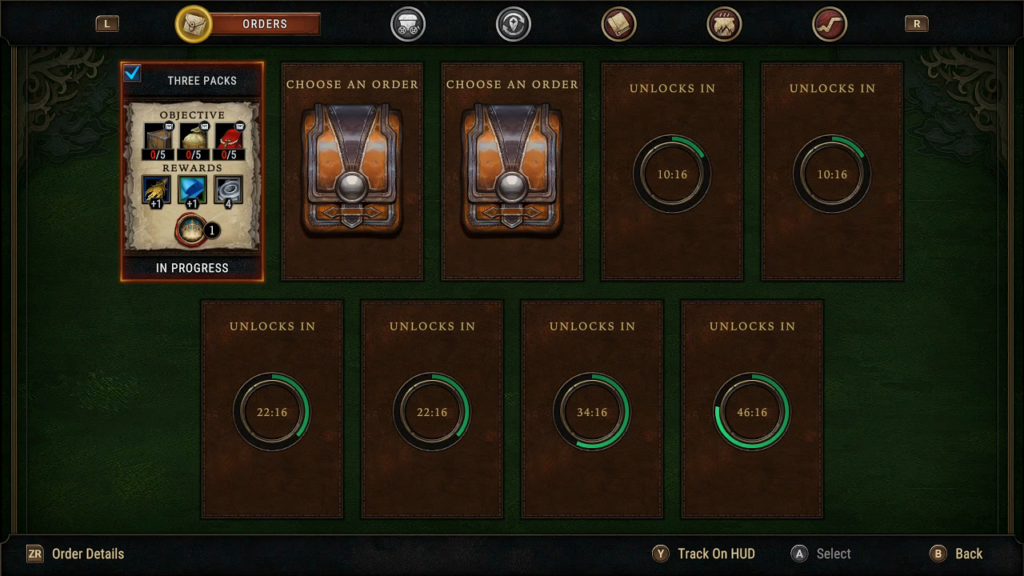
As my settlements creep away from the Smoldering City, I ascend into Pioneer difficulty. Expectations are raised here. The Queen’s Herald provides fewer tasks so I must gain more progress on the blue bar by appeasing my villagers. This progression continues through Veteran and by the Viceroy difficulty, the emphasis has flipped and most of my progress comes from villager resolve. Progression doesn’t end at Viceroy. There are twenty Prestige difficulty levels to work through, each adding a new factor of difficulty like slower and greedier villagers, fewer blueprint choices, and a more impatient Queen. It can take potentially hundreds of hours and hundreds of settlements to reach Prestige 20 levels of play. The imperceptible way Against the Storm nudges me along a path from total reliance on the Scorched Queen to being a benevolent bureaucrat for my villagers is one of its most impressive accomplishments.
Difficulty is not the only factor determined by a settlement’s location on the world map. Some hexagons glow with a mystical power. These mark the locations of Seals. Founding a settlement next to a Seal begins a special, more difficult challenge. In a glade near the settlement, my villagers will find an obsidian Seal built into the ground out of which stares a massive, blinking eye. By unveiling this Seal and completing four especially challenging goals in the settlement, I can summon the Scorched Queen Herself to appear and close the Seal, trapping the monster inside.
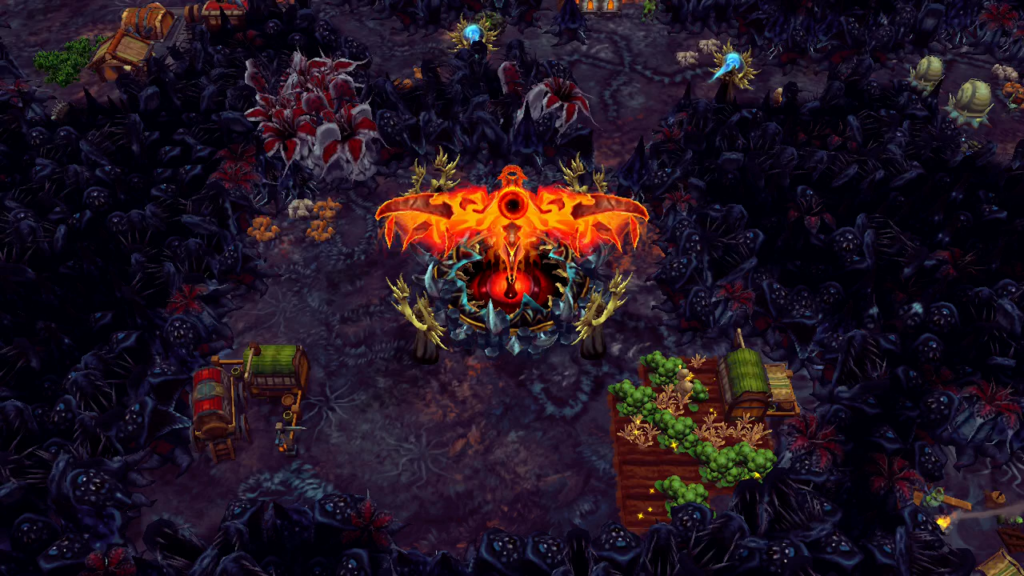
Building a network of successful settlements across the map to reach a Seal and then successfully closing it before the return of the Blightstorm is my main goal during much of my time with Against the Storm. Exactly who or what these Seals contain is never revealed, but they are implied to be connected to the ongoing Blightstorm. Closing a Seal extends the decades between Blightstorm cycles, letting me establish more settlements and reach Seals that are further afield from the Smoldering City. If I want to see the credits and “finish” Against the Storm, I have to reach and close four Seals. This takes me about eighty-five hours. There are many more Seals to reach and other goals to accomplish if I choose to keep playing across potentially hundreds.
Each time I finish a settlement, I am free to visit the Smoldering City. Individual settlements are transient, disappearing forever after the next Blightstorm cycle. The Smoldering City is eternal. It represents my growth as one of the Scorched Queen’s Viceroys and the sum total of my accomplishments across all of my settlements. This is most readily apparent by the image that represents the City. At the start of my time with Against the Storm, it shows only the Scorched Queen’s citadel sitting in a verdant valley at the foot of a volcano. After clearing the fourth Seal, the Citadel is surrounded by houses sprawling in all directions and important looking buildings rest on every hilltop, all housing and serving the thousands of refugees taking shelter from the Blightstorm.
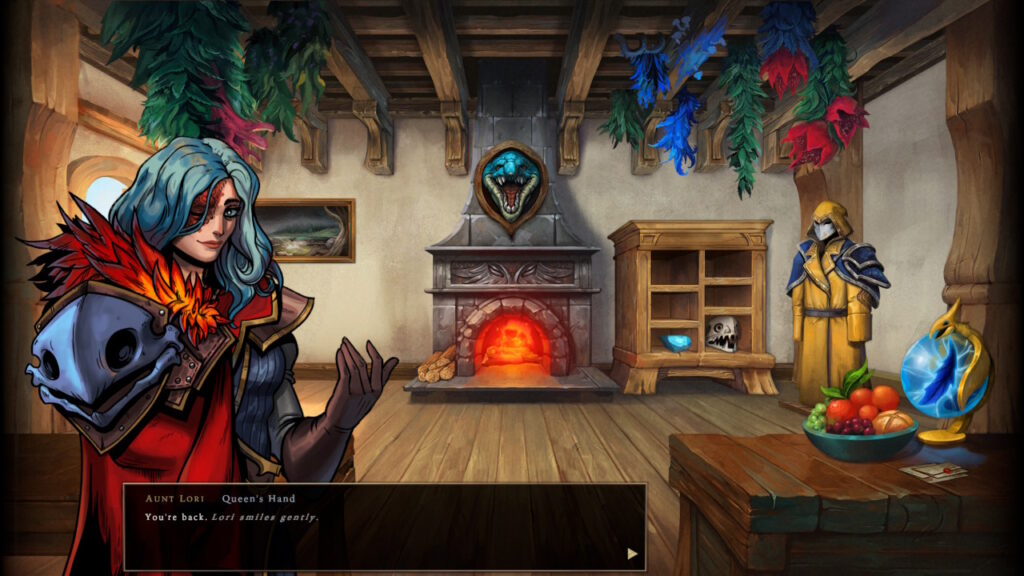
A more personal representation of my progress is my house. Like the landscape outside, this space is empty to start. As I complete Deeds—Against the Storm’s version of achievements—and reach certain milestones, new furniture and decorations are added to the room, the shelves fill with trophies and artifacts, and the cloak hanging on a mannequin, my mark of office, becomes more elaborate. This is also where I may converse with Against the Storm’s only actual nonplayer character, Aunt Lori, a master Viceroy who provides me with details about the world and personalized advice about my performance in my most recent settlement.
The most important element in the Smoldering City is the upgrade tree. Here, I may spend the rewards earned upon the completion of a settlement for upgrades that affect all future settlements. Most upgrades are small. They are also cumulative. 1% increased movement speed for my villagers may be imperceptible by itself, but after I’ve improved that upgrade a dozen times, it has a major impact on my settlements’ performances. The more uncommon upgrades have a greater impact on play, like adding more starting resources to every settlement. Purchasing enough of these lets me effectively skip some of a settlement’s early necessities, pushing me into the more varied mid- and late-game activities sooner. Against the Storm’s higher difficulty levels and more distant Seals can seem insurmountable at first. Taking the time and accepting enough losses to earn a few permanent upgrades makes them possible. I cannot be impatient if I want to succeed.
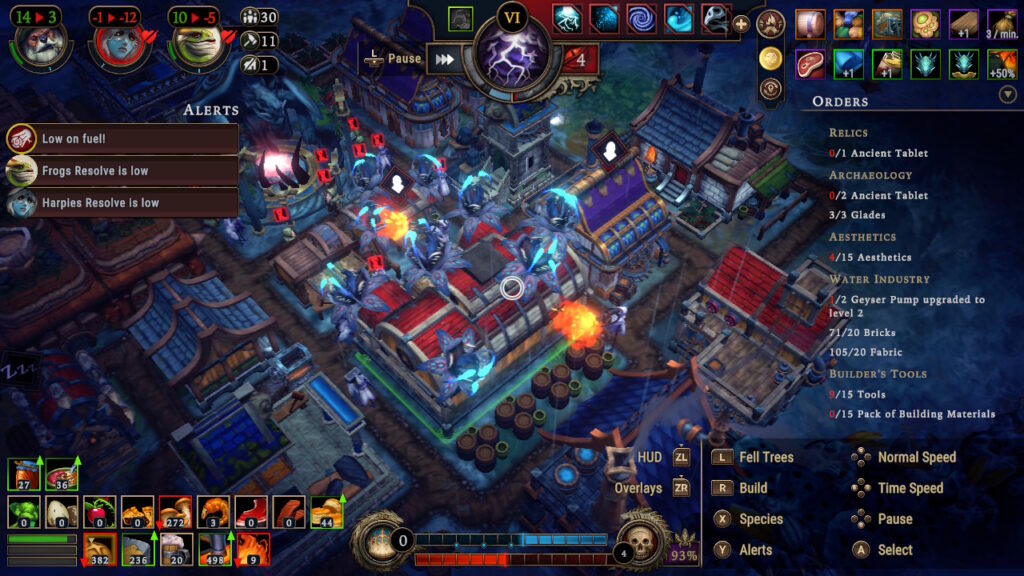
Against the Storm is an incredibly complicated videogame and what I have described so far, long and detailed though it is, covers only its broadest concepts. I haven’t mentioned some basic elements like housing, trading resources between settlements, and random map events because it’s simply getting into too much minutiae. Even these basics are not all Against the Storm has to offer. After I’ve had some success completing settlements, I gain access to new features. The most prominent is Rainpunk technology, steam-powered addons to buildings that utilize the cursed rainwater to enhance a building’s output. Rainpunk adds new risk-reward layers which I personally have barely explored even after finishing dozens of settlements across more than 100 hours of play.
The first time I played Against the Storm shortly after its PC retail launch, I found it overwhelming. The sheer number of factors to track and the overload of information dumped out from tutorials and in-game encyclopedias made me vibrate with so much nervous energy I had difficulty completing even one settlement. These feelings were enhanced by the randomization instilling a suspicion that everything I learned about success in one settlement might become useless in the next. That felt discouraging. As much as I loved Against the Storm’s premise and wanted to carry on playing, it simply felt better to walk away from it. I finished my first exposure to Against the Storm impressed and intimidated.
It was with Against the Storm’s console release that I returned and found the wherewithal to make it over that intimidating early hump. I have come to love this videogame. Many settlements feel like they are totally out of control, that no matter how much food, clothing, shelter, and entertainment I provide for my villagers, that I’m on an inevitable course for a loss. Then the win screen suddenly pops up. I’m so focused on trying to hold back what I see as an unfolding disaster that I don’t see the steadily filling blue bar marking my successes. I blink in surprise, take a breath, then start a new settlement and let it all begin again.
There have been two downloadable content packs released for Against the Storm at the time of this writing. At a minor level, they add new factors to be randomly drawn during the creation of future settlements. The more significant feature each adds is a new race.
The Keepers of the Stone DLC adds frogs. They are a sociable but haughty race; though their needs are more difficult to meet early on, their ability to increase the speed at which new settlers arrive lead to huge settlements and faster victories in the long term. They are also skilled sculptors, filling a conspicuous niche missing from the original five races through their skill at manipulating clay and stone. The Nightwatchers DLC adds bats. Bats are essentially the counterpart to Frogs. They remain the most insular of the Smoldering City’s refugees and their mood improves when there are more bats in a settlement than other races. To facilitate this, they add a unique building whose sole purpose is to slowly remove other races from the settlement.
While I appreciate the new complications that bats and frogs add to a typical settlement, if I were a returning player who had conquered all the Seals and hoped to find new things to do, I would be disappointed. The new races slide seamlessly in with the old ones; if I didn’t know they were added by downloadable content, I wouldn’t know they were anything new at all. Both add new possible tangled paths to a victory state but neither adds whole new events or goals beyond the ones in the original endgame.
It would be too dismissive to say Against the Storm is unchanged by the addition of these DLCs. It would also be too generous to say that their presence feels significant. They’re another variation on a videogame with which I have become deeply familiar. They don’t add anything new to work towards. In this regard, I consider them disappointments. If I were bored with Against the Storm, they would not change my mind. Keepers of the Stone and Nightwatchers are best enjoyed by all-new Against the Storm players who may regard them as part of the baseline package.

Allow me to add my voice to a chorus who have thundered the windows for years: Against the Storm is an impeccable videogame. Like my first tentative steps into playing it, I feel intimidated writing this review; Against the Storm is too complex to describe succinctly and too good for me to be pithy. It’s a masterclass in systemic design and using setting to contextualize mechanics that would otherwise feel abstruse and contrived. If I were to summarize it as a feeling, I would say that it’s like a stressful job trying to appease a boss who is usually patient and accommodating, is randomly unhelpful, and rarely outright spiteful. I’m concerned about how much I have come to enjoy this. I wonder what it says about me and my own relationship with work and those responsible for managing me. I think it takes a specific kind of person to fall in love with Against the Storm. If you’re that specific kind of person, it will keep you enthralled for hundreds of hours.