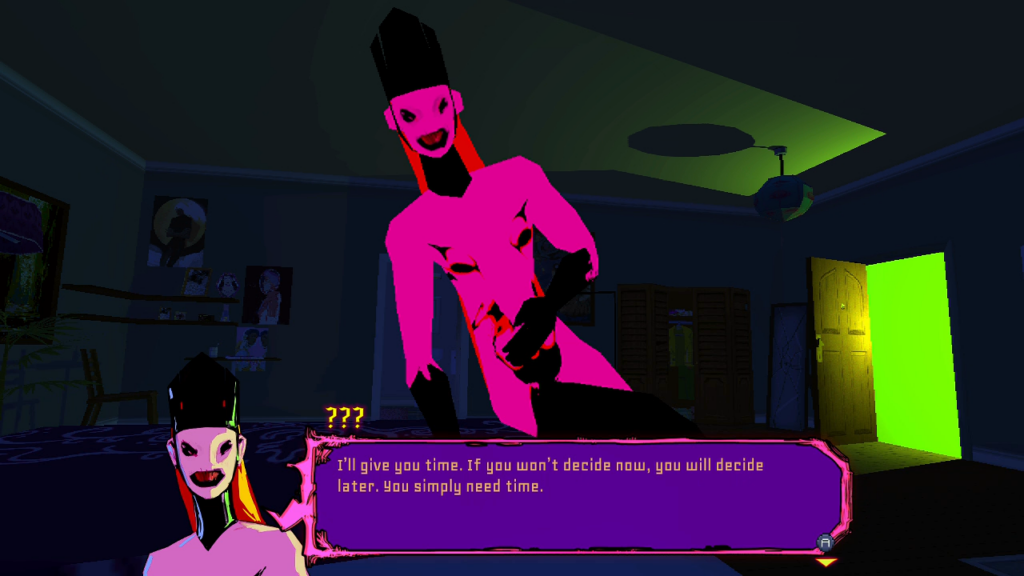
Sorry We’re Closed is a retro survival horror adventure videogame with prominent queer themes and characters that styles itself as a talkative and colorful reimagining of 32-bit genre classics like Resident Evil and Silent Hill. I play as Michelle, a depressed woman who sleepwalks through a grating service job following a breakup with her girlfriend. Her difficult life gets worse when she is visited by The Duchess, a fallen angel who believes they can gain re-entry into Heaven by obtaining the love they once received through God from a mortal. The Duchess’ scheme is undermined by their uncanny appearance, sadistic tastes, and inability to understand consent or affection; they do not make an appealing romantic partner. Michelle is the latest in a line of The Duchess’ benighted paramours. Cursed with a mystical Third Eye revealing her seemingly-ordinary English street is filled with hidden angels and demons, Michelle recruits the aid of old friends and new to convince The Duchess that she is not interested in a relationship—by any means necessary.
The primary way Sorry We’re Closed captures the spirit of foundational survival horror videogames is through its use of fixed camera angles. Wherever Michelle travels on her cozy city street and the hellish spaces adjacent to it, my view is locked to a single camera perspective. When Michelle steps beyond a certain point, the camera automatically cuts to a new angle.
Life is given to these angles by allowing the camera to move. Sometimes the frame will follow Michelle up and down the street or along a hallway as she walks through them. At other times she will step into the intersection of a corridor and the frame will jump to the far end of the new hallway, with Michelle now walking towards the newly static camera. These techniques give the visuals a cinematic and often dynamic presentation that resembles the B-grade films the original Resident Evil sought to emulate. This is the funny reality of retro videogames that emulate the first installments of Capcom’s seminal survival horror series: They homage videogames that homage low budget horror films.
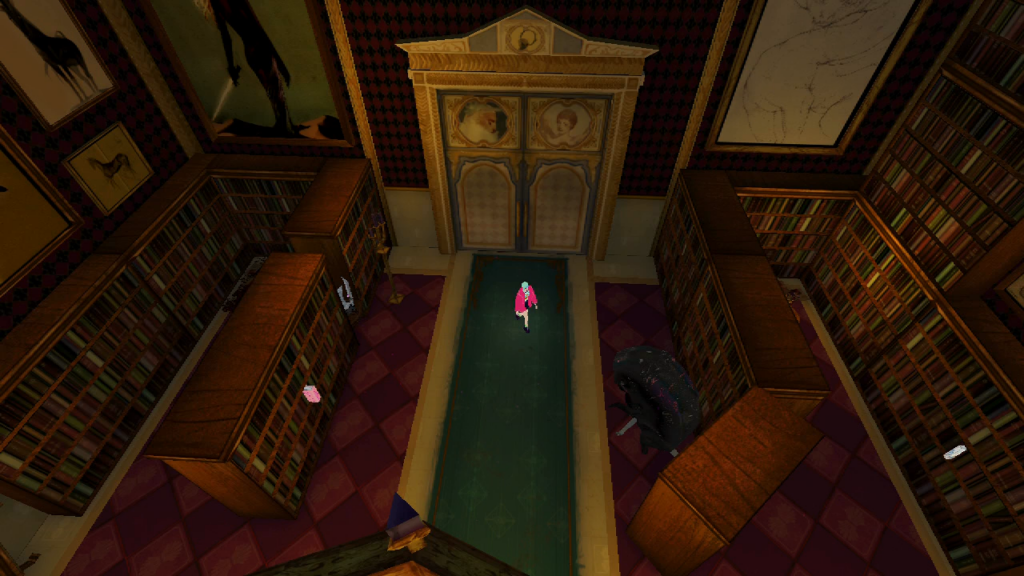
Mentioning the original Resident Evil comes with it the terror of its most notorious legacy: tank controls. There’s an input challenge for designers to overcome when a player character must be guided through a polygonal space represented by constantly shifting camera angles. Capcom overcame this challenge by assigning the gamepad’s up input to always move the player character in the direction they are facing instead of relative to the camera frame. This choice causes the player character to trundle forward, backwards, and pivot on a point like a tank.
Sorry We’re Closed avoids this problem by keeping its camera cuts simple and coherent. There are few, if any, places where Michelle will move between different perspectives and find her orientation changed. Forward is always forward, back is always back, and left and right are always left and right no matter how many cuts Michelle travels through. When there are large differences in perspectives, there are definitive transitions like doors and stairwells between them which must be activated with an action button. This allows Sorry We’re Closed to default to a familiar “modern” control scheme, where Michelle’s movement is always controlled relative to the camera angle. Genre purists may enable classic tank controls from the options menu.
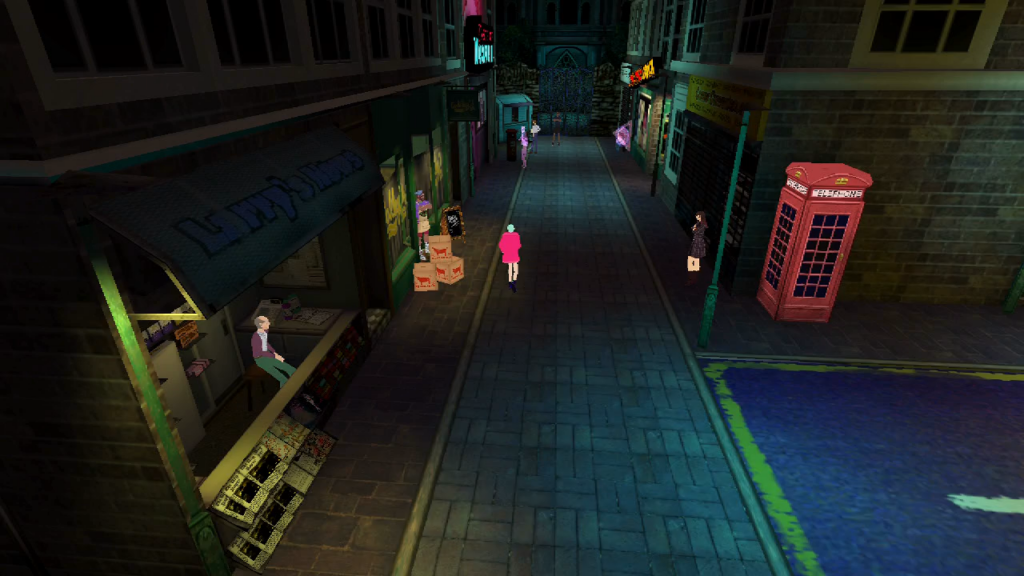
Michelle’s mission to rid herself of The Duchess’s unwanted attention takes place across three nights. Each nights goes through distinct phases where Michelle may perform different activities. The first phase of each night takes place in the early evening, in the street near Michelle’s apartment and the convenience store where she works. This is a social phase where Michelle may step into shops and visit with her friends. Larry runs a newspaper stand and happily lets Michelle browse articles for free, keeping her appraised of the events around the neighborhood. Many of the events the articles describe are secretly entwined with The Duchess’s machinations, subtly informing Michelle and myself of the villain’s plots. Next door to the convenience store is a record shop where Michelle’s friend Marty works. It’s a popular neighborhood hangout, but Marty’s real passion is Demonology. He gossips with his customers about the suspicious happenings around the neighborhood, never suspecting his friend’s deep involvement in them. Across the street are a nightclub and diner whose owners, Darrel and Oakley, are in a relationship.
The second phase of Michelle’s nightly excursions brings her to the derelict areas of her neighborhood. A shuttered subway station, an abandoned aquarium, or a disused crypt would be unsettling places to visit after nightfall under normal circumstances. With Michelle’s life now touched by the supernatural, these creepy locations are given a boost of the macabre. The subway terminal’s narrow hallways are made even more treacherous by hellish thorns that line its floors and walls like razor wire. The aquarium’s winding passages are made more oppressive by the rusty surfaces framing glass holding back filthy, fetid water. The crypt is built on a border between the angel, demon, and human worlds where perspective has lost all meaning. The fixed camera perspectives through which I view Michelle’s world are made even more diabolical when she steps through a doorway and finds herself walking on the wall or ceiling of a room she just left.
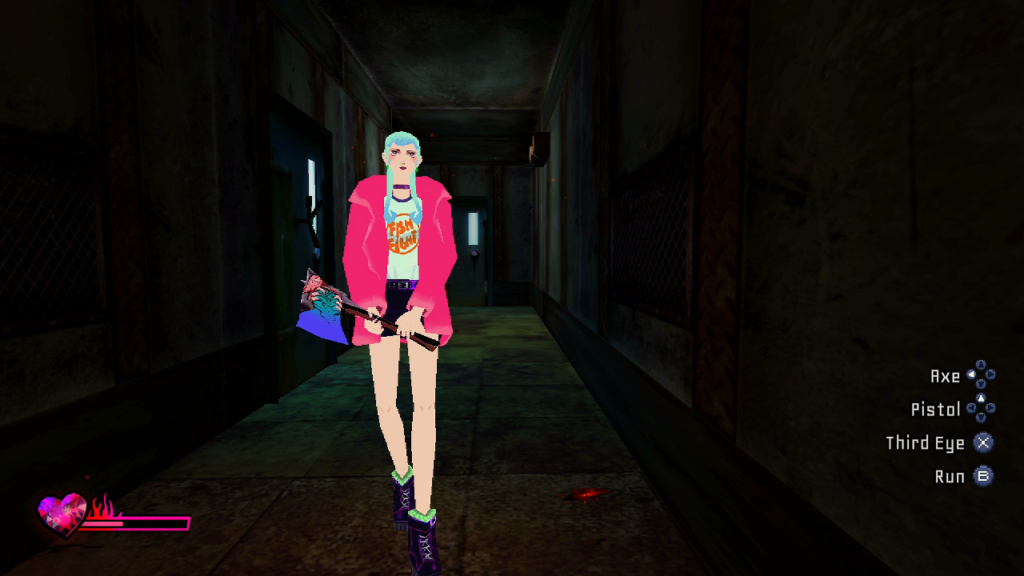
It is in these locations where Sorry We’re Closed most closely imitates classic survival horror level and puzzle design. Each haunted location hides one of the macguffins Michelle needs to disrupt The Duchess’ grasp on her soul. Only by searching each space thoroughly, using keys to open locked doors and unexpected components to complete puzzle boxes, will Michelle be free.
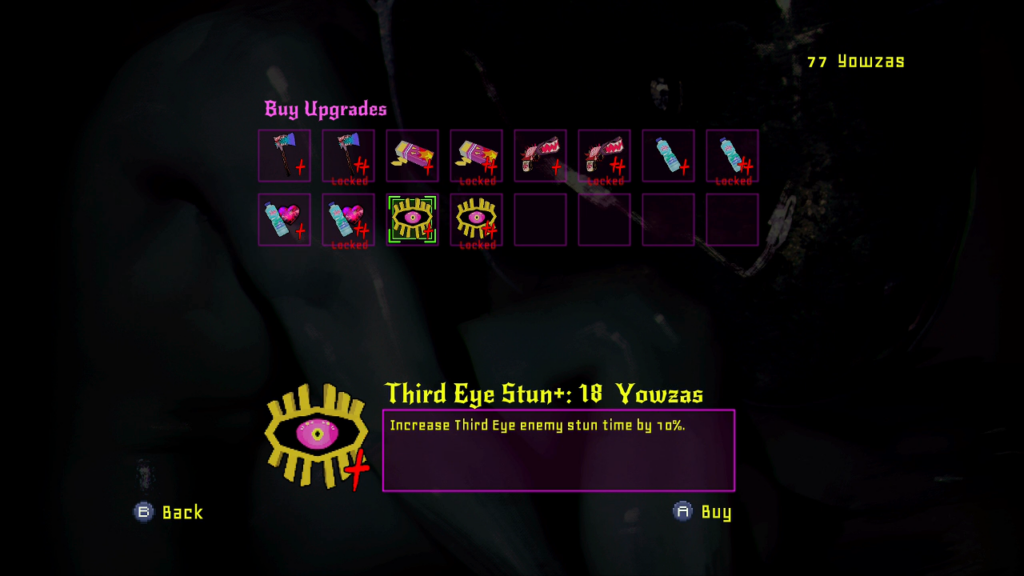
Not every item Michelle discovers during her excursions are used for puzzle solving. Objects as diverse as demonic artifacts, unusual cooking supplies, and random knicknacks with unique textures may be delivered to different NPCs in exchange for a currency called Yowzas. Yowzas, in turn, may be spent on small boosts to Michelle’s performance, injecting a light amount of RPG character building to the otherwise traditionally survival horror design.
To underscore Sorry We’re Closed’s classic design, when Michelle succeeds in her mission in each dungeon-like area, her performance is rated, just like at the conclusion of an escape from the Spencer Mansion, Raccoon City, or sleepy Silent Hill. Quickly finishing a dungeon and using fewer resources in the effort earns her a higher rating. After I have beaten Sorry We’re Closed, I may replay any dungeon from the main menu in a Time Attack mode to try and improve these scores. Discouragingly, there seems to be no incentive for doing so besides personal improvement and, perhaps, achievements on platforms that support them.
An important part of Michelle’s abilities is her Third Eye. Bestowed upon her by The Duchess upon marking Michelle as their latest conquest, it sits invisibly on her forehead until I prompt it to open with a button press. Once opened, the eye highlights a sphere around Michelle, unveiling how spaces appear to angels and demons. These glimpses can be decorative, revealing fire-scarred wood paneling, filthy wallpaper, and decaying plants beneath the veneer of a posh hotel hallway, or practical, allowing Michelle to make an impassable barrier disappear, turn a fetid water source into a bountiful recovery spring, or let her retrieve items that have disappeared from the human world.
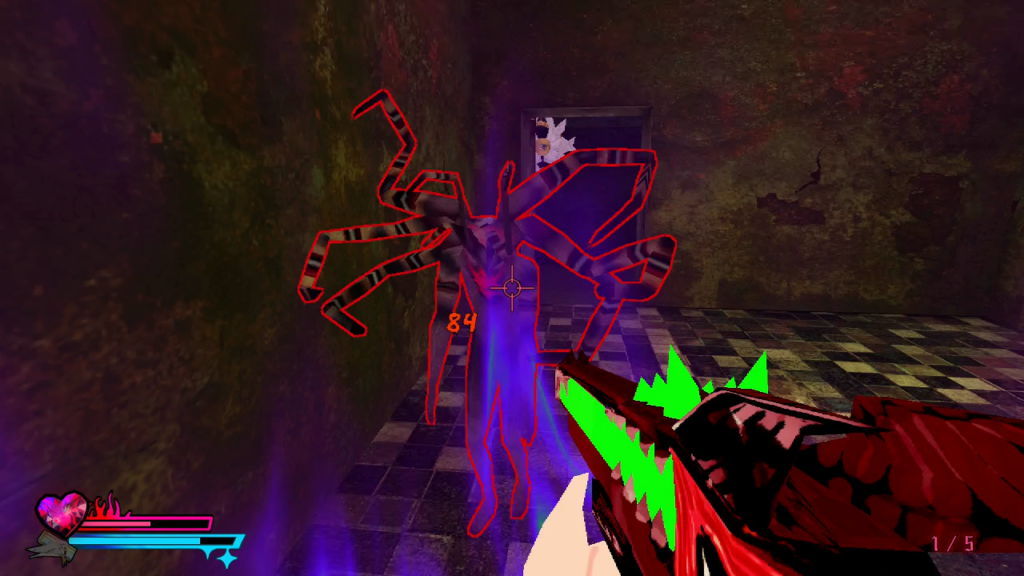
While exploring the night’s dungeon, Michelle is menaced by the demons who wander its rooms and corridors. To defend herself, she is outfitted with an arsenal of supernatural weaponry. Holding down a button directs Michelle to point and aim her weapon. This is where Sorry We’re Closed makes its most dramatic departure from survival horror conventions: Raising Michelle’s weapon shifts my perspective of the world to first-person, putting me behind her eyes as she defends herself from the crawling horrors that stand in her way.
Each implement Michelle wields fits into the familiar form and function of typical survival horror weaponry. The simple pistol Hellhound is her primary means of defense. Its ammunition is the most plentiful and it may fire with the most accuracy from the longest range, but it is also the weakest and its use is limited against large groups. The shotgun Hellfire is Hellhound’s deliberate counterpart. It has great stopping power and impressive spread, but that same spread makes it less effective the further Michelle is from her target. When Michelle’s magazines are emptied, or when the local demons are just too puny to waste bullets on, she can swing an axe to dispatch her foes.
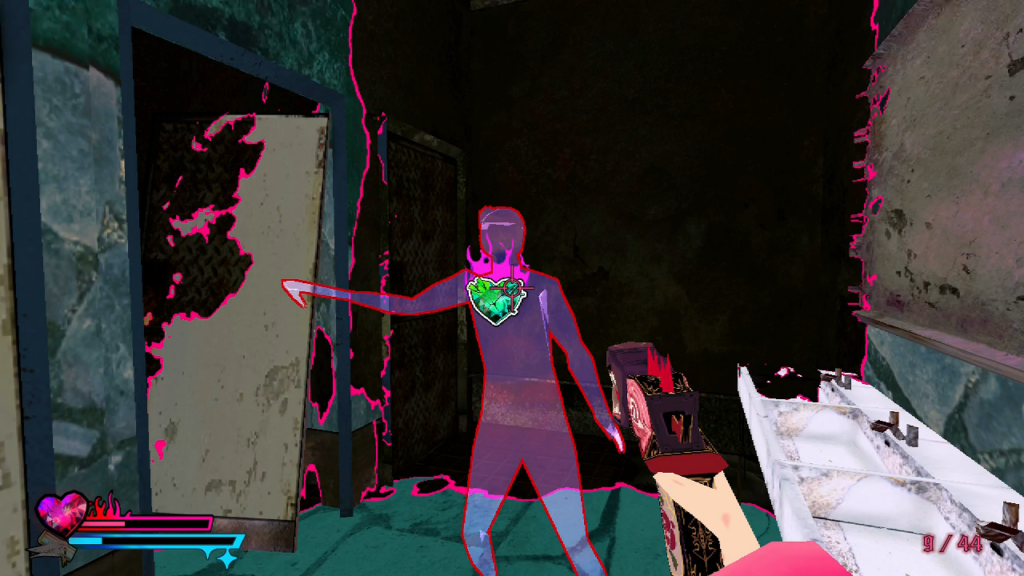
There are times when unloading a clip into a demon is the best choice Michelle can make. This is never the most efficient way to put them down. The most resource-efficient way is enabled by Michelle’s Third Eye. When a demon enters the Eye’s sphere of influence, Michelle is able to see a frozen heart hidden somewhere in their body. A single hit to this heart from any weapon will shatter it, briefly stunning the demon and causing another heart to appear. Shattering all of a demon’s hearts will kill them outright. The tougher the demon, the more hearts it possesses. If I can steer Michelle’s aim quickly and accurately enough, her target is dispatched for a minimum of ammunition.
Aside from the obvious benefits of efficiently killing Michelle’s enemies in an environment where ammunition is scarce, putting down demons by this method has a second bonus. Michelle’s most powerful weapon is an ancient weapon called The Heartbreaker. It can destroy all of a demon’s hearts in a single shot. Some of the most powerful demons Michelle encounters may only be permanently eliminated with this weapon. The catch is the Heartbreaker is powered by destroying demon hearts with Michelle’s other weapons. Some of the obstacles Michelle encounters, including Sorry We’re Closed’s most titanic and puzzle-like encounters, can only be overcome through skillful elimination of demon hearts and judicious application of the Heartbreaker.
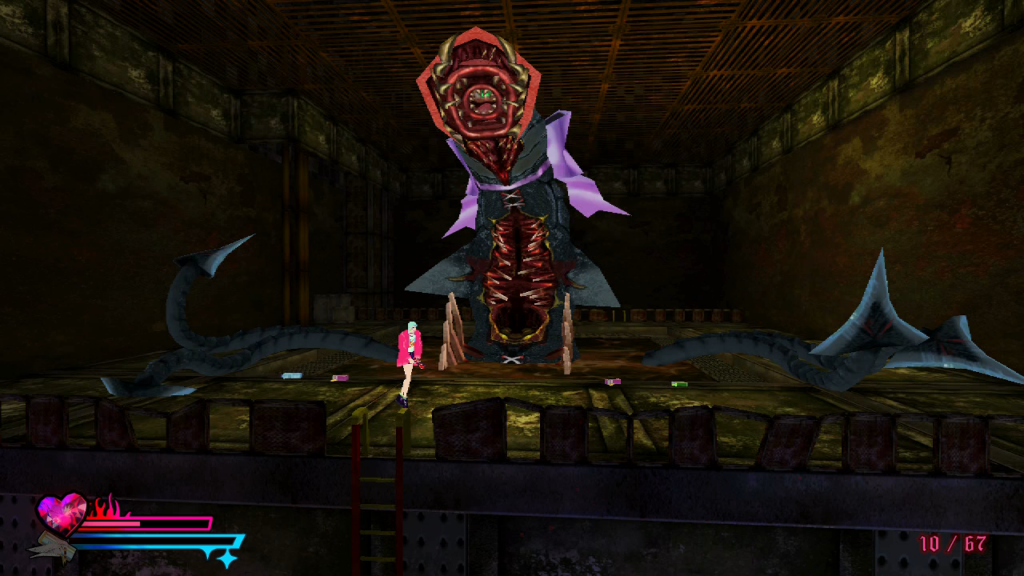
The problem with killing demons by targeting their hearts is the Third Eye’s limited range of influence. Any demon close enough to have its weak points revealed by the Third Eye is also close enough to strike Michelle with a horrible claw or ravenous bite. Demons are briefly stunned when the Third Eye first opens but this effect is so brief that it barely makes a difference. A few upgrades purchased with Yowzas turns the stun from imperceptible to negligible. Michelle will inevitably get hit and suffer a small amount of damage to her health.
Michelle’s health is restored when she drinks water. In the first few nights, water sources are common and bottomless. If I choose, I can have Michelle fight every demon in a dungeon one at a time, poking at all their weak points with her axe, and retreating to the last faucet or drinking fountain to restore any lost health lost in the clumsy melee. All this costs is the effort of running back and forth. This strategy stops being viable as later dungeons have no water sources. In these situations, Michelle is forced to rely on single-use water bottles hidden around each environment. Like ammunition, these bottles are deliberately scarce. If this limitation proves too much of a challenge, I may gift Michelle with an infinitely usable water bottle from the option menu. I don’t struggle with Sorry We’re Closed on its default difficulty. I am never tempted to take this mercy.
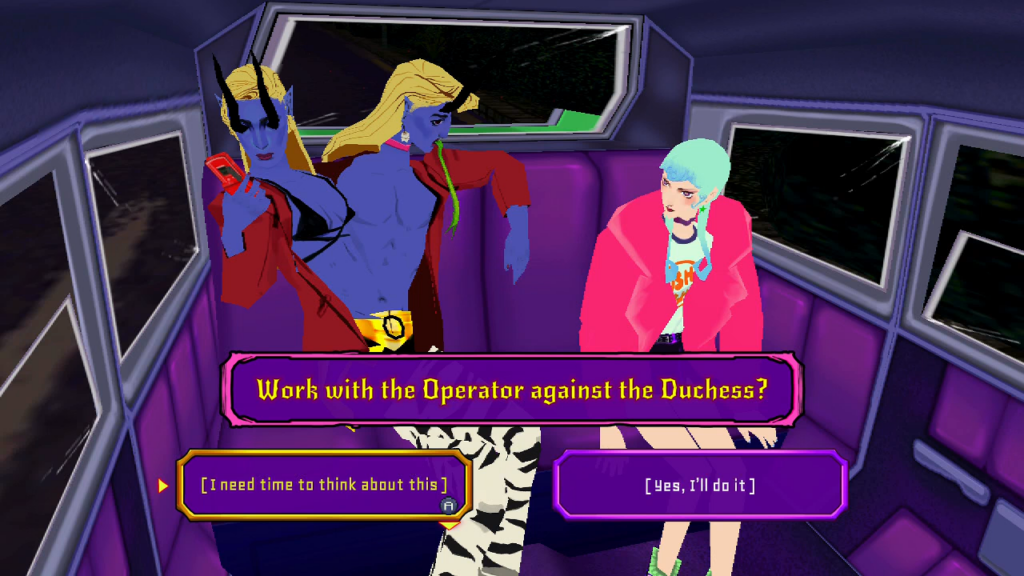
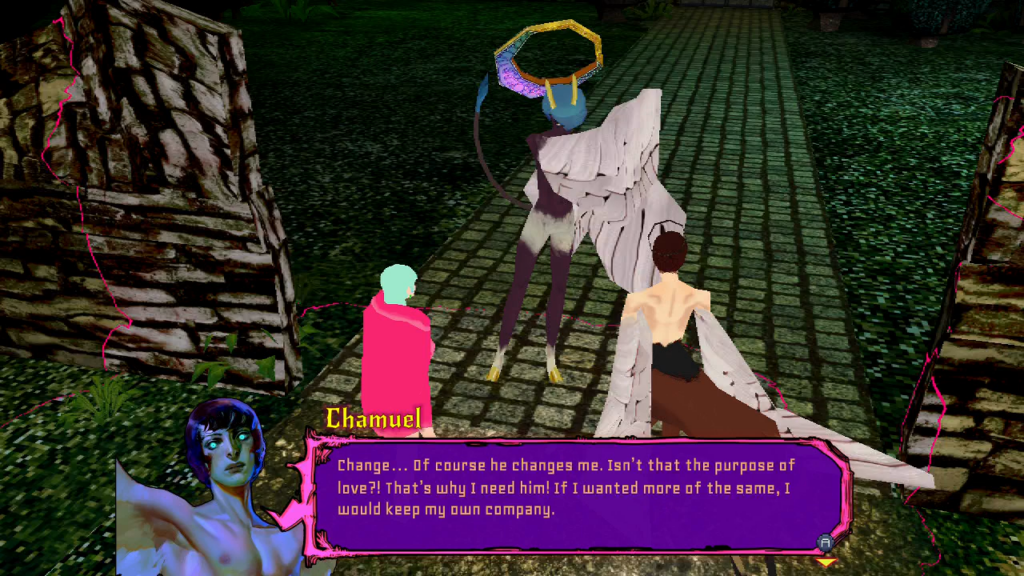
There are many narrative branches Michelle may follow through her three nights of struggle, leading to one of four possible endings. Outside dungeons, Michelle’s awakened Third Eye grants her the ability to see the angels and demons who visit her street. Several ask her for favors. The angel Clarissa wants Michelle to undermine the hotheaded Darrel, The Duchess’s lackey-slash-business manager, by sabotaging his relationship with Oakley. Michelle can play along with Clarissa, or help Darrel be a better partner to Oakley. Chamuel, a delicate angel with a youthful face, is on the verge of losing his divinity because of his romantic feelings for a demon. The ironically named Beloved, unable to convince Chamuel to abandon the relationship, asks Michelle to intervene. Michelle can support Beloved or Chamuel, but she cannot do both. Almost every NPC is ancient and divine, making a prospective deal with any of them perilous.
The choices Michelle makes, including choosing to ignore them entirely, open and close narrative gates that determine which endings are available when she arrives at the final area. She visits the same locations regardless of which gates she opens, following the same route through the plot in every instance. I won’t see the impact of her choices until the narrative nears its conclusion. It is the the context of her visits to each location that are changed by the gates; the characters she encounters and what they say to her shift based on her choices. When Michelle reaches her story’s climax, the endings available to her depend on which NPCs are around for her to speak with.
The exception is Sorry We’re Closed’s worst ending. Mechanically speaking, reaching it is much more complicated than the other three endings. It is so difficult to reach because its motivating factors are antithetical to what the narrative has to say about love. Giving love away, according to this story, is the best thing someone can do for another individual if it’s done willingly. Most of Sorry We’re Closed’s endings are straightforward to achieve because they all involve simple acts of love, either by helping Michelle’s companions express their love to their partners, or by helping Michelle to willingly give her own love away. Even the lukewarm, middle-of-the-road ending is built on the simple act of Michelle telling another person she isn’t interested in a relationship; not giving away love when you don’t feel it is also important.
The worst ending defies this aesop. It involves Michelle cutting a deal with a demon to force her ex to reciprocate Michelle’s feelings. This deal makes the protagonist little different from The Duchess. Getting this ending requires making several arbitrary choices and once obtained, its conclusion is unsatisfying—as it should be, because love given unwillingly is not fulfilling to its recipient. It is not real love. This is the lesson The Duchess must learn, and the lesson Michelle should already know at the narrative’s start. Her fate in her worst ending is her punishment for ignoring that wisdom.
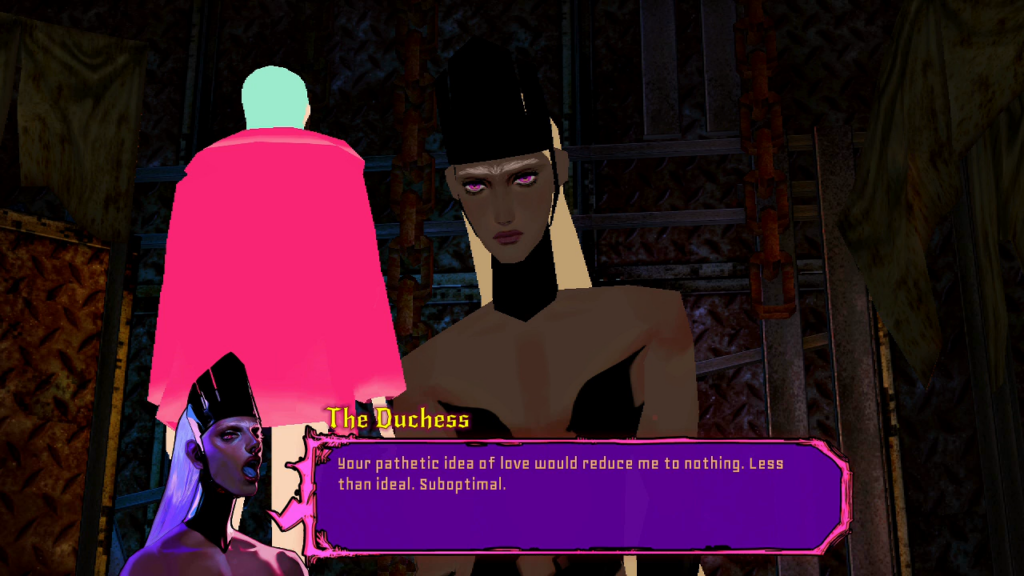
Sorry We’re Closed exalts in colliding contrasting ideas and feelings against each other. The old school survival horror design, lifted straight from classic Resident Evil, is matched against a narrative that explores the difficulties and virtues of being invested in a romantic relationship. Slow, tense gunplay in cursed environments filled with blood and horror is contrasted against a quaint English neighborhood home to an eccentric queer community. Bleak environments filled with grey, brown, and red clash with the neon color palette of the characters; Michelle wears a bright pink coat through her whole ordeal like it’s a flak jacket. This is a wonderful videogame that puts new life into old ideas and injects some original and brain-bending perspective-based puzzles along the way. Sorry We’re Closed is an easy recommendation for horror fans looking for something fresh and off-kilter.