The developer provided Play Critically with a review code for this videogame.
Messy Recipe: A Hidden Objects Game is a simple puzzle videogame about putting together recipes using ingredients strewn around a cluttered kitchen. I play as a nameless and faceless player character who is housesitting for their friend Kiko. We soon find that Kiko’s house is haunted by a ghost named Bouillon, a chef whose clumsy eagerness to help the player character prepare their regular meals becomes a friendly and comforting game. In order to complete each meal, I must locate the needed ingredients spread across the cavernous kitchen by Bouillon. As I complete each recipe, time passes and I learn more about Bouillon’s relationship with Kiko, whose return comes closer with every passing day.
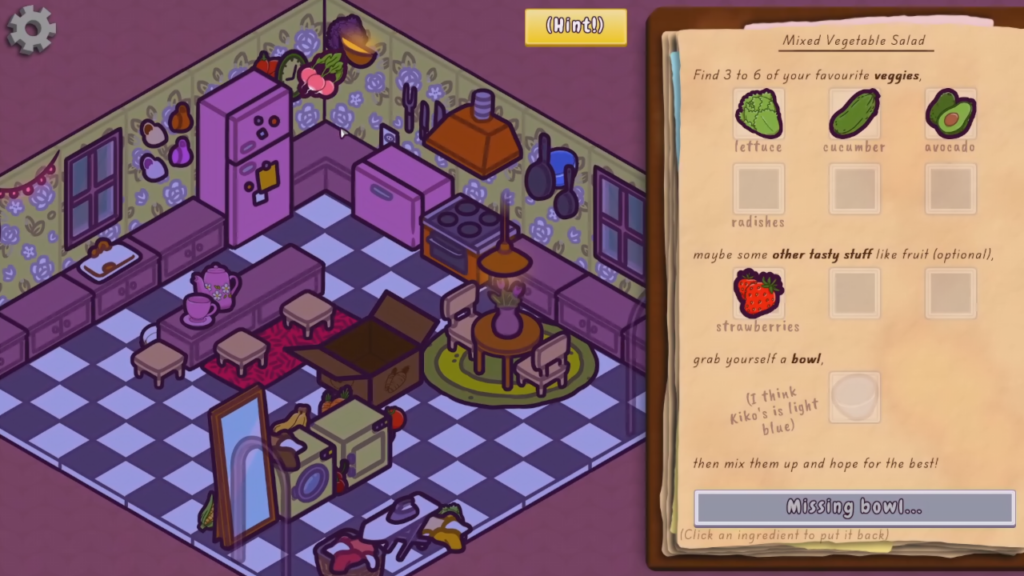
Messy Recipe is played through two windows. One window displays Kiko’s kitchen. It’s such a massive room that Kiko has moved in a washer, dryer, piano, and multiple seating areas just to fill in the empty space. The kitchen’s size is inexplicable for practical reasons. For videogame design ones, it’s a great space for spreading out the many ingredients and tools the player character uses to make their meals.
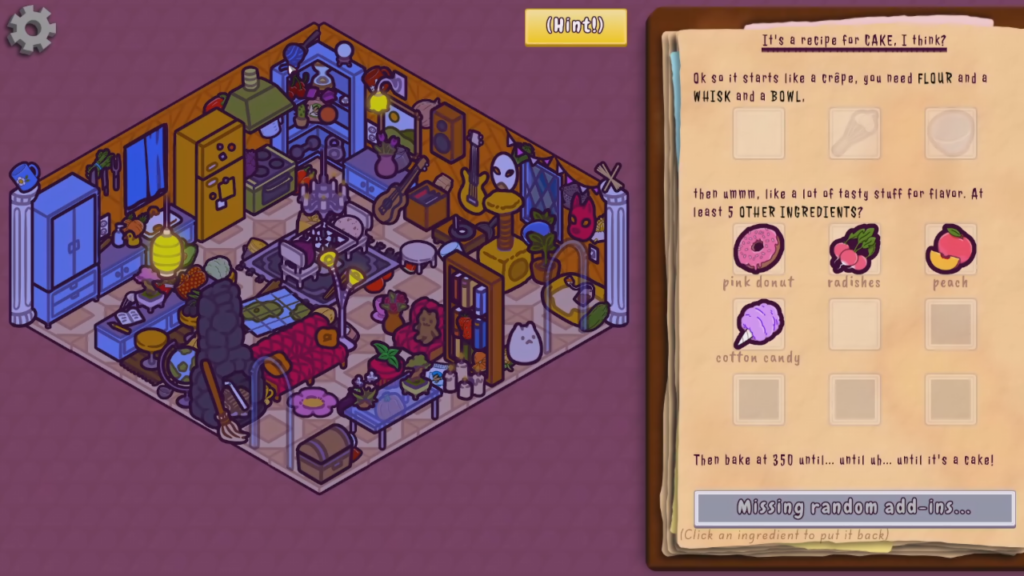
The second window shows a page from a recipe book that instructs how to prepare that level’s dish. Each ingredient or implement needed is represented by a large, empty box in the recipe. I fill in these boxes by selecting objects from around the kitchen. Some boxes may only be filled in with a specific item from the kitchen and are represented by a faint silhouette of that item. Other boxes allow for more improvisation; they may be marked with vague notes about what may work, or else have nothing in them at all. It can take some experimentation to discover which ingredients work. Most recipes are straightforward and the ingredients needed to complete them, even when unmarked, are obvious.
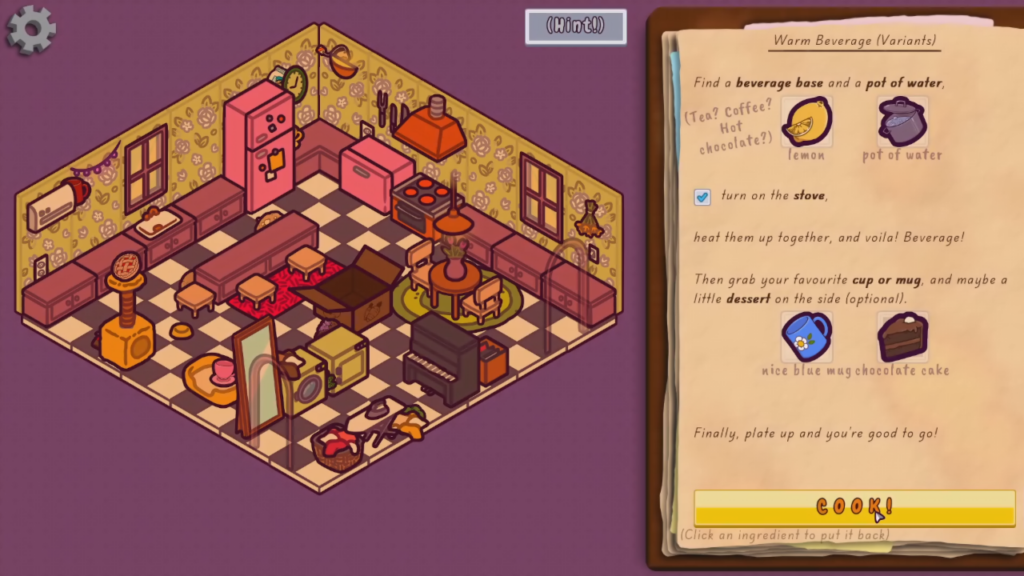
In most videogames with cooking minigames or activities, I expect there to be some element of skill or timing involved in completing a recipe. Ingredients must be placed in the right order, machines turned on or off at the correct time, and stirring, whisking, and mixing is represented by gyrations of the mouse or joystick. Messy Recipe is not this kind of cooking videogame. The puzzles created in its two windows are purely a matter of identifying and selecting the correct ingredients and tools. If I have filled every box with the correct ingredients, then the “Cook” button highlights and I may complete the level. If I have not chosen the right ingredients, then the recipe will not allow me to finish until I remove and replace the correct ingredients.
What makes selecting ingredients and tools engaging is how they are distributed around the room. Each puzzle begins with the needed ingredients and many more unneeded ones placed inside a box. When the box opens, its contents are spread across the room by a harmless explosion from an apparently excited Bouillon. This process is randomized. Every time I replay a puzzle, the ingredients I have to choose from will be the same, but the places where they land in the room will be different.
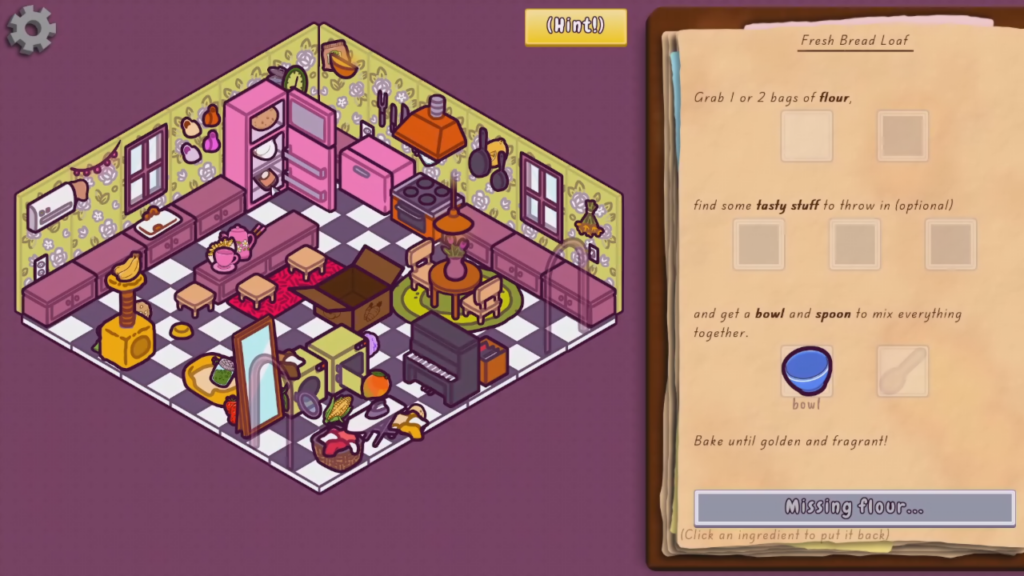
The kitchen’s furnishings further complicate completing each recipe. The explosion flings some objects slightly behind appliances, beneath tables and chairs, and under rugs. I must learn to identify items when I can only see a small portion of their icons peeking out from obstructions. Other items even impossibly end up inside containers, like inside the piano, the cat tree, the dishwasher, and the refrigerator. A simple click opens their doors so I may examine what items are hidden inside them.
While this random distribution of items among furniture and appliances is a good twist for Messy Recipe’s simple puzzles, after a few short levels I recognize its limitations. Despite the comical size of Kiko’s kitchen, the hiding places inside it are still small in number. It quickly becomes routine to circle through the room with my cursor, checking inside objects like the refrigerator and the curtains to see what items are hidden inside them. Once this routine sets in, every puzzle begins to feel fundamentally the same, barring the slightly unique different ingredients needed to complete them. The mechanics to solve them never change.
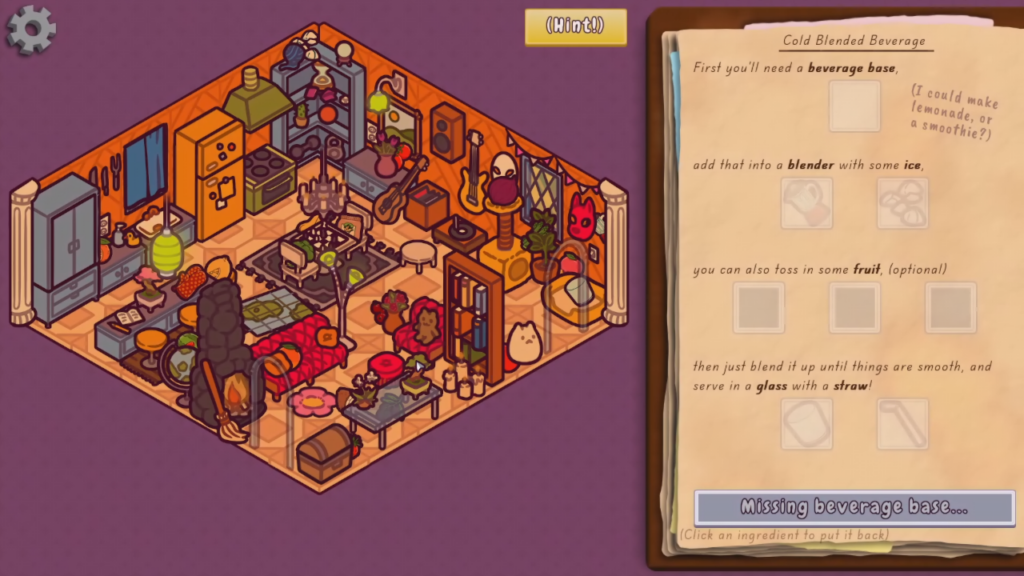
There is some effort made to create variety. A few times during the player character’s stay, Bouillon rearranges the kitchen’s existing furniture and adds a few new pieces. These refreshes add some new objects where ingredients may be hidden and more clutter for them to fall behind. I appreciate the effort but it doesn’t succeed in making later levels feel new or more challenging. It feels like what it is: A few new pieces of furniture shoved into the same space. Once I’ve identified which pieces may be opened to reveal hidden ingredients, they enter the routine, and solving each puzzle feels much the same as it did before.
Messy Recipe’s cleverest trick is exploiting the excess number of provided ingredients and the improvisation allowed by the recipes to allow multiple valid solutions for each puzzle. Each level has a broad theme, like baking bread, making a soup, or preparing a pasta dish. The ingredients I choose from the clutter determine exactly what variety of that level’s theme is produced. While baking bread, most of the ingredients are the same, but the final loaf may turn out to be white, whole wheat, or herb-baked bread, depending upon if a few specific ingredients are included or excluded from the recipe.
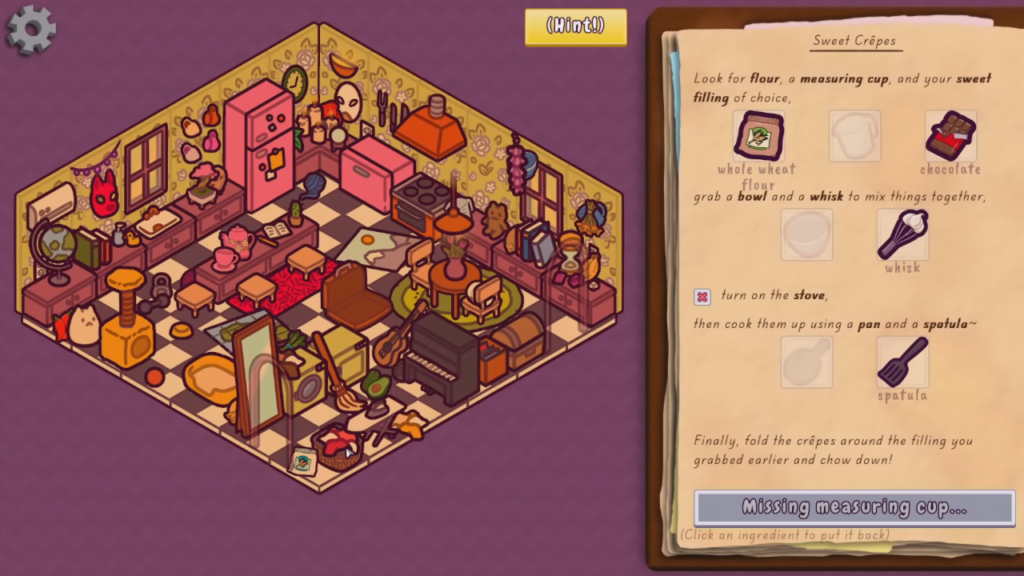
To finish any level, I need to find one valid solution to its puzzle. Once found, I may replay any level as many times as necessary to find the needed ingredients for every variation on a recipe. Like Messy Recipe’s other elements, this is simple. Most recipes only require a few obvious substitutions to change the outcome. Often, the recipe card will have notes written in its margins indicating what these substitutions should be. Actually finding them among the kitchen’s detritus takes more effort. Only the final puzzle, which has the most variations and the most nonsensical ingredients, takes any great amount of concentration to complete.
Each level is bookended by a short narrative sequence where my player character recalls their day or reads a letter from Kiko. It takes a few levels for these sequences to build up a dramatic thrust. This lets me stay focused on learning where ingredients may be hidden in the kitchen and not on digesting weighty character dynamics. It also crowds out space for anything to happen in the narrative. I am almost halfway through the ten levels before anything happens at all.
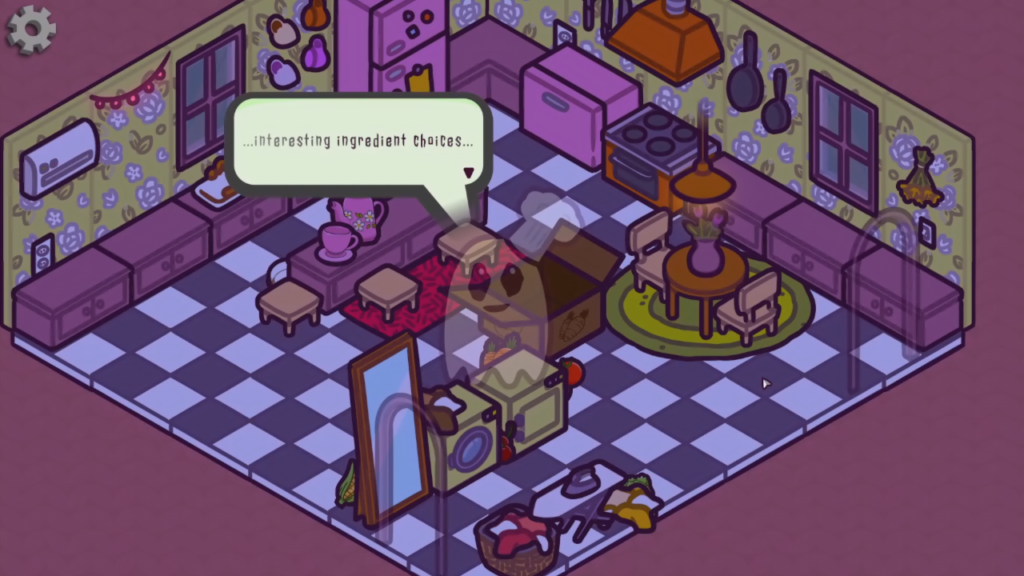
Messy Recipe’s emotional core is the ghost chef Bouillon that haunts Kiko’s kitchen. They are a timid and accommodating figure. It takes several nights before they properly reveal themselves to the player character, though the pair soon become firm friends by bonding over their shared interest in cooking. Through their conversations, it becomes clear that Bouillon is close with Kiko too. A conflict arises when Kiko’s letter reveals that she will be moving out of her apartment after her trip. The letter warns the player character not to tell Bouillon, who will not be able to join her.
This revelation should be the slope upon which Messy Recipe rises to its climax. Bouillon is not a deep character. They appear as a stereotypical white sheet ghost with a blank, smiling face. Their single distinguishing feature is a chef’s hat, marking their occupation in their afterlife. They are still an appealing character. They have an innocent and demure personality with hints of playfulness that manages to shine through despite the limited dialog they are afforded. My impulse is for nothing bad to happen to them, and I immediately feel concern for how they will react to Kiko’s departure. The entire issue is dismissed within a single level. The situation should make me feel concerned for Bouillon. Instead, the resolution makes me feel nothing for them since they will apparently be unaffected by the change. An opportunity for a sad or bittersweet ending is spoiled for a neutral one.
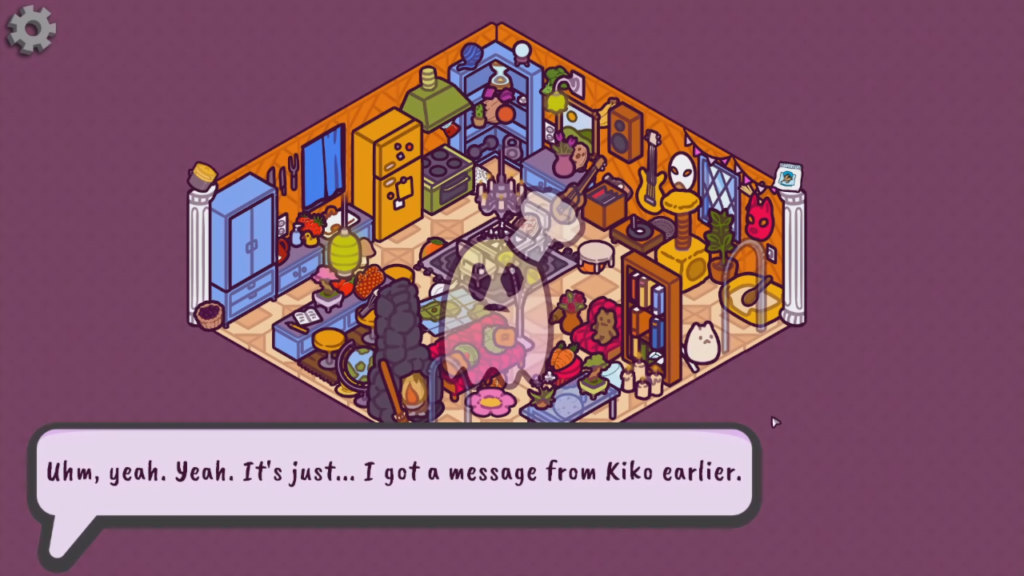
When I play Messy Recipe, I am constantly aware of its limitations. There are ten levels in total; I feel there should be more. Every level takes place in a single environment that only changes two or three times; I feel there should be more. Reaching the ending takes about twenty minutes and completing every recipe takes about ninety; I feel it should be longer. The narrative’s conflicts are resolved with little actual difficulty for anyone involved; I feel it should make braver choices. Sometimes a videogame being short and simple is a point in its favor. It offers exactly the amount it needs to feel rewarding for the player then ends before it overstays its welcome. I cannot bestow this compliment on Messy Recipe. It leaves me with a feeling of dissatisfaction.
Messy Recipe was not made for me. It is not suited for an intense play session followed by analysis of its interacting and intersecting systems. Completionists will dash through its short length then dash it off their backlogs, already forgetting it as they hurry on to a new list of achievements. Hardcore players will scoff at its friendly visuals and gentle activities and click away, never giving it a chance at all. Messy Recipe was not made for them either. I would not be doing my job as a critic if I exclusively considered these elitist, discerning perspectives when evaluating a videogame. It is true that there are times when I only need to consider my own expectations and biases when writing a review. The videogames with the broadest appeal, where it is presumed most players already have a general idea of what they will encounter, are where I am most free to be this insular. I am already speaking to my bubble. Messy Recipe is not that kind of videogame.
It is with this in mind that I urge myself to look past my misgivings to Messy Recipe’s strongest qualities. Its premise is simple, its graphics are appealing, and its scale is easily managed. I imagine the kinds of players who may enjoy a videogame with those qualities. I see a harried remote worker squeezing in one or two puzzles between service calls. I see an exhausted professional, with no time or energy to play an epic RPG or demanding live-service shooter, finding satisfaction in finishing a short and uncomplicated puzzle videogame after an easy evening meal. I see a parent with a toddler on their lap, introducing their child to a simple videogame in preparation for bigger and deeper videogames in years to come. Messy Recipe is not for me. It is for them. I’m not going to be so arrogant as to say they should not enjoy this videogame. I do not wholly enjoy Messy Recipe. I believe they will.