There are three kinds of videogame sequels. The riskiest are the transformative sequels. These take something familiar and reimagines it in a new context or design philosophy. When done badly, transformative sequels alienate previous fans and isolate new ones, creating fractured, polarized communities. Executed well, they enflame the old guard while ushering in a new one and tend to be the best-remembered among all videogames. The simplest are additive sequels. Cherished by fans and scorned by detractors, they offer more of the same experience, oftentimes feeling like they could pick up immediately after its predecessor’s final level without missing a step. The safest and most common are the iterative sequels. They cannot accurately be called the same videogame as their predecessors; they have a unique setting, refined mechanics, and a new narrative, creating a distinct experience. A sense of déjà vu still pervades iterative sequels, never letting the player forget that what they are playing may be newer and probably even better, but it cannot overwrite the memory of what came before. Sometimes relying on this memory is the entire appeal.
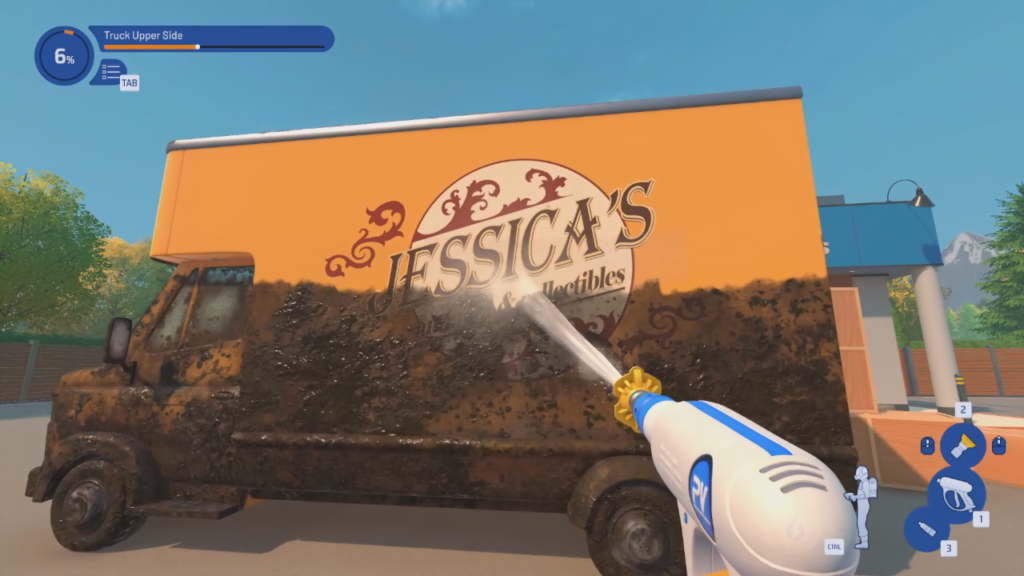
PowerWash Simulator 2 is the sequel to one of the most satisfying videogames I have had the pleasure of playing and it falls closer to the iterative side of the sequel triangle, though not without staking a claim near the additive corner as well. The refinements it makes to the simple and engrossing task of thoroughly cleaning a layer of filth from a vehicle, building, or space using a stream of pressurized water keeps it an immensely satisfying videogame to play. The downside is much of its novelty has faded and I cannot suppress a feeling that I’ve done all this before. The task is no less satisfying but feels more routine.
The broad goal in each of PowerWash Simulator 2’s levels is the same as it was in the first installment: Thoroughly clean an invisible client’s property in exchange for payment and access to additional jobs. The player character’s only tool for doing this is their pressure washer—as the first videogame cheekily reminds me, it’s only power washing when using hot water, so PowerWash Simulator is erroneously played with a pressure washer.
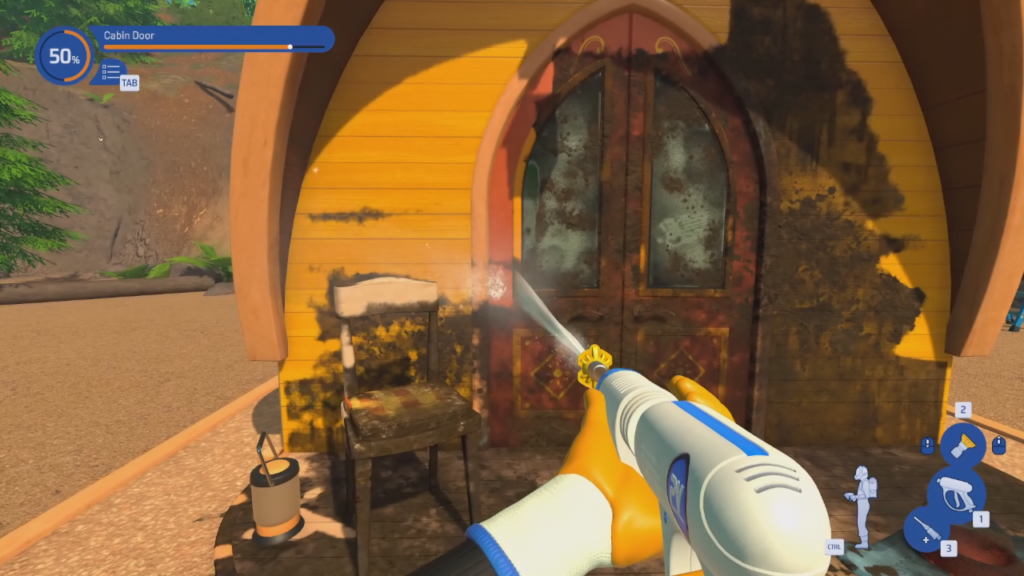
The pressure washer is a nearly magical device. It fires an endless stream of water from a small tank carried on the player character’s back. There are no hoses for them to trip over or get tangled around their workspace’s many corners. The pressure washer’s range and area effect can be adjusted with an assortment of extensions and nozzles. These are swapped onto the pressure washer’s wand in an instant with simple button presses, eschewing the considerable labor applying these addons would demand in real life. This is not the only aspect of PowerWash Simulator that feels unlike a simulation. Water vanishes a split-second after it impacts a surface, carrying any crud it has absorbed with it, eliminating the nastiest and most time-consuming part of a pressure washing job. These are smart omissions that ensure PowerWash Simulator stays focused on the most fun and engaging parts of the task and not on the tedious, backbreaking, and disgusting aspects of it.
What makes completing jobs in PowerWash Simulator rewarding is how they test my attention to detail. Jobs challenge the player character with diverse tasks like a rock climbing park, a traveling carnival fun house (inside and outside), a mobility scooter, a cement mixer, multiple parade floats, a roller disco, and a planetarium. Dirt has not accumulated in these spaces naturally. Every centimeter is coated in grime, as though somebody playing a parallel simulation videogame smeared handfuls of mud across every reachable surface just before the player character arrived, which my player character must wash away with a concentrated blast of high pressure water. This cannot be done carelessly. The more surfaces, angles, and protrusions a particular section of a level has, the more carefully a stream of pressurized water must be applied from every possible angle to ensure every speck of dirt is removed.
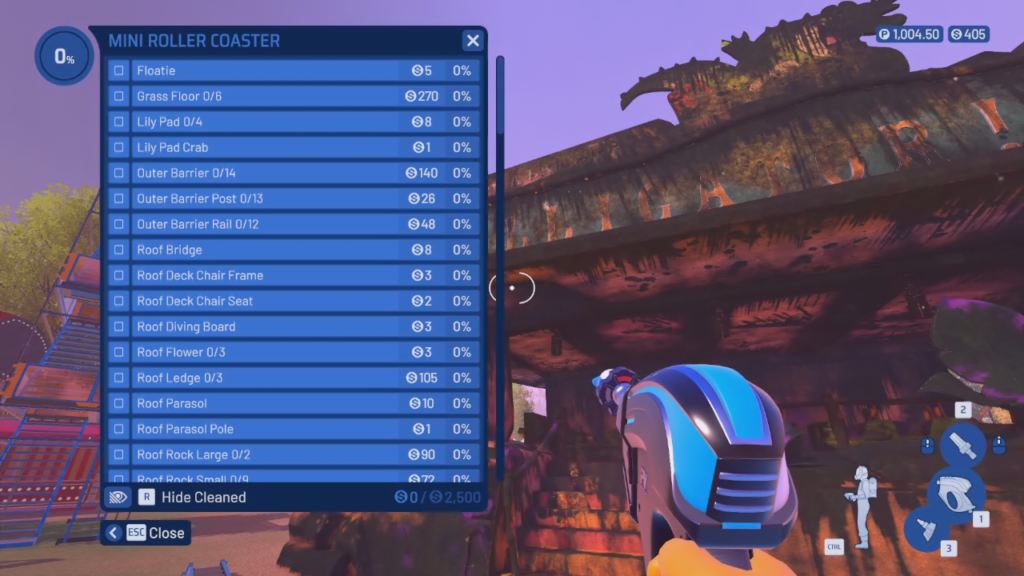
Every object in a job, from tiny mugs to large art installations to entire floors, walls, and ceilings, is tracked individually in a list I may pull up on the player character’s tablet computer at any time. When I have cleaned somewhere between 99 and 100% of an object, it flashes and a satisfying “ding” rings out. Cleaning objects to earn these flashes and dings quickly becomes a Pavlovian experience. Tracking down every dirty item in a job individually would be agonizingly tedious, but thankfully I can select any item from the tablet’s list and its surface will begin to blink, drawing my eye to it. With a little effort and a willingness to hunt for the smallest parts, cleaning one hundred percent of a level is not only practical, it is enticing. I could direct the player character to leave a job after 60 or 80%, but why would I? Their job doesn’t really feel done until every surface listed in the tablet is marked Cleaned.
While the first PowerWash Simulator is satisfying and engrossing to play, it is not without flaws. PowerWash Simulator 2 is more interested in attempting to remediate these flaws in thirty-eight new levels than in being a transformative experience.
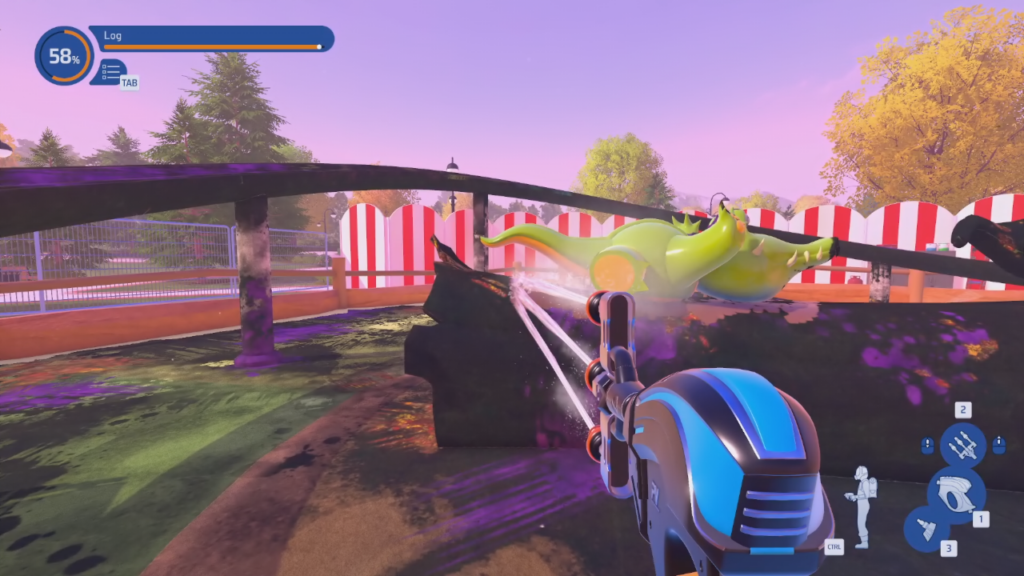
One of the more noticeable quirks of the first PowerWash Simulator is how limited its toolset feels. While the player character can purchase successively more expensive pressure washers that offer increasing water velocity, using any one of them feels mostly the same. The tip of the pressure washer’s wand can be fixed with differently colored nozzles that determine the width of the water stream it produces; the wider the stream, the more surface it covers, but the less impact the water provides, lessening its cleaning power. I soon learn that the yellow nozzle occupies a sweet spot between width and power and I use it almost exclusively in every job. Only the triple tip nozzle, a purposefully overpowered tool available only in the final few levels, breaks this habit.
PowerWash Simulator 2 tries to address the myopia of choices available in its predecessor by offering many more. The first thing I notice as the player character begins their first job is they now carry two pressure washers with them at all times. One is similar to the pressure washer familiar from the first videogame. The second offers greater range offset by reduced concentration, lessening its cleaning power. I may switch freely between the two washers at any time with a few button presses. Using money earned from jobs, one of the first new purchases the player character makes is for a surface washer, adding a third tool to their loadout. Instead of shooting a stream of high pressure water from a wand, the surface washer applies a spinning disc directly to a surface to scrub it clean. It is highly effective, not missing even the tiniest speck the other washers often leave behind, but this is counterbalanced by its short range. The surface washer is really only useful for cleaning floors.
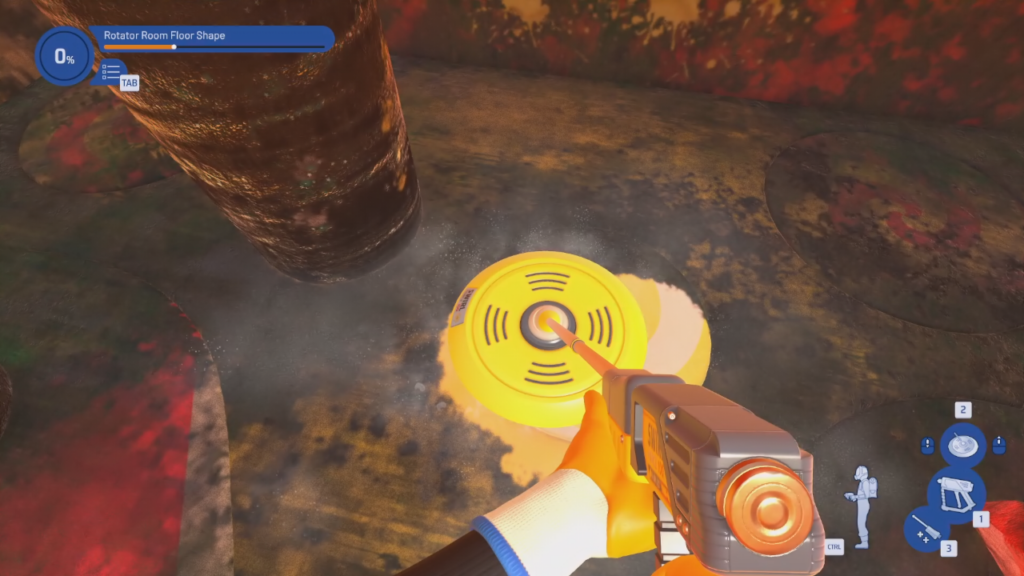
At first I am excited by the number of new tools available to the player character. This excitement dissipates over the course of the first dozen or so jobs. As intrigued as I am by a second pressure washer with different capabilities as the default washer, I never really find cause to use it. The default washer always has enough range to clean anything the alternate washer can, and with greater precision. The surface washer seems to dominate a useful niche right away, but as the player character adds more powerful wand-based washers to their equipment, it feels less and less useful. By the final mission, the player character exclusively uses the most powerful default washer for all cleaning tasks. The alternate and surface washers fulfill no demanding purpose. Despite an admirable attempt to diversify the player character’s options, their relevant choices end up being much the same as in their first adventure.
The player character begins their first job with a familiar assortment of multi-colored wand attachments. They function almost exactly as they did in the first installment, though the green nozzle feels more universally useful this time around due to adjustments to the default pressure washer’s overall power.
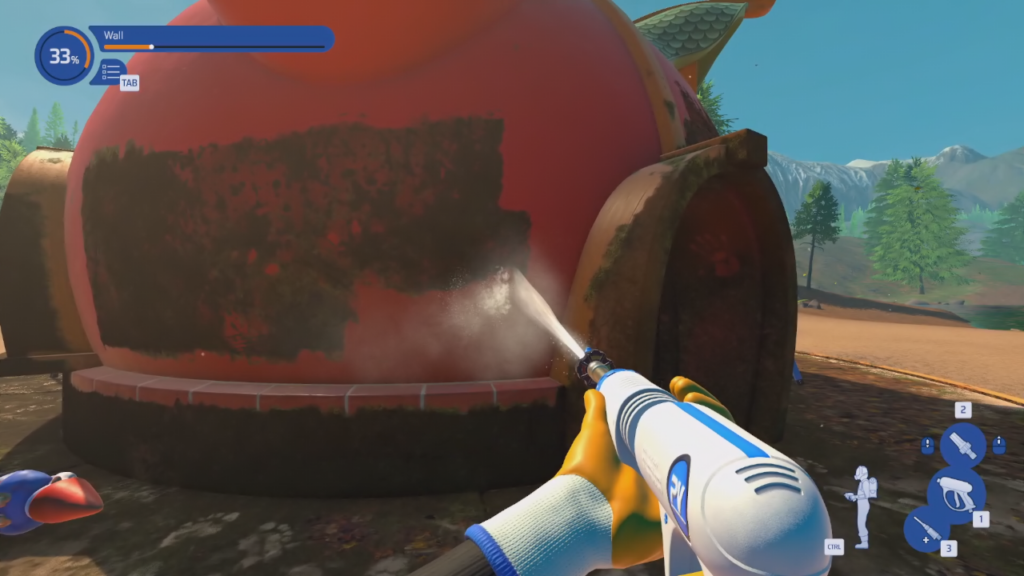
It’s when the first level is finished and I browse the in-game shop that I am able to see all the new nozzles available to the player character. Most are gimmicks that create a blast of water in an ultra-concentrated area. The triple tip nozzle returns as well, now joined by a double-tip nozzle that fits the alternate pressure washer that I end up never using. The most intriguing addition is the adaptable nozzle. Once fixed to the pressure washer’s wand, the width of the adaptable nozzle’s stream may be expanded or narrowed with a button press. It’s ultimately a superfluous addition; whether the player character uses the adaptable or the colored nozzles, they get the same results from slightly different interfaces. My player character ends up using the adaptable nozzle throughout the campaign just so I feel like they’re having even a negligibly different experience from the first videogame.
The final nozzle available for purchase is another that was also available in PowerWash Simulator. Of all the elements carried over to the sequel, this nozzle is the one that has received the most care and attention: the soap nozzle.

Popular advice in the first PowerWash Simulator is to ignore its soap nozzle. It is impractical to use and an extra few seconds of water applied with a narrow nozzle will yield the same results. Since so many other elements of the sequel feel similar, my impulse is to carry on with this plan as well. An early job to clean a cement mixer seems to be deliberately placed to re-educate players like myself who trained themselves to ignore the soap nozzle. The thick layers of dry cement covering its core parts are nearly impossible to clean with water alone.
The cement mixer job teaches me that soap has been made more useful by removing the restrictions that overcomplicated its use in the first installment. There is only one kind of soap which is effective on all surfaces, and the player character’s supply is limited only by the amount they may place at once; the nozzle will eventually stop spraying soap until some of it has been washed away, or all sprayed soap may be erased at once with a button press.
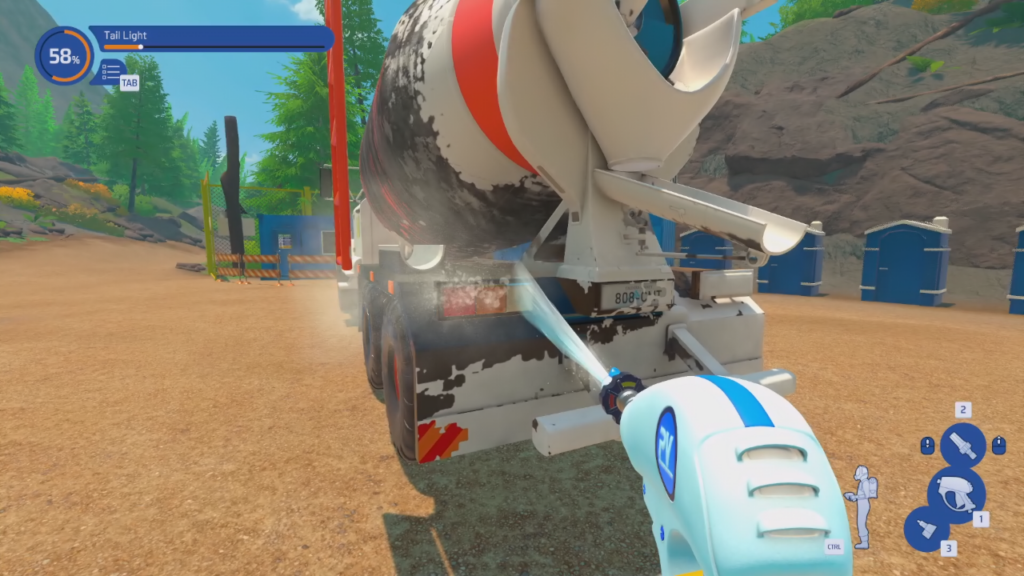
Once soap is applied to a surface, it expands like a sponge into every infinitesimal nook and cranny around it. The gentlest subsequent touch of water from the pressure washer’s widest nozzle causes the soap to melt away along with the muck it absorbed. A few brief minutes with this new soap nozzle completely transforms the approach I take with every subsequent job. It’s not just against the toughest cement, oil, and rust residue where it is used. Every surface I see gets sprayed down with soap, then cleared away with water. This tool, more than any other, demarcates PowerWash Simulator 1 from PowerWash Simulator 2. It may even make the new jobs too easy, as the soap’s ability to spread into every crevasse leaves far fewer of the tiny missed spots that could bedevil me in the first videogame’s jobs.
Another way PowerWash Simulator 2 sets itself apart from its predecessor are the places its jobs take place in. Many of the first videogame’s environments have a generic look to them, as though they were plucked from a defunct, low-budget first-person shooter and repurposed for a silly videogame about cleaning up dirt. Environments in the sequel have bright colors from a unique color palette and many friendly, rounded edges. These simple visual choices give PowerWash Simulator 2 a distinct personality and identity all its own. Remove the user interface and the pressure washer from a screenshot of the first videogame and I might mistake it for an image from a Unity or Unreal asset shop. PowerWash Simulator 2’s levels are immediately recognizable as its own.
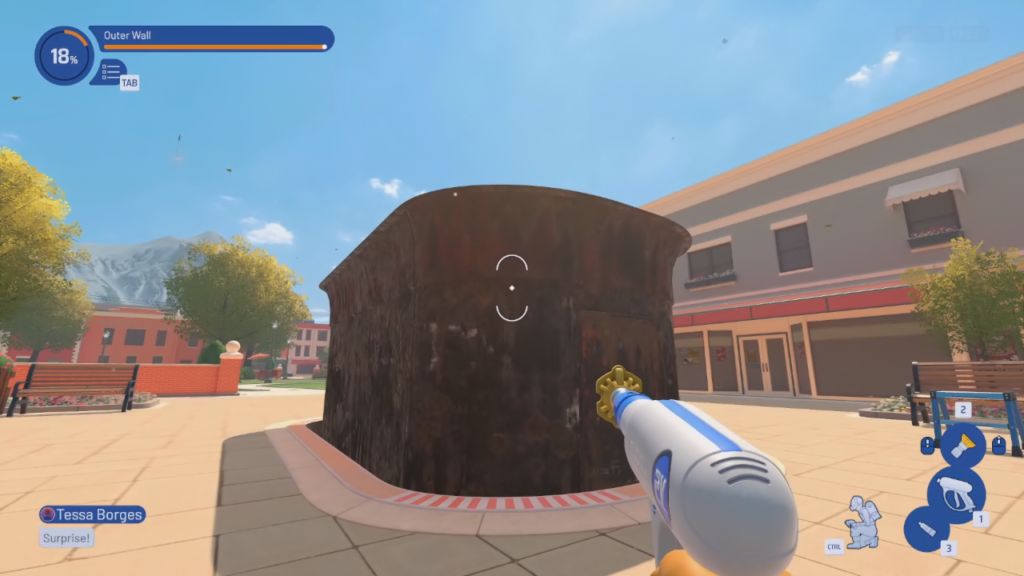
The new set of jobs also distinguish themselves through their increased complexity and interactivity. Jobs in the first videogame were static and practically motionless, giving them an eerie and purgatorial atmosphere. PowerWash Simulator 2’s jobs almost immediately introduce locations that transform themselves as the job progresses, beginning with an elaborate public bathroom that is first disguised as a metal decoration in a courtyard. The more of its surface is cleaned, the more the total structure reveals itself, ending with doors that open to reveal the bathroom’s interior must be cleaned as well.
As jobs grow in size, all of the familiar ladder varieties from the first videogame return. They function in the exact same way. A diminutive stepladder may be placed almost anywhere, but the added height it provides is almost never worth the effort. Longer climbing ladders get much more use, but may only be placed at preset locations. Last is the scaffolding, a mighty tower of ramps and platforms that provides easier access to tall objects and installations. The scaffold may be moved and rotated freely, but finding a location where it will allow itself to be placed back down is temperamental at the best of times.
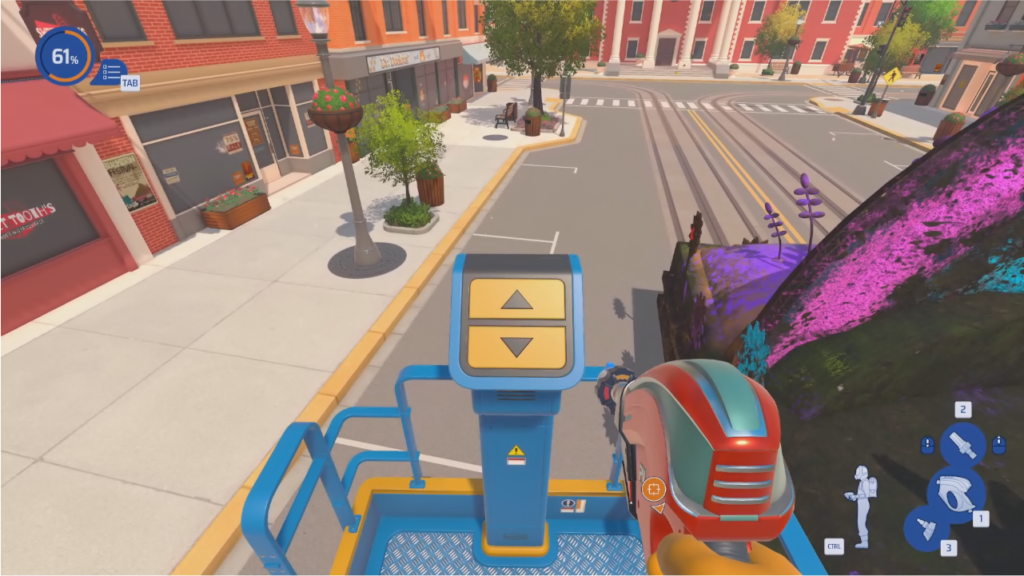
There are also new tools that help the player character on taller jobs. The scissor lift affords the player character greater control over the height they work from than any of their preceding tools. The downside is it can only be raised and lowered by activating buttons built onto its control panel. It’s strange that in a videogame that otherwise so effortlessly localizes all of its interactions to the control pad to have this one tool that can only be activated by line-of-sight. The scissor lift’s smaller footprint and greater flexibility makes this an acceptable annoyance when compared to the picky scaffolding.
My favorite addition is the abseil, a harness that lets the player character glide up and down a wall to clean its surface as easily as they would a floor. The abseil’s complicated frame mechanism would be a major job to set up in real life; in keeping with how PowerWash Simulator greatly simplifies all of these tasks, I can set up and move the abseil between walls simply by pointing and clicking. This tool is put to great effect on jobs that would be impossible to do with only ladders, creating taller levels than almost any that appeared in the first videogame. Any time I see the abseil lying on the ground at the beginning of a job, I get excited.
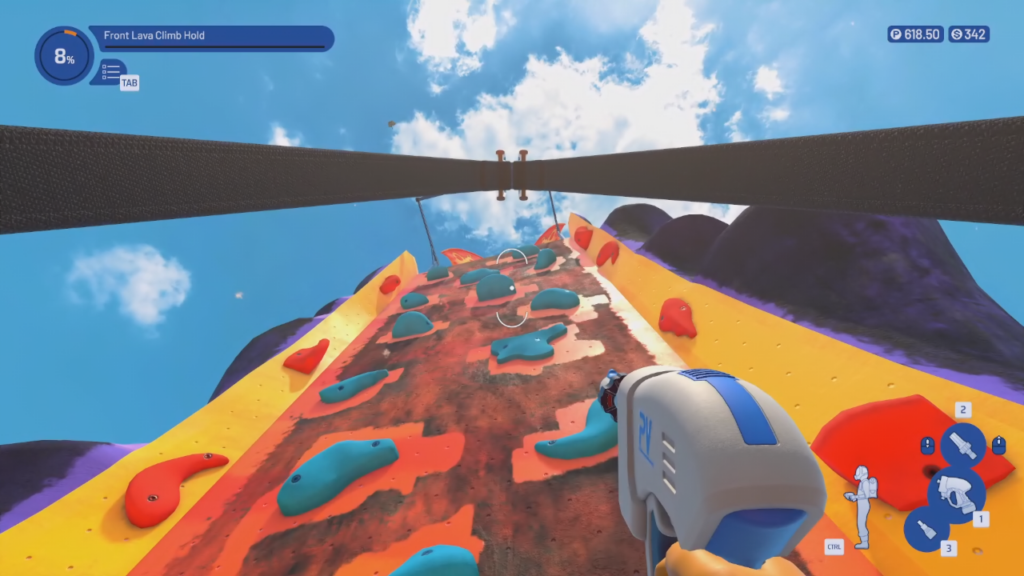
Where PowerWash Simulator 2 feels most evolved from its predecessor is the scale of its jobs. This is best demonstrated by looking at the finales of both videogames. The final mission of the first is an epic mission set around a massive monolith that can easily take up to six hours to finish. 2’s final job, while no less momentous in the context of the narrative, can be finished comfortably inside of an hour.
This shrinking feels like a deliberate choice. It makes the sequel’s levels easier to finish in one or two play sessions. While there are still some gigantic jobs that take several hours to complete, 2’s most ambitious jobs are only as large as 1’s middle-sized ones. While I personally miss the zen-like state into which I can slip while scrubbing a subway terminal, elaborate tree house, or ancient pyramid for an entire evening, I recognize that this change accommodates the tastes and attention spans of more kinds of players and is in the series’ best interest in the long run.
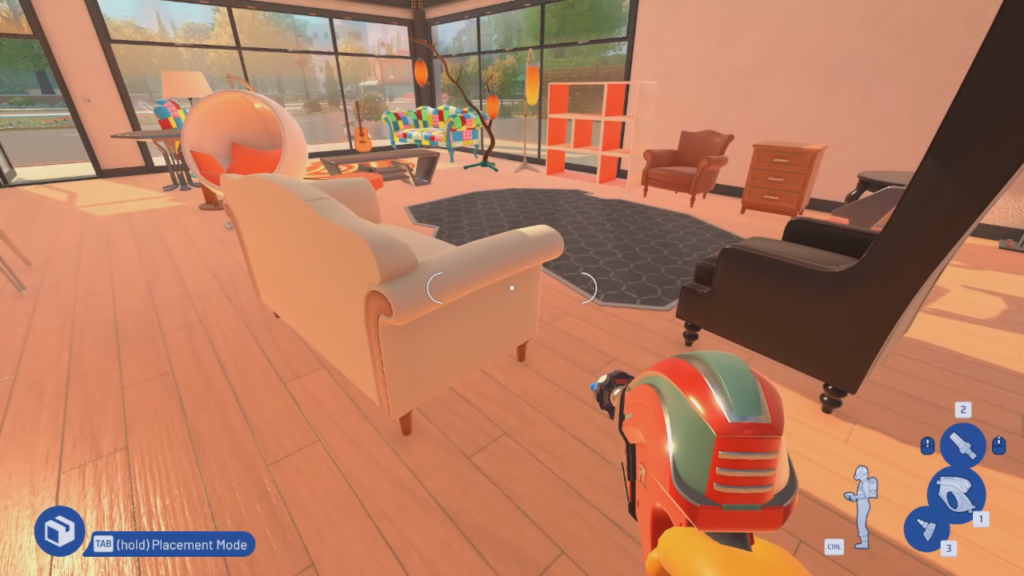
In between jobs the player character can return to their home base. This building is where I can choose their next job from a map, see a visual representation of their progress through their jobs in a trophy room, and decorate an empty room with purchased furniture. Each piece of furniture needs to be cleaned before it may be displayed. I like the trophy room and the map, as they do a better job of displaying progress than a series of clunky menus. The decorating aspect feels like a shallow afterthought. There’s no real reason to do it. Placing each individual piece of furniture is as finicky as moving the scaffolding, especially because of weird choices like an inability to place objects on top of carpets.
PowerWash Simulator 2 has an unimpactful narrative. It picks up from the conclusion to the first story with the player character resuming their mundane service job after their unique skills saved the world. The previous story’s antagonists return to tamper with the solutions the player character found to the past conflict’s problems, setting off a new crisis. All the story really has to say is the rich and powerful will endanger the world to become even more rich and powerful, but they will be stopped by supernatural intervention. Thrilling stuff.
The story in the first PowerWash Simulator already feels slight and it is only a series of obviously supernatural jobs that capstone its campaign which make it feel suitably epic. PowerWash Simulator 2’s jobs feel much more random. There is no sense of rising action, leaving it entirely on the shoulders of the brief and underwhelming ultimate job to create a sense of finality. It was already easy to ignore the first videogame’s story since it was delivered mostly through text messages and pre-mission briefings. 2’s story is even easier to ignore because it is much less interesting and lacks the subtle sarcasm and elements of parody. This matters little; nobody is playing PowerWash Simulator for its plot. An interesting narrative is missing but not missed.
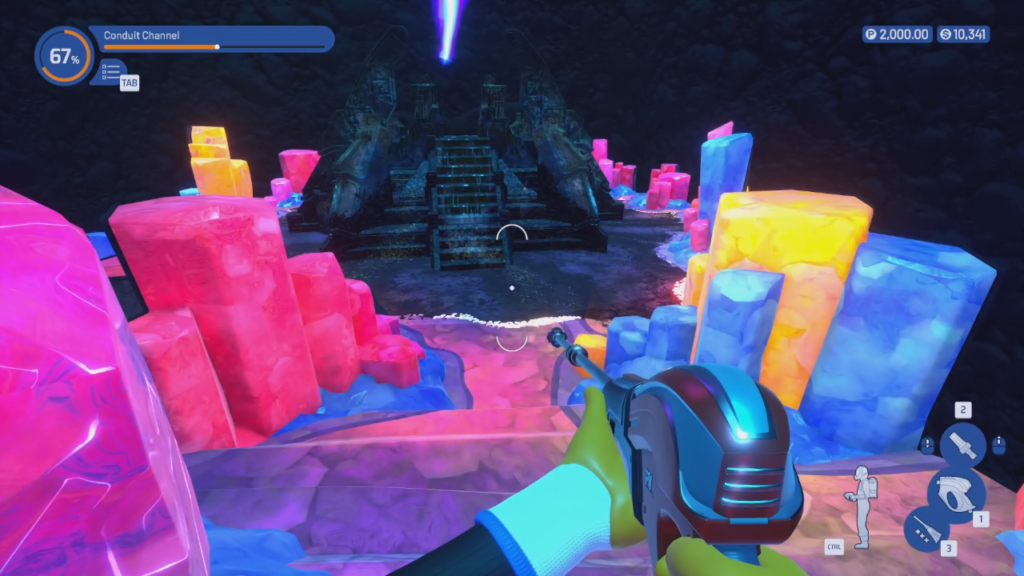
I am surprised to find myself balancing a strong recommendation with reluctant ennui when it comes to summarizing PowerWash Simulator 2. It is a superior videogame to its predecessor. A more unique visual style, greater diversity in available jobs, fewer multi-hour marathon jobs, and interesting new features like abseiling, the surface cleaner, and a total overhaul of the soap nozzle are enticing reasons for veteran players to sign up for another few dozen hours of meticulous pressure washing. Despite these elements in its favor, I also find myself unable to be as enthusiastic as I was about its predecessor. I don’t find myself impressed that this stupid premise for a videogame not only works but is fun and engrossing. I’m merely happy to have more levels to play through. It’s an example of a videogame sequel that is bigger, smarter, and more refined, but doesn’t feel as special. Maybe this is the best a sequel to a videogame as absurd as PowerWash Simulator can hope for.