A PR representative provided Play Critically with a review code for this videogame.
Ayasa: Shadows of Silence is a slow-paced cinematic platformer that follows a young survivor through a besieged city filled with symbolic calamities. I play as a purple-haired girl whom I shall presume is the titular Ayasa. She wakes up alone at the edge of a forest and is soon chased by an ominous black cloud into the alleyways of a dark city. Her escape is not an easy one. The city is beset by fire and water, crumbling beneath random explosions and marauding looters, and patrolled by shambling creatures who seek to capture her. Ayasa must push boxes, leap over gaps, and exploit her burgeoning psychic powers to overcome these obstacles. My time with this poor girl follows her fearful escape from the heart of the city to its edge where she may find a better life.
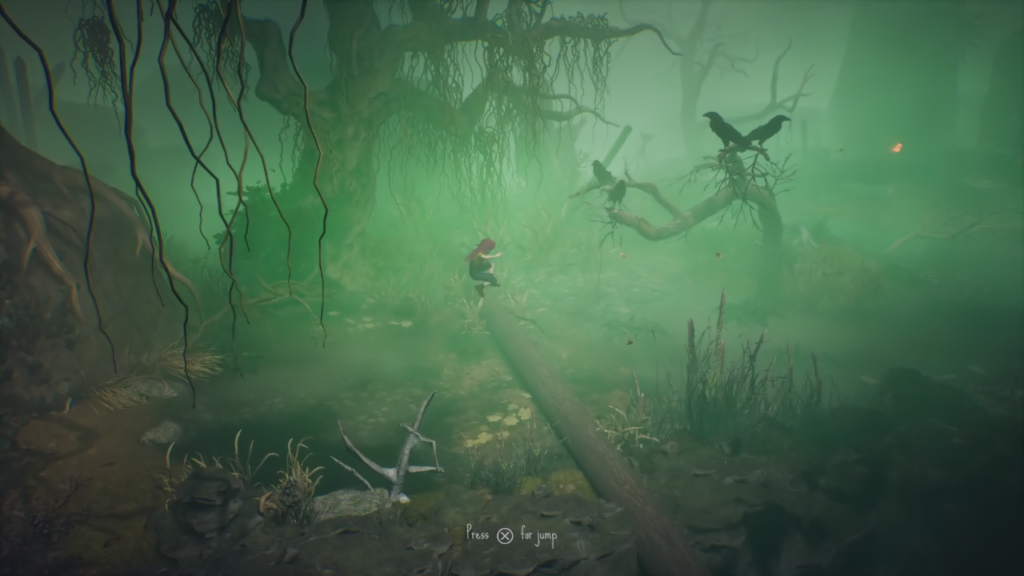
From the moment I begin controlling Ayasa, I encounter difficulties. Her path is almost immediately impeded by a fallen log. An on-screen prompt instructs me to press the X button to direct her to jump over the obstacle. I press that button many times and nothing happens. When I press the A button, Ayasa jumps. I quickly deduce the problem: This videogame supports both PlayStation and Xbox controllers but displays PlayStation button prompts regardless of which is connected. This brief, early confusion is a preview for an entire experience that feels half (or less) finished, not clearly communicating what is happening or where Ayasa is in its world, often leaving me confused about the videogame’s behavior.
It’s frustrating enough that Ayasa: Shadows of Silence displays incorrect button prompts when I’m trying to learn how to play. It becomes infuriating when additional prompts are nonexistent. Ayasa’s way forward often requires her to activate levers found throughout the environment. There is no visual indicator that these levers may be interacted with. I only learn they do anything at all when, after steering Ayasa around a room for a few minutes, I have her stand next to one and press a button out of desperation, causing her to mime activating a lever. No icon appears on screen telling me this is possible. The lever itself doesn’t even move. I only know something has happened because I hear the sound of a heavy metal door unlocking and the frame lurches backwards, clumsily expanding the view of the game world in a way that makes me worry for players susceptible to motion sickness.
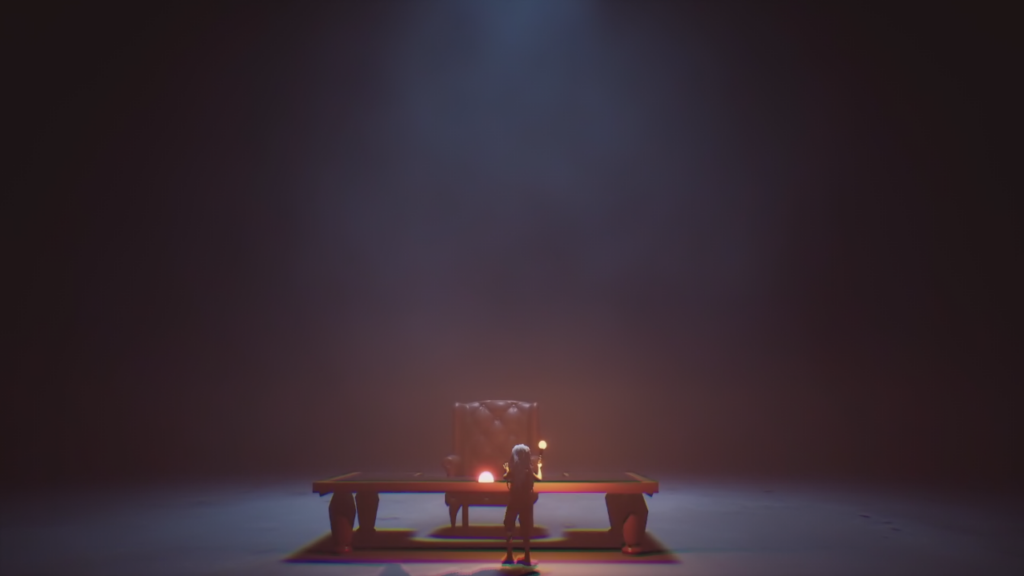
It’s rarely clear what objects in the environment Ayasa may interact with. At a few points throughout the city, she comes across large, flashing red buttons. These objects beg to be pushed, wisely or unwisely. I direct her to press them with the interact button, climb up and put her whole weight on them, and even jump repeatedly on their tops. They do not respond. I waste many minutes with these buttons, convinced they must do something. If they do have some function, they never properly activate for me.
At key milestones during her escape, Ayasa unlocks access to psychic abilities. The first and most frequently used lets her rebuild any broken objects she encounters, from small passages to staircases to the occasional building. In a city being smashed into pieces by random explosions, this is a highly useful ability. But not every broken city street Ayasa passes through may be repaired. Only specific ones can, and like the levers and buttons, there is no visual indicator that Ayasa may reassemble a pile of rubble into a traversable object.
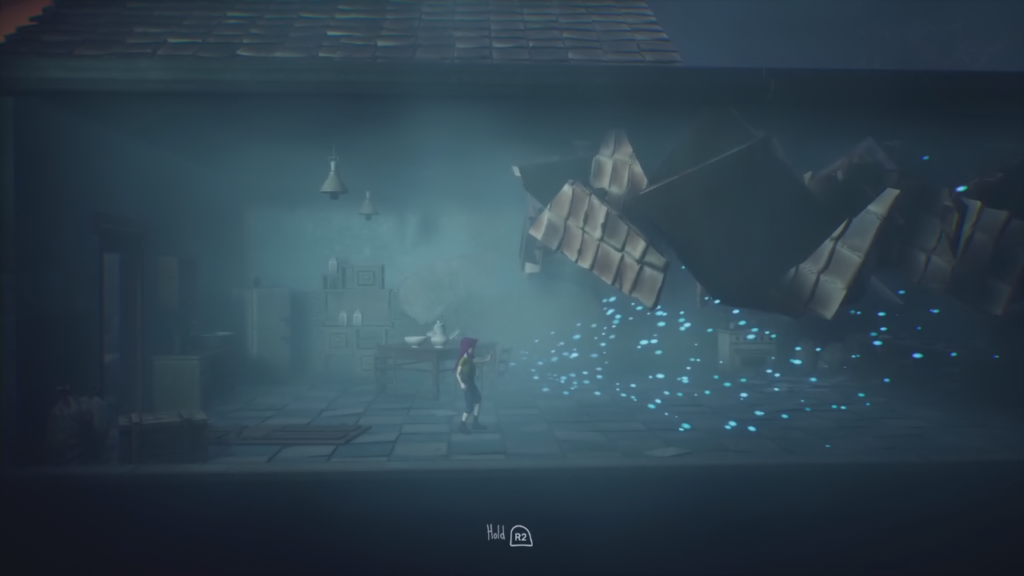
On at least one unfortunate occasion, Ayasa must rebuild a collapsed archway to pass through to the next area. For whatever reason, the first time I try this, nothing happens when I press the button. It is only after I’ve wasted many minutes steering Ayasa around the rest of the area, trying to activate every other object strewn around the courtyard, that I return to the archway and this time the repair actually works. A lack of visual indicators on what Ayasa may or may not interact with is a serious hindrance towards enjoying the videogame, especially when there’s no guarantee a first attempt will even work.
Another major way Ayasa interacts with the environment is platforming. The frame through which I view the game world is locked to a single angle, viewing the city from the side and close to the ground. It is still a 3D space that allows Ayasa to move closer to and away from the frame. This approach carries with it all the usual pitfalls that can befall a poorly made platformer, particularly in regards to depth perception.
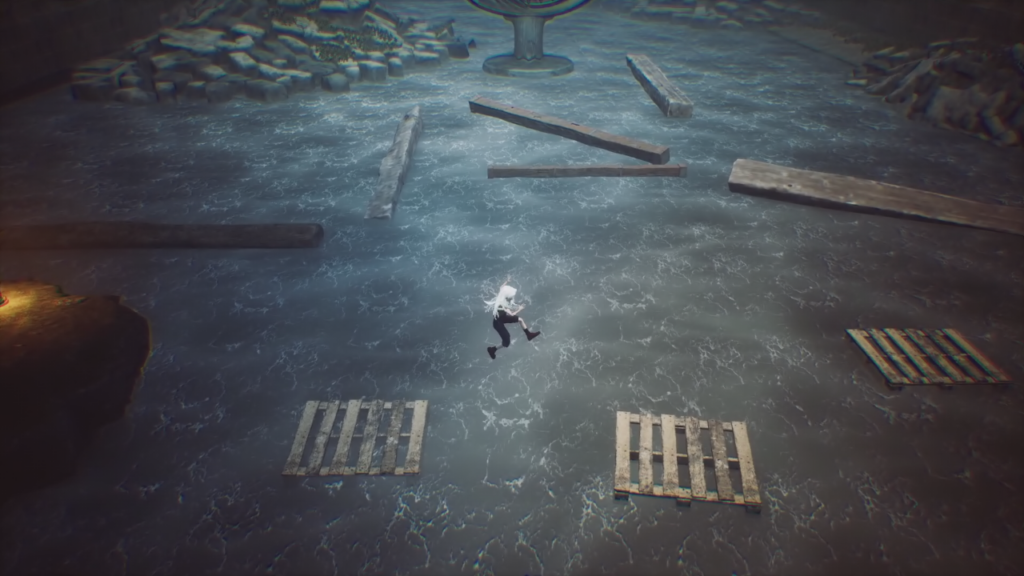
Ayasa’s jump carries her far enough to clear most gaps and it is responsive to my inputs, so leaping through places with broad platforms and no deadly hazards is easy. There are a few occasions where Ayasa must cross a body of water by leaping between flotsam floating on its surface. It is surprisingly difficult to complete these precarious jumps because the crate or pallet may look lined up with Ayasa’s feet when it is still some distance behind her. Ayasa’s fall into the water punishes me with a short loading screen before depositing her at a checkpoint just before the water’s edge—except for the few occasions where the videogame doesn’t notice that she is underwater and I am able to guide her along the river’s bottom, out of sight but still under my complete control.
Between set pieces where Ayasa pulls levers to open doors, uses her psychic powers to repair passages, and jumps between platforms, she enters broader, more open-ended areas. These brief bubbles are filled with striking, eyeless figures, humanoid in shape but not human in appearance, who seem to quiver with the misery of their existence as they stumble back and forth across predictable paths. In between their regular patrols, they come to a stop, folding in half as though their spines are made of rubber. These are the moments when Ayasa may creep past without being noticed. In theory.
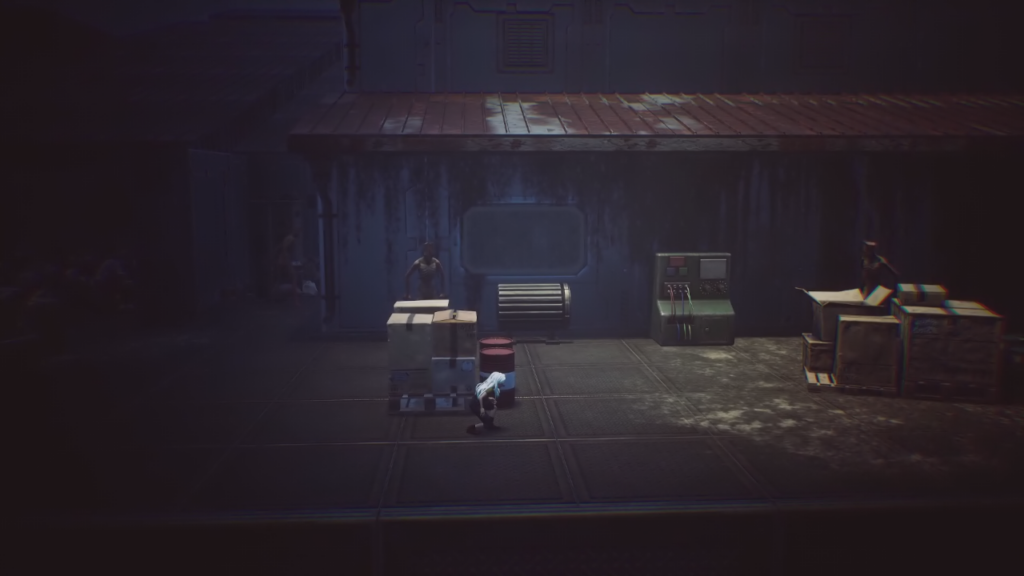
Ayasa’s ability to get past the figures unnoticed seems completely random. Even if I wait several seconds for them to completely enter their huddled, inactive state, they may still spot Ayasa and chase after her. Sometimes I may have her creep past as soon as they become dormant and she will be successful. Worse, the figures move much more quickly than Ayasa. Running is pointless; if they spot her, they will capture her. Luckily, as with the deadly platforming sequences, checkpoints are generously placed just before every stealth space. I never feel like my time is wasted running repeatedly across spaces that Ayasa has already been through. It is only wasted waiting for the lucky roll that lets her pass the figures unnoticed.
I do gain some hope about completing these stealth sequences when Ayasa learns to make herself invisible midway through her journey. Frustratingly, I have no success using it to evade the figures until literally the last pack just before the city’s edge. All others happily chase Ayasa even after she becomes an intangible silhouette. Given how inconsistently most things in this videogame behave, I cannot be sure if this is the intended behavior or not.
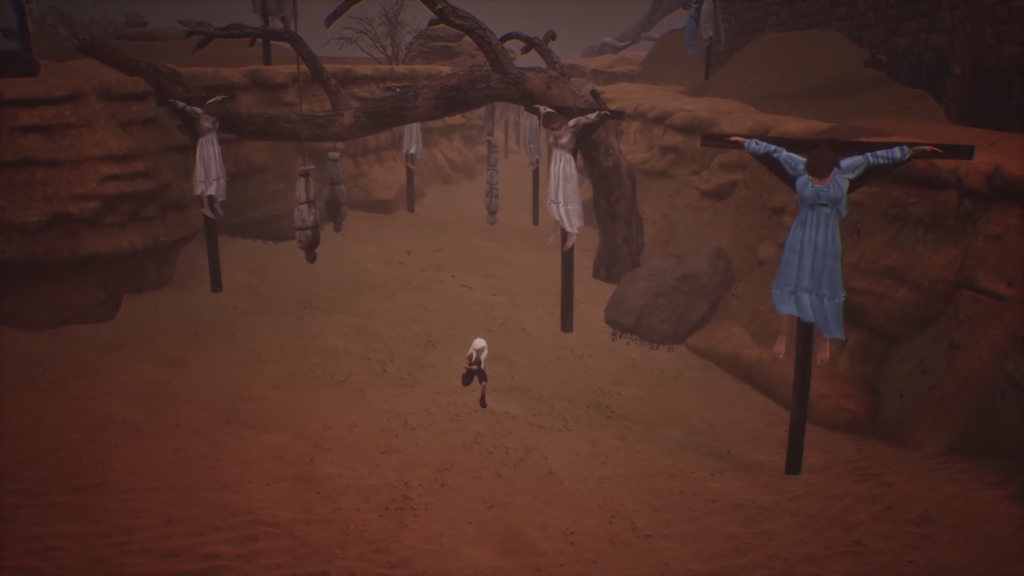
All of these interactive elements are encountered across a city that successfully makes itself feel grand and historic, making the destruction Ayasa encounters across it a genuinely emotional experience. It would be more affecting if I could explore it in more detail. In one particularly horrific location, Ayasa comes across a line of crucified bodies erected along a path leading into the background. I am enticed to have Ayasa follow this path, but she is soon impeded by an invisible wall. A road is visible there, but Ayasa is not allowed to explore it. Her journey can only move from the left to the right. This makes the videogame easy to complete. It is impossible to get lost, despite the suggestion that Ayasa should be able to follow some alternate paths.
Then I discover that not every path has an invisible wall that prevents Ayasa from venturing down it. These occasional exceptions only make her escape from the city even more difficult. The camera is unable to follow her into these background locations, so whatever is there remains a mystery. She still encounters obstacles there, potentially trapping her until I reload the game, thankful yet again for the generous checkpoints. On one memorable occasion, I somehow manage to have Ayasa leap into a swirling vortex beneath the world. Since the videogame does not expect her to be there, she is allowed to run around in the screaming hellscape unimpeded until I get bored and reload the checkpoint, ready to press on.
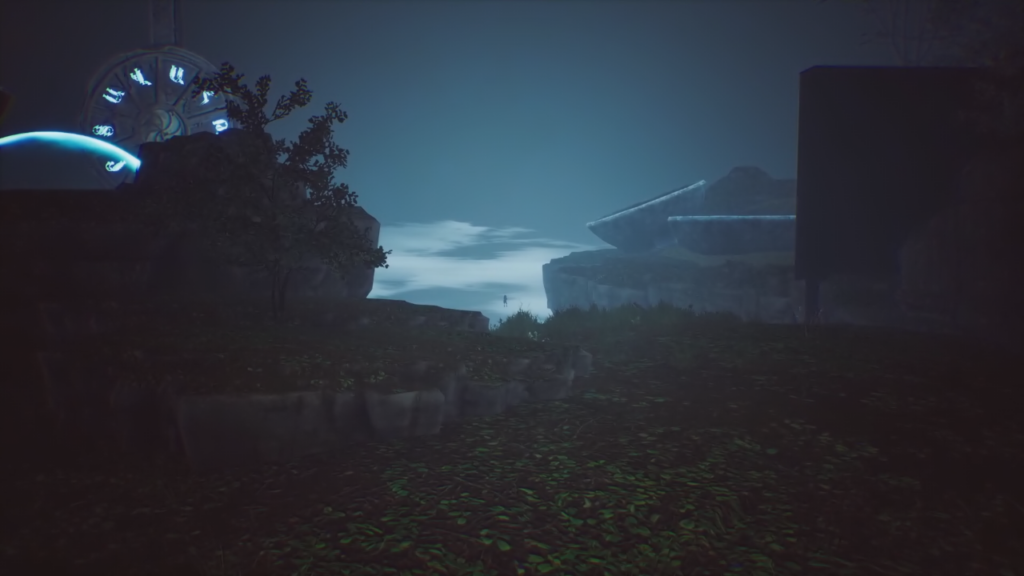
Some of the scenarios meant to add challenge and texture to the adventure are positively braindead. Ayasa encounters a boiler room where blazing furnaces block her path. She must activate buttons on the wall to disable the furnaces in an apparent puzzle. The puzzle’s solution? Press each button in order from left to right. Another puzzle does leave me stuck for several minutes, though not for any good reason. The space contains a box with no collision detection; Ayasa may walk through it as though it doesn’t exist. After fruitlessly trying to find some way to use the box to reach a rooftop, I realize there is another path forward and the box is a superfluous decorative object. A technical glitch has transformed it into a red herring. Or, Ayasa really is supposed to be able to climb on the box and reach that rooftop, leading to a hidden area that rewards an achievement, another of several obtainable by this method. By the time I reach the intangible box, I am so frustrated that I no longer care about achievements.
I can confirm that it is possible to reach the end of Ayasa: Shadows of Silence. The means to get there are not always clear, the methods to reach it often break, there is an apparent element of randomness to many scenarios, and overall it is rarely enjoyable to experience. But it is possible to play this videogame from beginning to end. That’s something to appreciate.

I recognize that this has been an uncharacteristically negative review. I take no pleasure in describing my poor experiences and disappointed observations in such detail. I am heartened somewhat to report that there is at least one aspect of this videogame I do admire.
Cinematic platformers build themselves on spectacle, filling their spaces with high-speed routes and breathtaking vistas. It’s these qualities that make them cinematic. Ayasa: Shadows of Silence emphasizes spectacle over speed. In the moments when it chooses to truly put its visual and thematic elements over any other consideration is when it becomes a haunting and compelling experience.

I first witness this spectacle while Ayasa escapes across a river in a boat. Her route takes her between massive statues, half-submerged in the water. They suggest the majesty of this city, that it has survived for centuries and left behind a heritage so ancient that it is almost forgotten, half-drowned in its lifegiving waterways. The carnage around Ayasa gives them additional meaning. They are no longer signs of safety and permanence. They are soon to be gravemarkers for this once great city, their remains vast and trunkless effigies in a scarred wasteland.
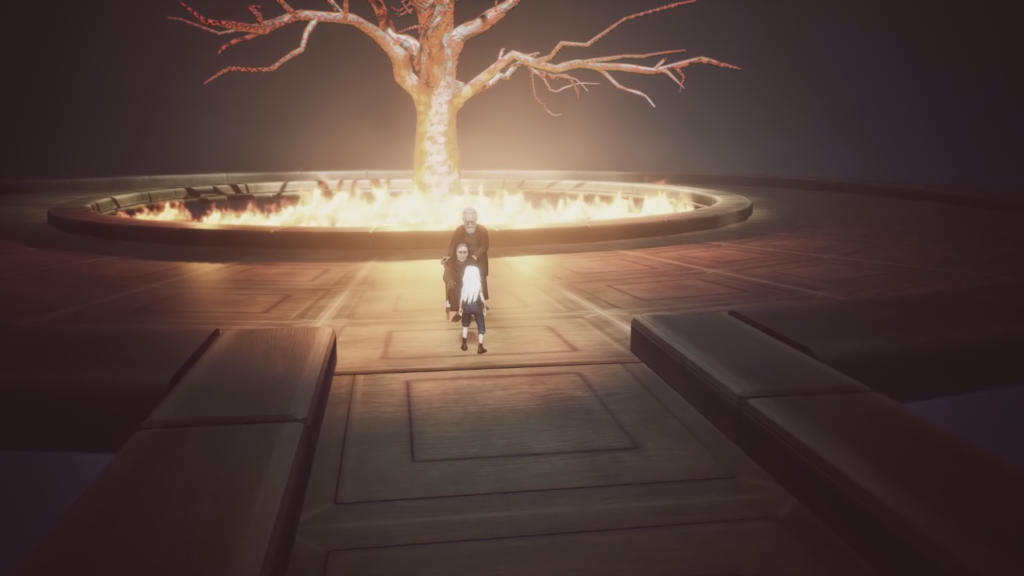
Ayasa encounters more impactful visuals than these waterlogged statues. Each time she reclaims a psychic power, she encounters a pale vision of a group huddled around a white light. They may be ghosts or refugees, existing in a liminal state between life and death. Her union with these groups are comforting but brief, alleviating her from the tension of her city escape before she is thrust back into it. Wherever these people are going in a living or dead realm, she cannot join them.
Late in her journey, Ayasa comes across tiny men in grotesque masks endlessly firing mortar cannons. It’s entirely possible they’re firing on another city or a nearby entrenched army. Since the only explosions I see are those impacting Ayasa’s city, I have to assume this mortar team is the source of that destruction. This city’s inhabitants are destroying themselves, killing the ghostly refugees, and casting Ayasa alone out into a dangerous world. And it’s never clear exactly why they are doing this.
Ayasa: Shadows of Silence begins with a message from its developers written in a curvy font over an image of the submerged statues. It implores players to report any elements that “feel wrong, broken, or confusing” in their Discord server instead of leaving a negative review. Without putting it in so many words, this message admits that players are paying for the privilege of alpha testing this videogame. Critics such as myself, invited to play in exchange for our thoughts, are baffled to be asked for our opinions about a product that isn’t ready to be sold. I’m sorry to leave a negative review instead of reporting my troubles in Discord, but that is not how game development works. It is clear that a “sell it now, fix it later” approach to videogame design has failed yet again—failed the videogame, failed its developers, and failed its players.
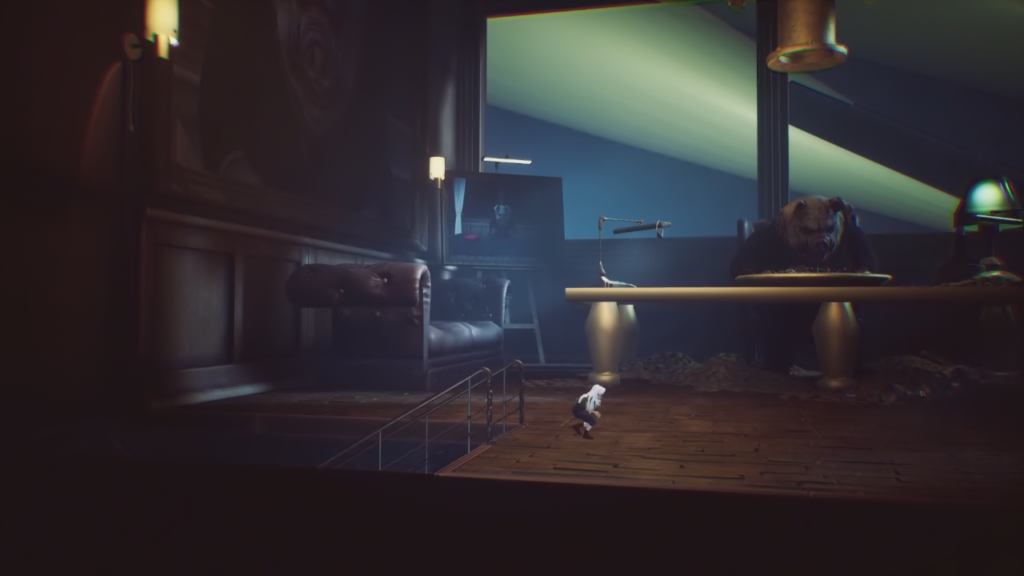
This is the 231st review I have written for Play Critically, and of all those videogames, Ayasa: Shadows of Silence feels least ready to be put into the hands of players. Basic iconography that highlights what I may interact with is often absent, and where it does exist, it may be showing the wrong icons. Platforming is made imprecise by depth perception issues. Only the scarcity of deadly platforming challenges minimizes aggravation. Level design consists uniformly of running from the left side of an area to its right. Stealth mechanics function inconsistently, when they function at all, so success feels disconcertingly like a coin flip. Many open areas that allow Ayasa to explore beyond the linear path are prone to breaking the camera, the level, or the player character. Elements that might salvage the experience are themes and visuals. It isn’t much of a recommendation for a videogame that its best parts are its non-interactive ones. Maybe if this laundry list of problems are addressed, Ayasa: Shadows of Silence will become visually interesting, if mechanically predictable. Right now it simply isn’t ready to be in players’ hands.