The developer provided Play Critically with a review code for this videogame.
The Valley Beyond is an open-world puzzle videogame set in a tranquil landscape filled with strange objects and mysteries to discover. I play as a disillusioned version of myself, weary of their life, who takes an unusual vacation. I accept an offer from an agency who transports my consciousness into a faceless, endlessly reproducible synthetic body in the idyllic Valley. Relieved from responsibilities and the constraints of my physical body, I am free to relax and explore as I wish. The Valley is filled with abstract art installations my hosts have installed, and after I have visited them all, I may visit an exit station to return home. But if I linger, I may discover much more than what my Hosts intend me to find.
The star of The Valley Beyond is its familiar and comforting setting. The Valley’s gentle, stony slopes are grown over with a light layering of grass, low shrubs, and pine trees. While pleasant grasslands dominate the space, the topography does have some appreciable variety. A swamp ringed by tall, thick fronds lies near the Valley’s center. Beside it is a ring of deciduous trees, their leaves resplendent in autumnal red and orange, their roots and branches tangled together to create a small labyrinth. In the southeast corner is a deep canyon, its depths hidden in fog and darkness that suggest the presence of obscured secrets. At the Valley’s extreme edges are a beach bordering a rocky island spire, a towering glacier, and a massive desert. The Valley feels like a place where it would be nice to take a nature walk, disconnected from the noise and distraction of streaming music or video, letting the sound of wind weaving through leaves and sticks cracking beneath my feet be my soundtrack.
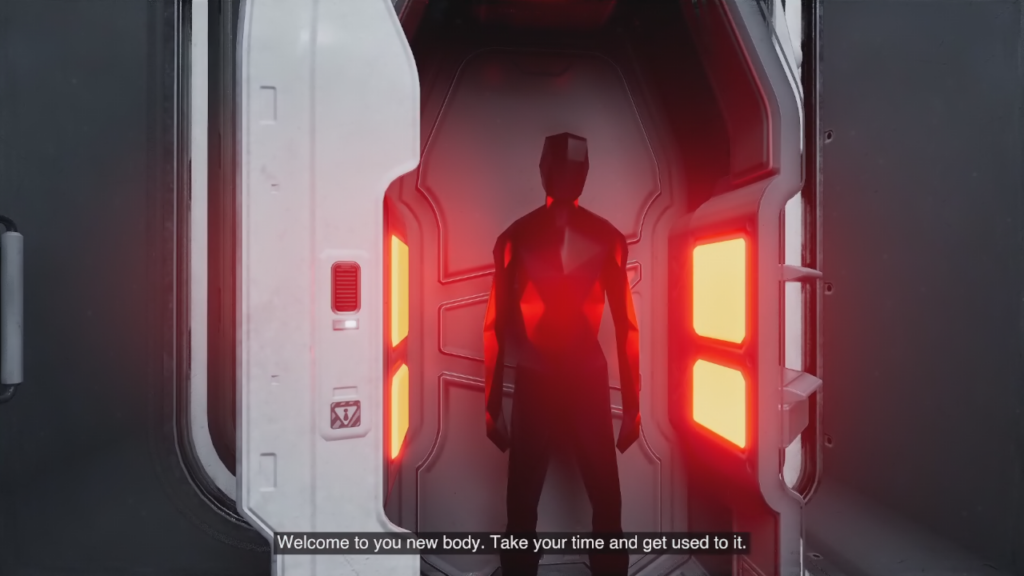
There are parts of the Valley that do feel alien. My synthetic avatar, assembled from a collection of black, sharp-edged polygons into a vaguely human shape, enters the Valley from a cold, sterile pod placed midway up a slope. Several more of these pods are dotted around the Valley, their white plastic and glass construction clashing with the earthy colors around them. As soon as I leave this entrance pod, I spot the attractions placed around the Valley by my Hosts. They are made from the same gleaming obsidian as my avatar. A circle built from interconnected columns lies to my left, penning in random blocks piled into an awkward mountain. In the distance, long rectangles are suspended in the air between a colossal diamond and a shattered circle perched on hilltops. It’s artfully ironic that the parts of the Valley that feel the most alien are its human additions. It’s a constant, subtle reminder that I am the intruder in this space.
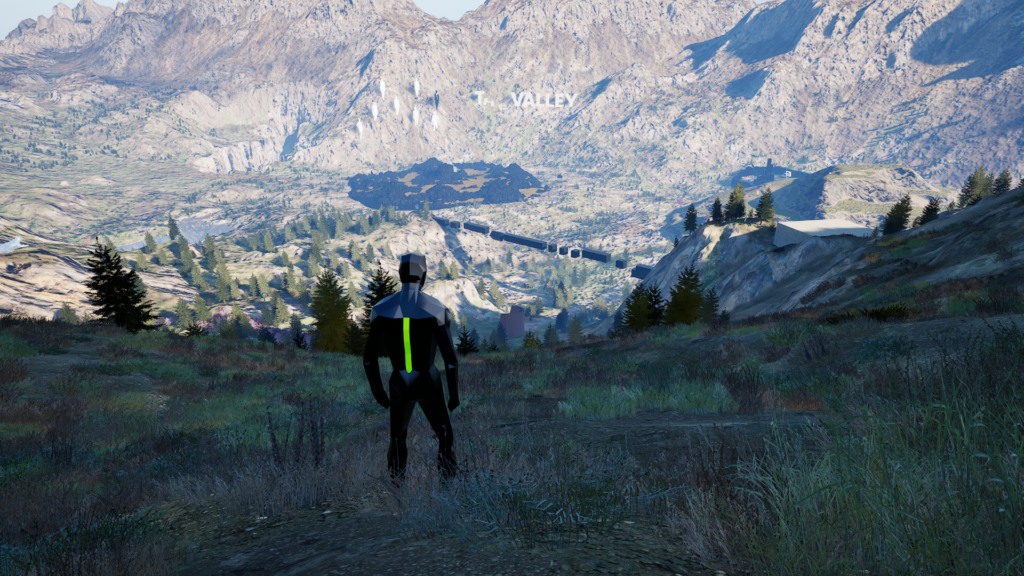
My ability to immerse myself in this environment is constantly impeded by The Valley Beyond’s poor performance and optimization. In the most minor instances, bushes and trees do not appear as I rotate the camera, leaving large parts of the Valley appearing barren until the missing pieces burst into visibility for no apparent reason. The more extreme issues arrive in locations with dramatic weather effects. A heavy fog obscures my vision near the swamp and swallowing shadows consume the depths of the chasm. The framerate slows to a slideshow crawl for a few moments when these effects first appear before rising back to a playable level. I have a moderately powerful PC specced to run new AAA releases without difficulty. It experiences repeated struggles running the comparatively modest The Valley Beyond.
I admit that I am a novice when it comes to configuring software to effectively run on my computer. It is possible that The Valley Beyond would run much better if I fiddled with some of its graphic settings. But I want to play the videogame, not toggle options in a menu while jogging repeatedly through a troublesome environment to see if anything has changed. My philosophy about graphic options is I shouldn’t have to touch them for the videogame to run well. At meeting this expectation, The Valley Beyond is a failure.
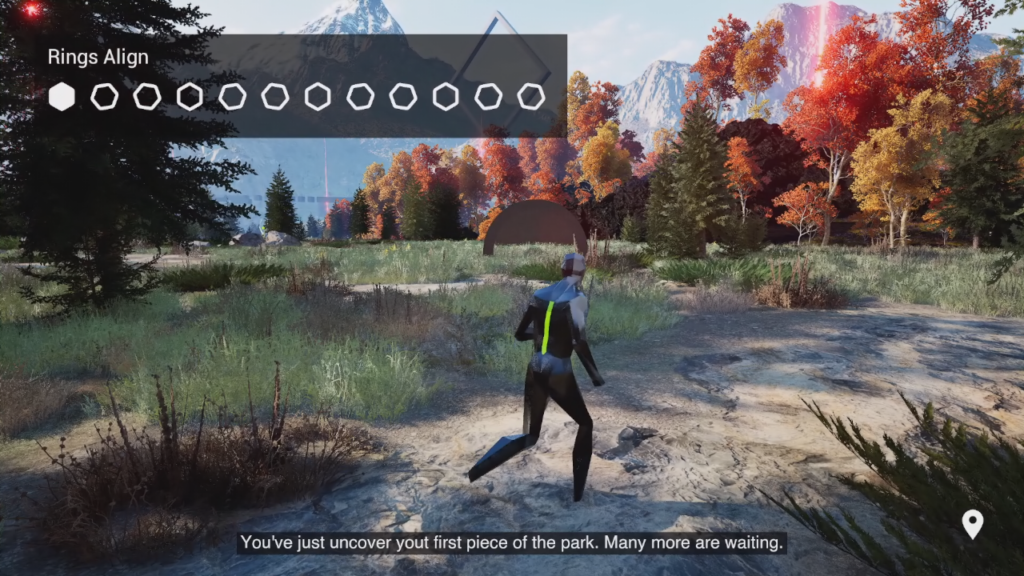
My goal upon first assuming the form of my artificial avatar is to visit eight art installations, called “Masterpieces,” found around the Valley. At first these objects appear to be purely decorative. As I examine each one, it becomes apparent they have a particular puzzle associated with them I may solve. While circling a pair of rings, I find that I can manipulate my perspective so that one of the rings seems to sit perfectly inside the other. By climbing a hill to reach some suspended rectangles, I can run across their tops, jumping between each in turn. Sometimes all I need to do with an art piece is stand near it, such as a frog statue surrounded by deep water in the swamp or a sculpture hidden in a winding thicket of trees. Reaching them appears simple but my path is inevitably blocked by some unexpected obstacle. Puzzles immediately solve themselves once I have moved my avatar into the proper position, so sometimes I find a solution simply by passing near an art piece or rotating the camera at a certain angle near it. There are a few occasions where I’m not entirely sure what I have done to “solve” the puzzle.
My progress at visiting each art piece and solving its associated puzzle is marked by a group of statues posing on a hillside, not far from the pod where my avatar enters the Valley. They are so massive that they are visible from almost anywhere my avatar may travel. The statues turn from white to black as I solve puzzles, making them a handy diegetic gauge of my progress, though I may still view a cold accounting of my progress on a stats page if I wish. When I have solved every art puzzle and turned every figure black, then the door to the exit pod unlocks and a friendly, automated voice invites me to meet my hosts.
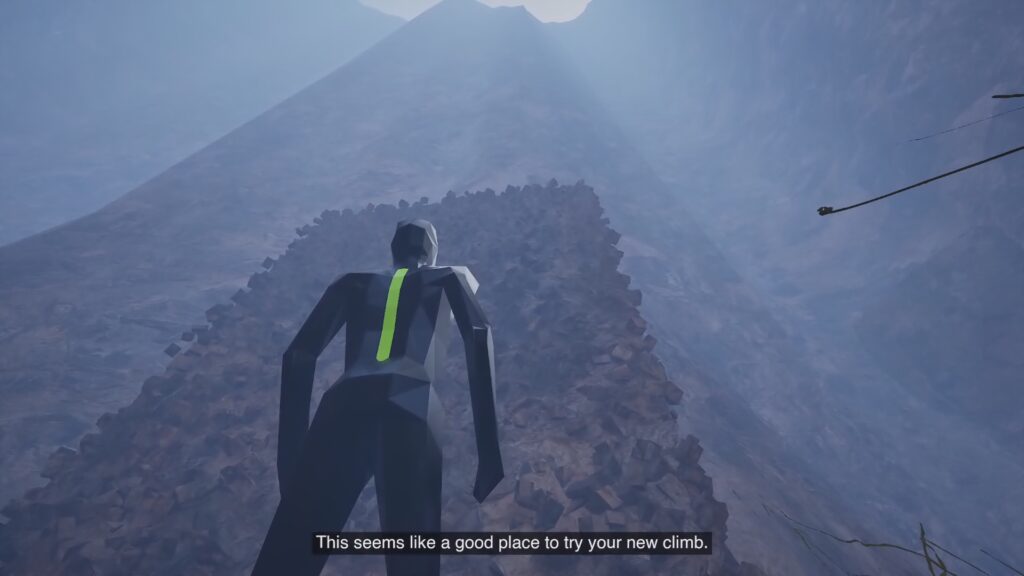
This artificial woman’s voice is my only companion on my visit to the Valley. At first, it is a welcome addition, providing sparse exposition that gives just enough context to what is happening without removing the mystery and majesty from The Valley Beyond’s general concept. Over time, the voice’s limitations become apparent. There are no variations on its advice so it will mechanically repeat the same sentences as my avatar wanders back and forth across the terrain. In a few places, the voice’s triggers are outright broken. At one point, my avatar approaches a wall with a unique texture. The voice chimes in, encouraging me to use my new tools to climb the wall. It is several hours later before I actually discover those tools. When I return to the wall to climb it, the voice is silent.
My time in the Valley would seem to be over after finding the eight art pieces and solving their puzzles. There are a few other objects hidden around the Valley—optional art pieces, remnants of the people who dwelled in the Valley before my Hosts, and sixteen tiny spinning tetronimos—but there is no impetus placed upon me to seek them all out. I follow the guide’s advice and travel to the exit pod to meet my Hosts and return my consciousness back to its body. When I arrive at the exit pod, I discover that the Hosts are gone and the machinery to transport me home is inaccessible. The Valley Beyond reveals its trick: I have been playing a horror videogame all along.
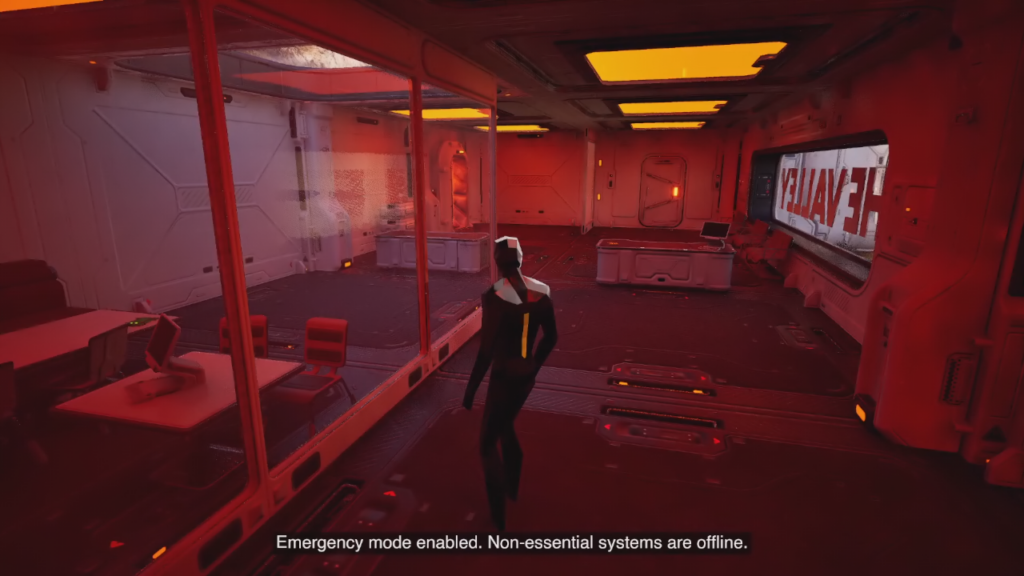
While seeking out the eight Masterpieces, I presume I do not see my Hosts or other guests because the Valley is meant to be an artfully serene and lonely place. When I discover the Valley is actually empty, the serene loneliness is transformed into a bleak and horrifying emptiness. Nothing about how the videogame is played or conveyed is changed. Only my new knowledge causes this change in sensation. The Valley Beyond does an excellent job obscuring itself behind this veil of ignorance. It even masks its existence by not having any achievements for the new activities that become available at this point, save for the one I earn by reaching the adventure’s final destination.
Reaching that final destination is much less directed than the clear goals with which The Valley Beyond first presents me. Beginning with a datapad left in the exit pod, I must retrace the steps of the Hosts across the Valley to find where they now reside. Along the way I will discover the Host’s maintenance bunkers, some clearly visible and others hidden in the landscape, and discover new traversal tools that allow my avatar to reach the Valley’s most remote areas. Several of these areas introduce significant platforming sections, a task at which The Valley Beyond quickly proves itself out of its depth. Reaching the Hosts and the real ending requires the nimbleness and dexterity of Super Mario when my synthetic avatar handles more like C-3PO. Finishing The Valley Beyond is a test of my patience.
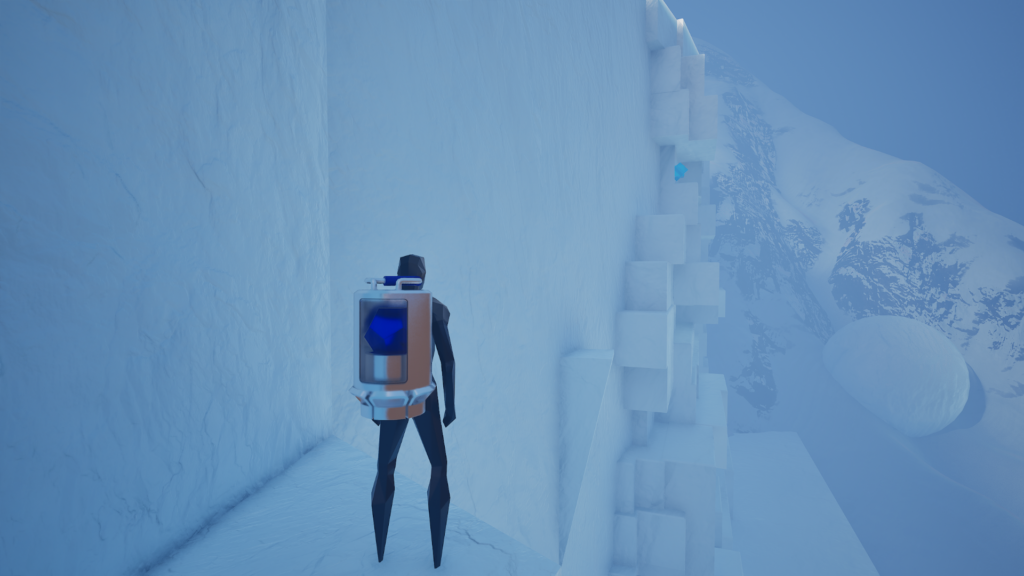
As I enter The Valley Beyond’s second scenario, it becomes impossible to ignore that traversing its world is tedious and sometimes overly difficult. My avatar’s smooth metal feet have difficulty finding purchase in the Valley’s stony earth, causing them to slide backwards on even gentle inclines. Places where I may confidently walk are supposedly marked by grass, as the voice guide often reminds me, but the avatar often slips even on slopes where grass grows. Reaching certain locations takes far more circuitous wandering than seems necessary.
I may use fast travel points to move quickly around the Valley. These points are limited and take some effort to unlock. What convenience they might provide is undermined by their inconsistency. Instead of moving my avatar instantaneously between points, or else generating a new synthetic body and transferring my consciousness into it, The Valley Beyond’s fast travel seems to fling the avatar between points along a path buried beneath the ground. Multiple times, my avatar becomes stuck on an invisible obstacle along this path and “dies,” respawning at a checkpoint near the point I tried to fast travel from. On one occasion, the avatar successfully completes its journey, but its legs are stuck beneath the ground at its destination. It takes several minutes of wiggling and jumping to free the avatar from the terrain.
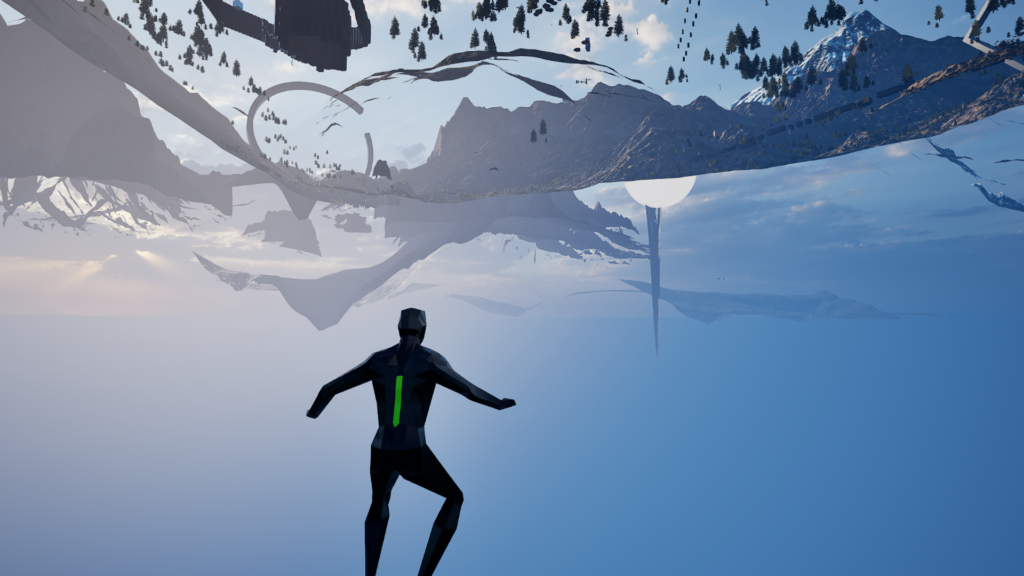
The unreliability of fast travel points and the inconvenient locations where they are placed forces my avatar to trudge from one place to another. In the early half of my time in the Valley, when the next art piece is over a hill from one I have just solved, this does not feel like much of a problem. In the second half of my visit, when relevant locations are often on opposite edges of the Valley and it is not always clear where I need to explore next, plodding aimlessly across the landscape begins to dominate most of my playtime.
The tedium is exacerbated by my avatar’s limits. Its energy levels are not bottomless; every step it takes drains a tiny amount of power from a bar visible on its back. I may refill this bar by touching glowing energy gems scattered across the Valley. They are densely clustered near the Valley’s center, to the point that I must deliberately ignore them for my avatar’s energy to deplete. The farther I travel from the area curated by the Hosts for my avatar to explore, the more scarce energy gems become. Thoroughly exploring the areas at the Valley’s periphery is a fraught experience, hoping that my avatar discovers another precious orb before its energy depletes. If this does happen, my avatar returns to the last orb it collected. The real penalty is having to once again march across the landscape, hoping to discover an energy orb, a breadcrumb left by the Hosts, or else retracing my avatar’s steps back to more bountiful terrain. None of these choices are enticing.
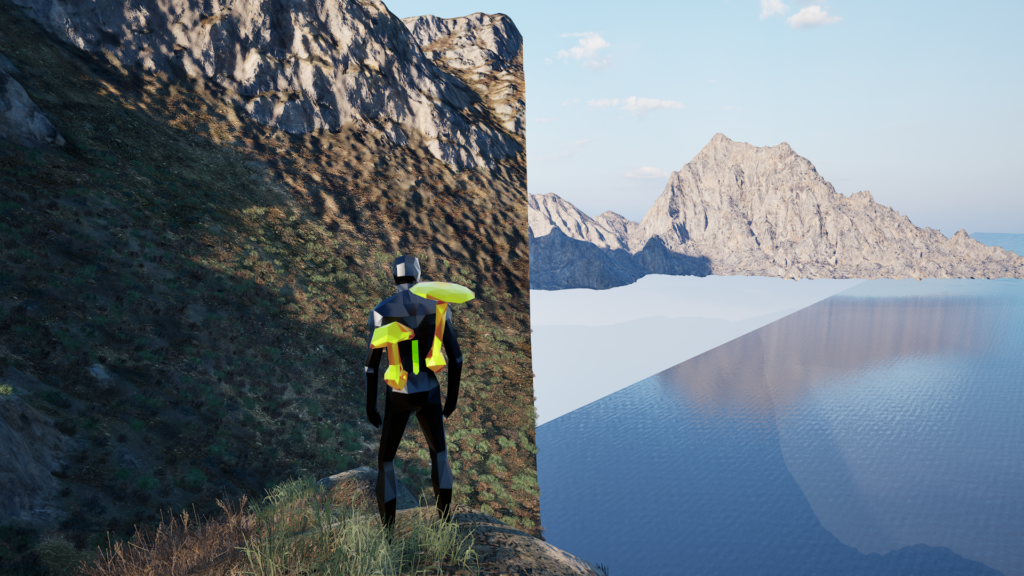
At the extreme edges of the Valley is where the integrity of its spaces crumbles entirely. Tucked into some corners, I find gaps between rocks where my avatar may drop beneath the terrain of the world, discovering sudden edges that lead into the digital void in which the Valley is suspended. Another one of these voids is found at the Valley’s southern edge, where the world simply stops generating with nothing to prevent me from stepping off its edge. If I wish, I may plummet my avatar off this edge, though it will soon respawn at my last collected energy orb. Nothing about these failures of space suggest something about the true nature of the Valley. They are failures in videogame design, and they feel like it.
When I first open The Valley Beyond, an animated wave form representing the voice guide invites me to explore the Valley, “the ultimate land of art and adventure.” The reality of my experience falls far short of this pitch. I adore the broad idea. A puzzle videogame where I solve geometric riddles using perspective tricks and simple platforming that gives way to a broader, open-ended exploration videogame tinged with existential horror is appealing to me. This appealing idea is marred by poor performance and optimization, tedium in traveling from place to place, and a world that frequently breaks in either visual or interactive ways. My final moments with The Valley Beyond summarize my entire experience. While trying to use a fast travel point to return to the desert and find the last optional collectible to earn the final achievement, my avatar gets stuck on something and falls into the infinite void beneath the world. Somehow, my game autosaves at this moment. Every time I reload, I am stuck watching my avatar fall endlessly to its doom, respawning moments later only to fall again. The Valley Beyond needs far more polish for its genuinely good ideas to shine.